
Method of treating weave printing and dyeing wastewater by slurries production technology
A technology for textile printing and dyeing and production process, applied in the field of textile printing and dyeing wastewater treatment, can solve problems such as restricting the expansion of production capacity of textile printing and dyeing enterprises, not yet realizing comprehensive utilization, wasting water resources, etc., achieving low wastewater treatment costs, reducing pulping costs, The effect of reducing pollution
Patent Information
- Authority / Receiving Office
- CN · China
- Patent Type
- Applications(China)
- Current Assignee / Owner
- Publication Date
- 2007-09-12
- Estimated Expiration
- Not applicable · inactive patent
Smart Images
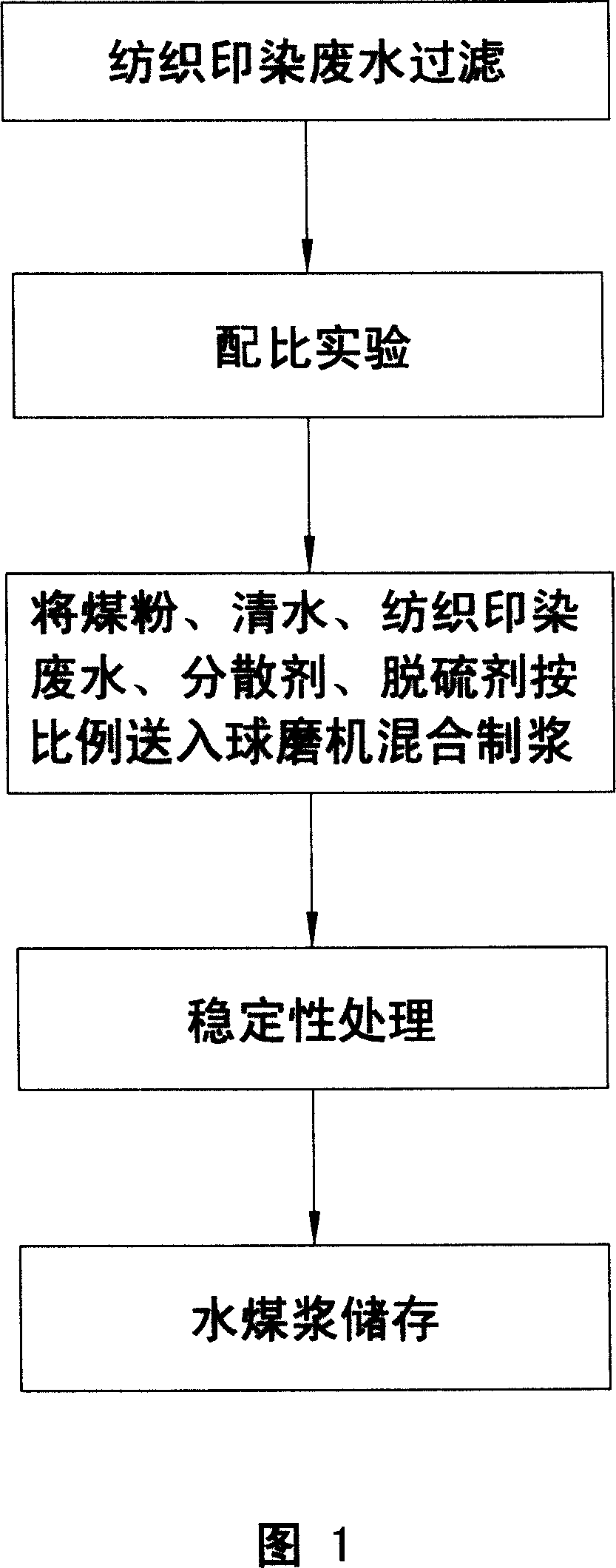
Figure 1
Abstract
Description
technical field
[0001] The invention relates to a method for treating textile printing and dyeing wastewater by utilizing a coal-water slurry production process. Background technique
[0002] The textile industry is a traditional pillar industry in my country, including five parts: textile, printing and dyeing, chemical fiber, clothing and textile special equipment manufacturing. With the rapid development of the national economy, my country's printing and dyeing industry has also entered a period of rapid development. The level of equipment and technology has been significantly improved, and the production process and equipment have been continuously updated. Printing and dyeing enterprises, especially private printing and dyeing enterprises, have developed very rapidly. At the same time, the total wastewater discharge of the textile printing and dyeing industry ranks fifth in the national industrial industry. It accounts for about 7% of the nation...
Examples
Embodiment Construction
[0018] The method that present embodiment utilizes coal-water slurry production process to process textile printing and dyeing wastewater comprises the following steps:
[0019] (a) Filtration step: filter textile printing and dyeing wastewater to remove impurities with larger particle sizes, and the filtered residue can be disposed of by burning, landfilling, etc.;
[0020] (b) Proportioning step: take a sample from the filtered textile printing and dyeing wastewater, mix it with clear water in a ratio of 1:1, then add lignosulfonate as a dispersant, and then gradually add lime water (i.e. Ca(OH) 2 Solution) as a desulfurizing agent until the pH value of the sample is equal to 8, the pH range after the proportioning can be between 8 and 10, that is, it only needs to be weakly alkaline, so that the effect of removing sulfur in the coal can be achieved. In this step, the ratio relationship among desulfurizer, dispersant, clear water, and textile printing and dyeing wastewater c...