
Composite temperature cold treatment process
A composite temperature and cold treatment technology, which is applied in the field of heat treatment of metal materials, can solve the problems that the amount of retained austenite cannot be significantly reduced, the time of structure transformation is different, and the temperature difference between the surface of the core of the workpiece is large, so as to avoid macro cracks and reduce Retained austenite, the effect of increasing hardness
Patent Information
- Authority / Receiving Office
- CN · China
- Patent Type
- Patents(China)
- Current Assignee / Owner
- Publication Date
- 2013-07-31
- Estimated Expiration
- Not applicable · inactive patent
Smart Images
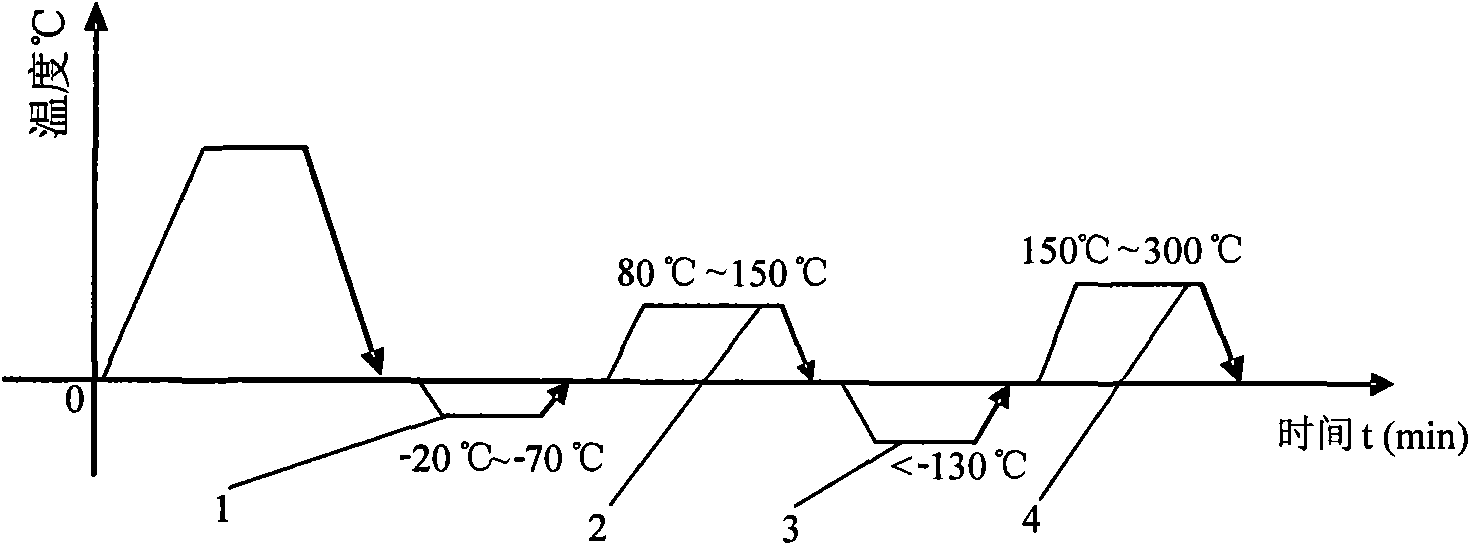
Figure 1
Abstract
Description
technical field
[0001] The invention relates to a heat treatment process for metal materials, in particular to a cold treatment process for high-carbon alloy steel after quenching. Background technique
[0002] After the steel parts are quenched, a certain amount of retained austenite will be retained. The retained austenite is an unstable phase and will be transformed into martensite in the subsequent processing or service process, which will affect the dimensional stability of the workpiece. room temperature to -70°C) to reduce the amount of retained austenite and increase the hardness. Cryogenic treatment (<-130°C) can not only achieve the purpose of cold treatment, but also further reduce the amount of retained austenite, and precipitate ultrafine carbides, which can significantly improve the wear resistance of the material.
[0003] In the prior art, there are three kinds of processes involving cold treatment of high-carbon low-alloy steel, (1) quenching + cold trea...
Examples
Embodiment Construction
[0033] 20mm with GCr15 material 3 The sample is example, carry out following embodiment:
[0034] GCr15 is quenched first, and immediately after quenching, cold treatment is performed. The temperature of cold treatment is -20°C to -70°C, and the time is 60 minutes. It is warmed up in the air. After reaching room temperature, the first low-temperature tempering is performed, and the temperature is 80°C ~150℃, the time is 60 minutes, cool in the air, after reaching room temperature, carry out cryogenic treatment, the temperature is -180℃~-130℃, the time is 60 minutes, then return to the temperature in the air, after reaching room temperature, carry out the second Secondary low-temperature tempering, the temperature is 150 ℃ ~ 300 ℃, the time is 120 minutes, and then cooled in the air. As a result of the treatment, the hardness is 60-64HRC.
[0035] The following table is the following table for the hardness performance of the workpiece after each embodiment specific parameter a...