
Complex-space curved-surface dot-motion induction heating hardening device and method
A technology of induction heating and quenching device, which is applied in the direction of quenching device, heat treatment equipment, heat treatment process control, etc., to achieve the effects of high work efficiency, low degree of workpiece oxidation and high degree of generalization
Patent Information
- Authority / Receiving Office
- CN · China
- Patent Type
- Applications(China)
- Current Assignee / Owner
- Publication Date
- 2011-05-11
Smart Images
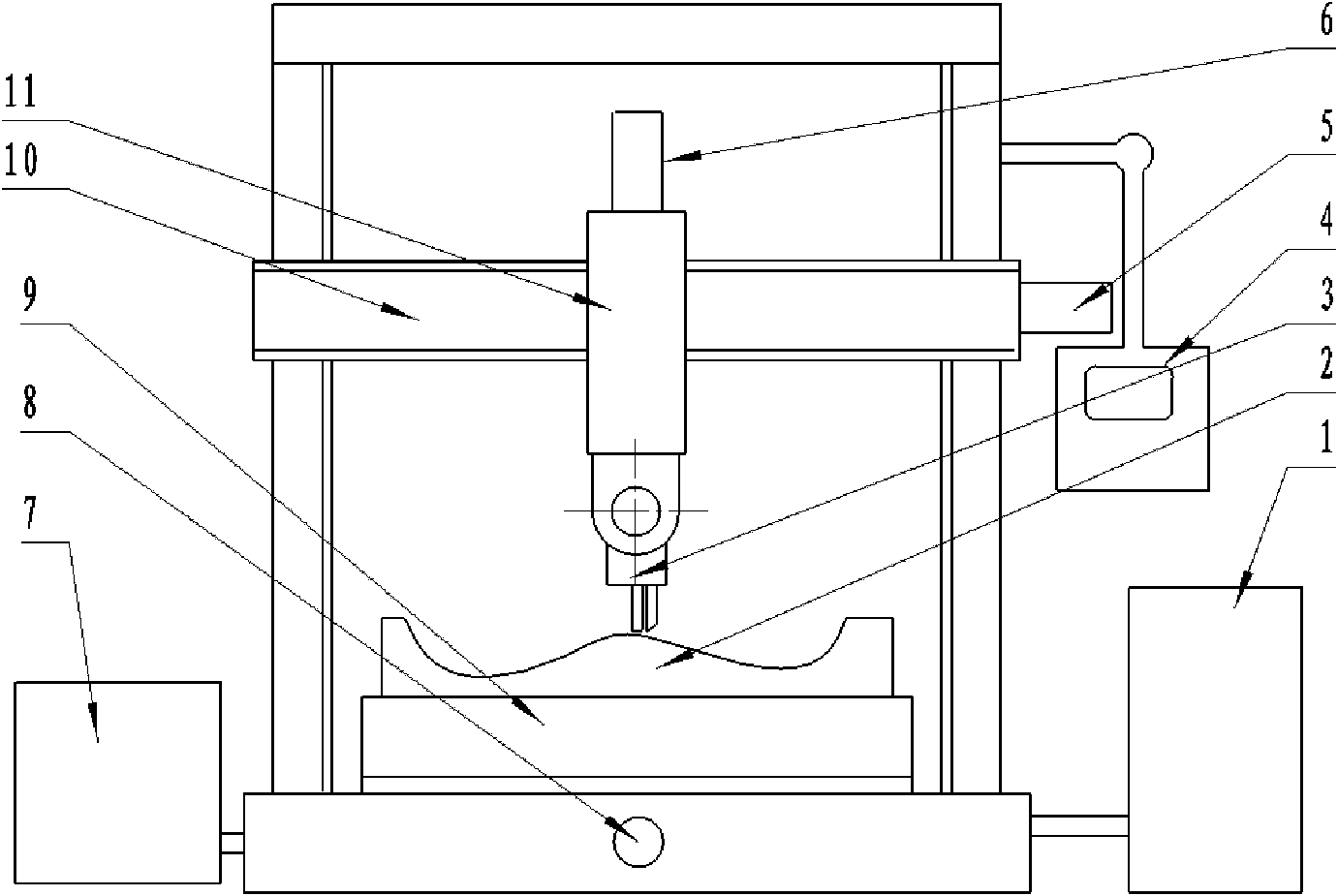
Figure 1 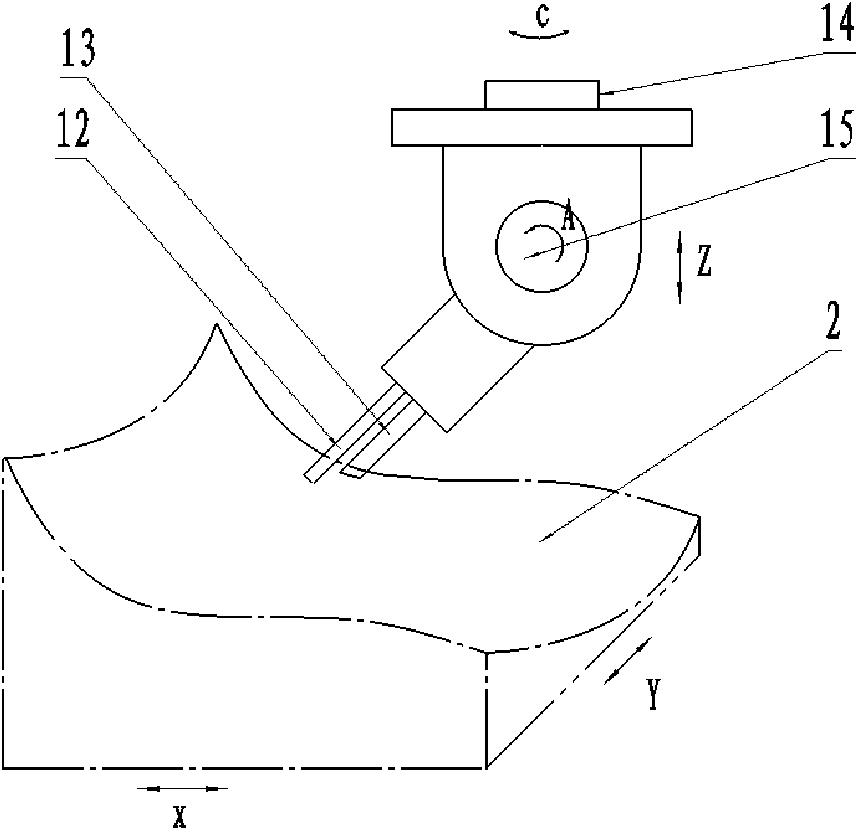
Figure 2 
Figure 3
Abstract
Description
technical field
[0001] The invention relates to the technical field of heat treatment of metal materials, in particular to a quenching method for surface strengthening of complex spatial curved surfaces by using induction heating and adopting an appropriate cooling method. Background technique
[0002] At present, there are more and more parts with complex spatial surfaces, such as: drawing dies for sheet metal stamping, bending dies, metal dies for casting and plastic injection dies, extrusion dies, blown dies, etc. Surfaces of molds such as plastic molds, marine propellers, aerospace vehicle parts, etc. With the widespread application of multi-axis linkage CNC machine tools, the surface machining accuracy is getting higher and higher. In order to improve the working performance and service life of these parts, it is usually strengthened so that the core has high impact resistance, and the surface has high hardness and wear resistance.
[0003] In the existing process tec...
Examples
Embodiment Construction
[0038] In order to better understand the present invention, the content of the present invention will be further clarified below in conjunction with specific embodiments and accompanying drawings, but the content of the present invention is not limited to the following embodiments.
[0039] The complex space curved surface quenching device provided by the present invention has a structure such as figure 1 As shown: it is mainly composed of a numerical control system 4 installed on the frame, a five-axis servo mechanism, an induction heater 12 driven by the five-axis servo mechanism, and a coolant nozzle 13, wherein: the induction heater 12 and the coolant nozzle 13 Three-dimensional continuous movement along the complex space surface of part 2. The induction current provided by the induction power supply 1 is passed into the induction heater 12, and after the surface of the part 2 is heated to the austenite transformation temperature, the cooling medium is sprayed from the coo...