
Method for producing feed microecological preparation by synergic fermentation of probiotics
A micro-ecological preparation and collaborative fermentation technology, which is applied in the fields of application, animal feed, animal feed, etc., can solve the problems of weak disease resistance, low feed conversion rate and production performance, and large toxic and side effects, so as to promote animal growth and improve animal health. Intestinal microenvironment, the effect of improving protein utilization
Patent Information
- Authority / Receiving Office
- CN · China
- Patent Type
- Patents(China)
- Current Assignee / Owner
- Publication Date
- 2014-07-09
- Estimated Expiration
- Not applicable · inactive patent
Smart Images
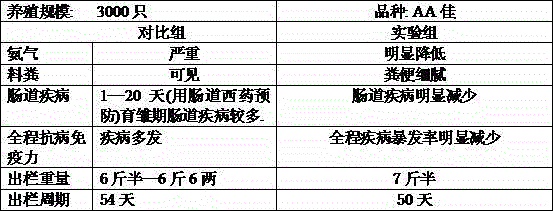
Figure 1
Abstract
Description
technical field
[0001] The invention relates to the field of biological fermentation, in particular to a method for probiotics cooperative fermentation to produce feed microecological preparations. Background technique
[0002] With the continuous development of economy and society, people's quality of life is gradually improving, not only requires food rich in nutrition, flavor, safety and hygiene, but also requires a good living environment, but the breeding industry that is closely related to this has encountered many new problems: such as The prevention and control of livestock and poultry diseases has become more difficult. Avian influenza and swine unidentified high fevers have occurred from time to time. The problem of sewage treatment in the breeding industry is becoming more and more serious, and the safety and flavor problems of animal-derived food. In particular, frequent food safety accidents in recent years have continuously stimulated the nerves of Chinese peo...
Examples
Embodiment 1
[0009] With Bacillus subtilis, Lactobacillus plantarum and Candida as bacterial strains, Bacillus subtilis, Lactobacillus plantarum and Candida are all inserted into the fermenter according to the 5% inoculation amount of the medium volume and mixed evenly, and the medium is By weight: 96% chrysanthemum meal, 0.8% astragalus, 0.8% forsythia, 0.8% houttuynia, 0.8% hawthorn and 0.8% tangerine peel, mixed and evenly crushed through a 60-mesh sieve, first carried out aerobic ventilation fermentation, fermentation The temperature is 30°C, the ventilation rate is 0.5L / min, the ventilation is stopped for 10min every 30min, the stirring speed is 45r / min, cultivated for 28h, and then anaerobic fermentation is carried out, the fermentation temperature is 32°C, the stirring speed is 20r / min, and cultivated for 24h.
Embodiment 2
[0011] With Bacillus subtilis, Lactobacillus plantarum and Candida as bacterial strains, Bacillus subtilis, Lactobacillus plantarum and Candida are all inserted into the fermenter according to the 7.5% inoculation amount of the medium volume and mixed evenly, and the medium is By weight: 95% chrysanthemum meal, 1% astragalus, 1% forsythia, 1% houttuynia, 1% hawthorn and 1% tangerine peel, mixed and evenly crushed through an 80-mesh sieve, first aerobic ventilation fermentation, fermentation The temperature is 33°C, the ventilation rate is 0.8L / min, the ventilation is stopped for 10min every 30min, the stirring speed is 52r / min, cultivated for 34h, and then anaerobic fermentation is carried out, the fermentation temperature is 33°C, the stirring speed is 30r / min, and cultivated for 36h.
Embodiment 3
[0013] With Bacillus subtilis, Lactobacillus plantarum and Candida as bacterial strains, Bacillus subtilis, Lactobacillus plantarum and Candida are all inserted into the fermenter according to the 10% inoculation amount of the medium volume and mixed evenly, and the medium is By weight: 94% chrysanthemum meal, 1.2% astragalus, 1.2% forsythia, 1.2% Houttuynia cordata, 1.2% hawthorn and 1.2% tangerine peel, mixed evenly and crushed through a 100-mesh sieve, first carried out aerobic ventilation fermentation, fermentation The temperature is 35°C, the ventilation rate is 1.2L / min, the ventilation is 30min, stop for 10min, the stirring speed is 60r / min, cultivate for 40h, and then carry out anaerobic fermentation, the fermentation temperature is 35°C, the stirring speed is 40r / min, and cultivate for 48h.
[0014] The relevant test data are as follows:
[0015] 1. Shape and color
[0016] The semi-solid is brownish-yellow or taupe; the liquid is brownish-yellow.
[0017] 2. O...