
UV (ultraviolet) curing ink and application thereof
An ink and resin technology, applied in UV-curable ink and its application fields, can solve the problems of high processing cost, adverse effects on human health and safe production, etc., and achieve the effect of good cutting fluid resistance, less environmental damage, and high surface hardness
Patent Information
- Authority / Receiving Office
- CN · China
- Patent Type
- Applications(China)
- Current Assignee / Owner
- Publication Date
- 2013-08-07
Smart Images
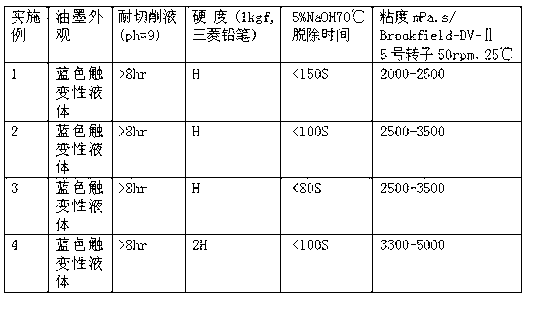
Figure 1 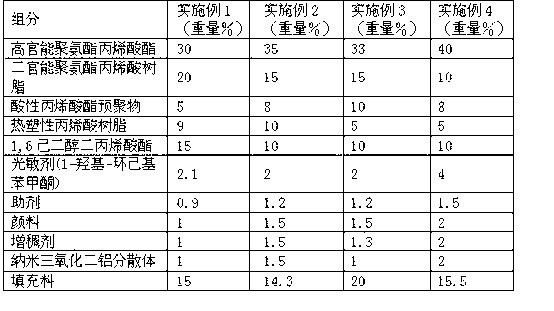
Figure 2
Abstract
Description
technical field
[0001] The invention relates to the field of inks, in particular to a UV-curable ink and applications thereof. Background technique
[0002] At present, mobile phones are developing in the direction of smart phones, among which touch-screen mobile phones are popular, so glass is increasingly becoming a common and important material in mobile phone manufacturing. Usually mobile phone glass processing technology: glass raw material → cutting → profiling → fine carving → rough grinding → fine polishing → cleaning → strengthening → printing → packaging. Among them, rough grinding and fine polishing are mainly to solve the problem of glass being scratched in the first few processing processes, but the processing cost of these two processes is very high, and the dust has a great adverse effect on the health and safety of workers.
[0003] Therefore, the existing technology needs to be improved and developed. SUMMARY OF THE INVENTION
[0004] In view of the abov...
Examples
Embodiment
[0100] The present invention is further described in detail by the embodiments 1-4 shown in Table 1 as follows:
[0101] Table 1
[0102]
[0103] The components in any of the proportions of Examples 1 to 4 in the above Table 1 were added to the container according to the stated proportions, and the mixture was uniformly mixed under stirring conditions and constructed according to the following process and parameters.
[0104] Process sequence:
[0105] Substrate cleaning → printing → IR baking → UV curing → surface processing → 5% NaOH solution removal at 70 °C → clean water.
[0106] Process parameters:
[0107] Mesh: 200-300 mesh / inch (77-120 / cm);
[0108] Film thickness: 16-20um (Mitutoyo);
[0109] Cumulative UV energy 1500~2200mj / cm 2 (EIT UV Power Puck II);
[0110] Spectral range: 180~420nm;
[0111] UV lamp power: 80-120W / cm;
[0112] IR temperature: 100-110°C: 2-3min.
[0113] The properties of the ink layers obtained in Examples 1-4 on the glass surface...