
A direct torque control device and method
A technology of direct torque control and torque, applied in the direction of controlling electromechanical transmission devices, control systems, and control generators, etc., can solve problems such as difficult to meet the voltage requirements of induction motors and low voltage transmission, achieve high voltage transmission ratio, improve Effect of voltage transfer ratio and complexity reduction
Patent Information
- Authority / Receiving Office
- CN · China
- Patent Type
- Patents(China)
- Current Assignee / Owner
- Publication Date
- 2017-03-22
Smart Images
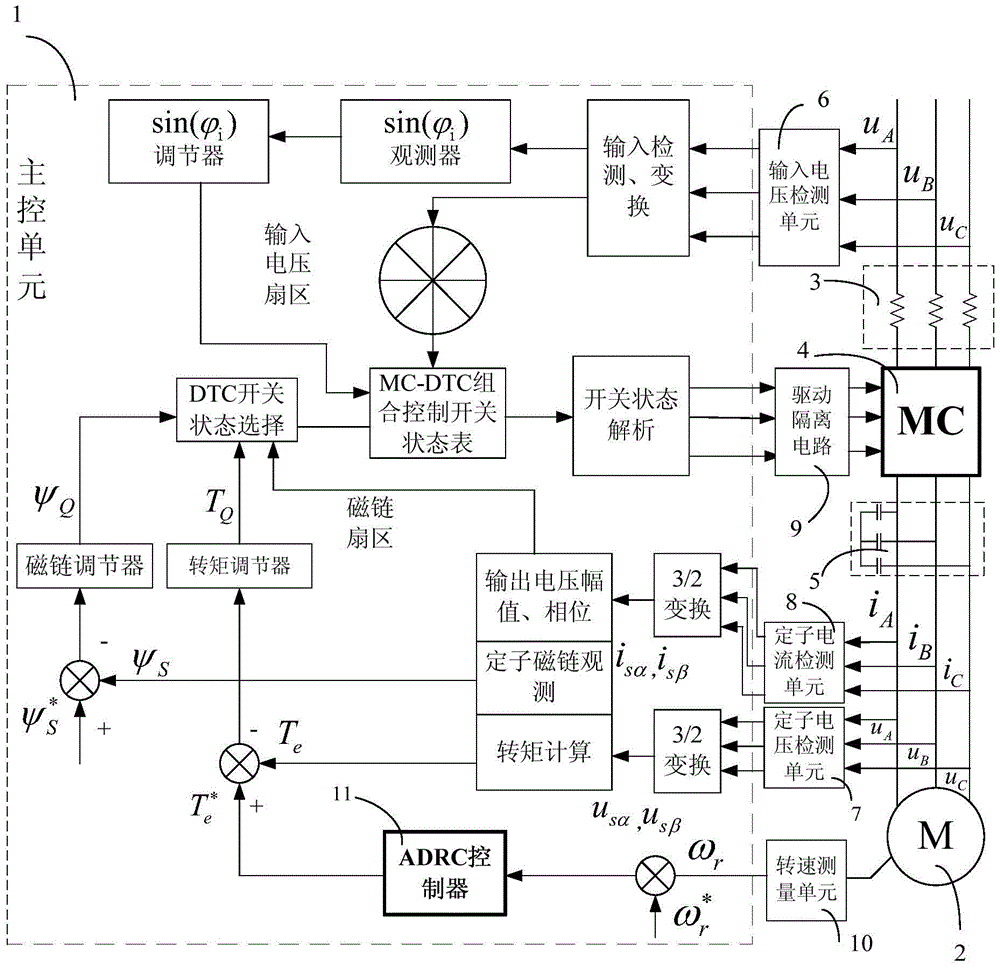
Figure 1 
Figure 2 
Figure 3
Abstract
Description
technical field
[0001] The invention relates to the field of motor torque control, in particular to a direct torque control device and method. Background technique
[0002] Direct torque control overcomes the parameter-sensitive defect in traditional field-oriented vector control, does not need to convert the induction motor output torque into an equivalent current reference value, and does not require a complex controller. It takes torque as the center and realizes comprehensive control in the way of stator magnetic field orientation, which avoids the complex coordinate transformation of vector control and the mathematical processing of the motor model, and directly calculates the flux linkage and torque on the stator coordinates of the motor to realize the stator magnetic field. The double closed-loop control of chain and electromagnetic torque can obtain real-time and fast control effect. However, the conventional direct torque control (DTC) system uses PI controller to ...
Examples
Embodiment Construction
[0047] The present invention will be described in detail below in conjunction with the accompanying drawings and specific embodiments.
[0048] The invention provides a direct torque control method, comprising the following steps:
[0049] (1) On the input side of the induction motor, detect the stator voltage and stator current, and perform a 3 / 2 transformation on them, and then calculate the amplitude and phase of the output voltage and estimate the stator flux linkage and torque. Specifically, it can be obtained by Calculated as follows:
[0050]
[0051]
[0052] Where: R s is the stator resistance; Ψ sα , Ψ sβ are respectively stator α-axis and β-axis flux linkage; i sα i sβ are the current components of the stator α-axis and β-axis respectively; P n is the number of motor pole pairs; L m is the mutual inductance of the stator; T e is the electromagnetic torque.
[0053] (2) Detect the motor speed and compare it with the given value, and the comparison resu...