
A detector system for x‑ray pulsar navigation and positioning
A pulsar navigation and detector technology, applied in the field of detector systems, can solve problems such as limited detection area and limited aperture size, and achieve the effects of improving signal-to-noise ratio, compact structure, and high recognition accuracy
Patent Information
- Authority / Receiving Office
- CN · China
- Patent Type
- Patents(China)
- Current Assignee / Owner
- Publication Date
- 2017-06-27
Smart Images
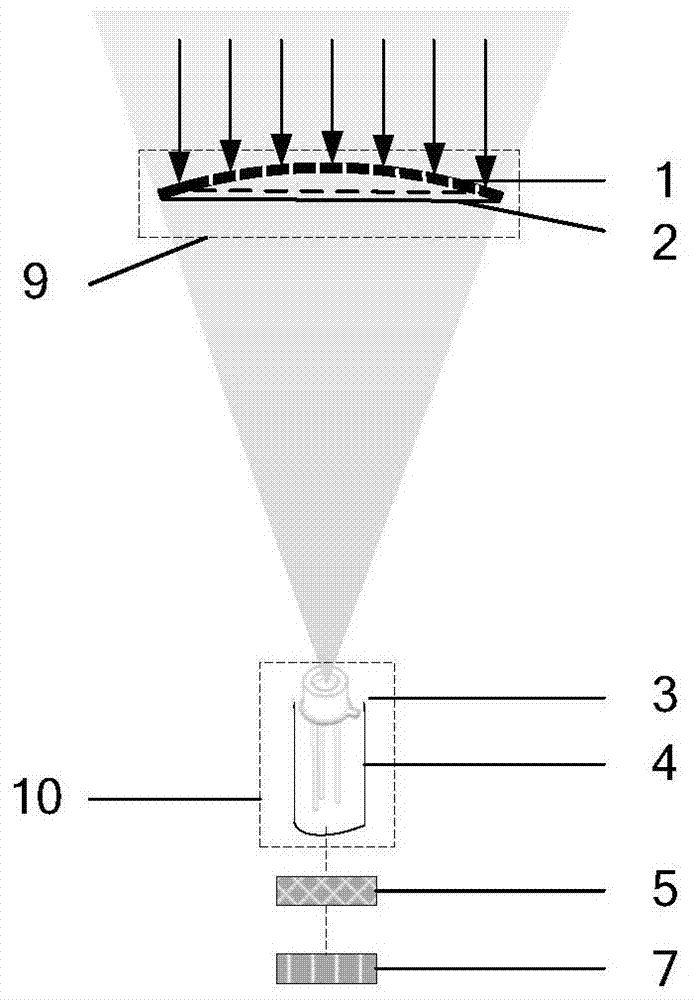
Figure 1 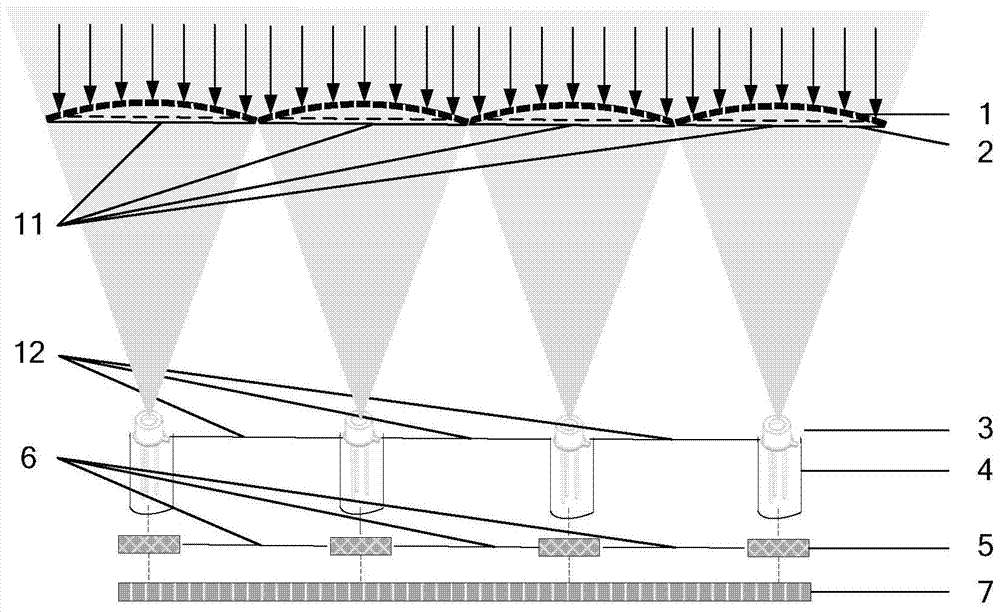
Figure 2 
Figure 3
Abstract
Description
technical field
[0001] The invention relates to a detector system capable of arbitrarily splicing detection modules according to detection area or signal-to-noise ratio requirements, and effectively detecting X-rays in a field of view. Background technique
[0002] X-ray Pulsar-based Navigation (X-ray Pulsar-based Navigation, XPNAV) uses the determined pulsar space position and highly stable pulse signal to navigate and position the spacecraft, which is a new astronomical autonomous navigation. Positioning Technology. It can be seen from its principle that how to detect and obtain accurate waveforms is the core problem of the X-ray pulsar navigation system.
[0003] The "XNAV Program" of the United States and the "Pulsar Navigation Research Program of Deep Space Probe" of the European Space Agency both use micro-aperture optical systems to focus the X-rays from pulsars. This optical system has many advantages such as small size and light weight. It can efficiently suppress...
Examples
Embodiment Construction
[0022] The curved surface Micro-Pore Optics (MPO) is used as the focusing optical system, which can focus the X-rays from the pulsar to the non-imaging detector, and at the same time realize the lightweight of the X-ray optical system.
[0023] Curved MPO lens is a curved converging device with fine structure, small size and light weight. In the MPO microchannel, the principle of grazing incidence is used to deflect the X-ray transmission direction and then converge. For photons in a certain energy range, the background stray light can be eliminated by accurately designing the bending degree of the MPO, and the detection signal-to-noise ratio can be improved. At the same time, the Si detector has a high response time, which can ensure that the system has a high time resolution, which can provide a strong guarantee for detecting the X-ray pulse cycle waveform.
[0024] The curved MPO lens is composed of many tiny rectangular cells arranged on a spherical surface. Each small cub...