
New purpose of embelia parviflora wall for preparing medicines for treating liver fibrosis
A technology of liver fibrosis and angelica vine, which is applied in the field of new application of angelica vine in the preparation of drugs for treating liver fibrosis, can solve the problems of not finding angelica vine, achieve significant therapeutic effect, improve liver function, and reduce the risk of LN Effect
Patent Information
- Authority / Receiving Office
- CN · China
- Patent Type
- Applications(China)
- Current Assignee / Owner
- Publication Date
- 2015-08-26
- Estimated Expiration
- Not applicable · inactive patent
Smart Images
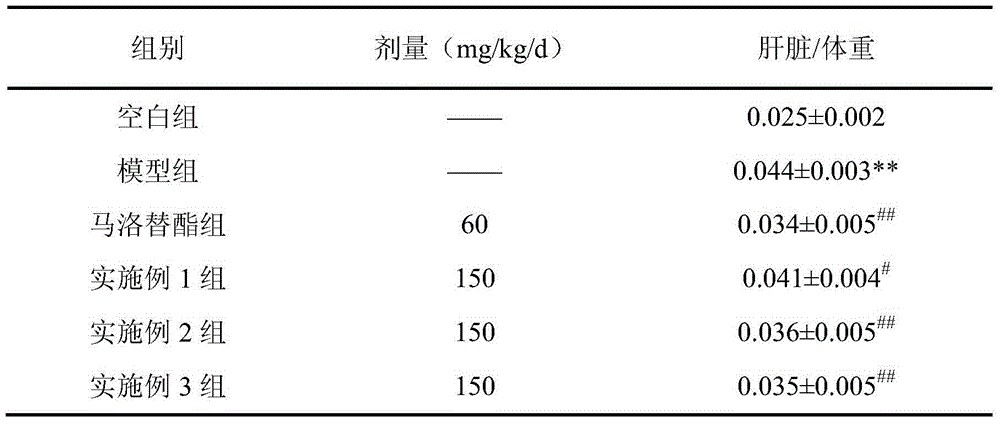
Figure 1 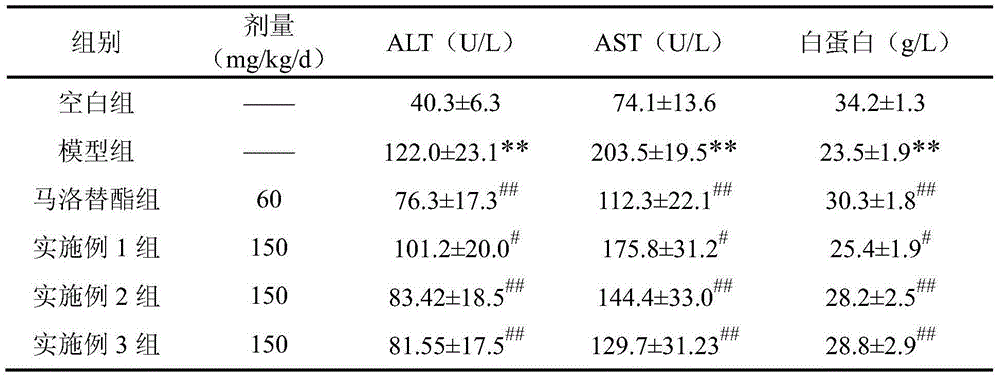
Figure 2 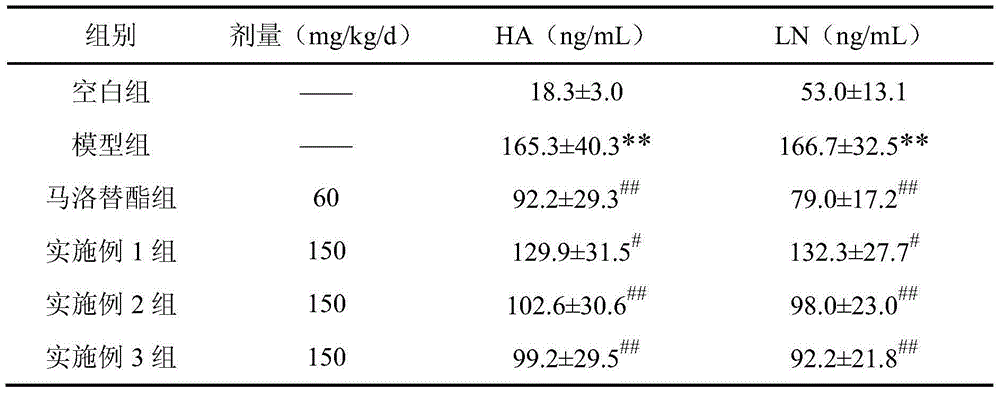
Figure 3
Abstract
Description
technical field
[0001] The present invention relates to the new application of Angelica vine, especially the new application of Angelica vine extract and total flavonoids of Angelica vine, that is, the new application in the preparation of medicines for treating liver fibrosis. Background technique
[0002] Hepatic fibrosis is a pathological process caused by the unbalanced synthesis, degradation and deposition of extracellular matrix when liver injury persists and tissue repair response occurs. The complex network system involved in the occurrence and development of liver fibrosis. Liver fibrosis is an important pathological feature of chronic liver disease, and it is also the main intermediate link in the further development of liver cirrhosis. If the cause persists, the liver fibrosis will gradually increase, the normal structure of the liver lobule will be destroyed, and the central venous area and the portal area will have septa and pseudolobules, that is, liver cirrho...
Examples
Embodiment 1
[0034] Embodiment 1: the preparation of angelica vine extract
[0035] Take 10kg Angelica sinensis and pulverize, add concentration and be 80% ethanol water bath and extract 3 times, the ethanol consumption of each time is respectively 12 times, 10 times, 8 times of the total weight of medicinal materials, the water bath temperature is 70 ℃, and each extraction time is respectively 60min, 50min, 40min, combine the extracts, concentrate, filter, and dry to obtain Angelica vine extract.
[0036] Taking rutin as the reference substance, the yield of total flavonoids from Angelica vine was 0.35%.
Embodiment 2
[0037] Embodiment 2: the preparation of the total flavonoids of Angelica vine
[0038] Take 10kg Angelica vine and pulverize it, add 80% ethanol, extract 2-3 times with 780W microwave, each ethanol dosage is 12 times of the total weight of medicinal materials, each extraction time is 15min, combine the extracts, concentrate under reduced pressure, Add diatomaceous earth to filter, and the filtrate is adsorbed by ADS17 resin, eluted with 70% ethanol, the eluate is concentrated, and vacuum-dried to obtain total flavonoids of Angelica vine.
[0039] Taking rutin as the reference substance, the yield of total flavonoids from Angelica vine was 0.49%.
Embodiment 3
[0040] Embodiment 3: the preparation of the total flavonoids of Angelica vine
[0041]Take 10kg of Angelica sinensis and grind it, add 60% ethanol and microwave extraction 3 times, the amount of ethanol each time is 15 times, 10 times, 8 times of the total weight of the medicinal materials, and the extraction time is 20min, 15min, 10min respectively, combined The extract is concentrated and filtered, the filtrate is adsorbed by ADS17 resin, eluted with 80% ethanol, the eluate is concentrated, and vacuum-dried to obtain the total flavonoids of Angelica vine.
[0042] Taking rutin as the reference substance, the yield of total flavonoids in Angelica vine was 0.66%.