
Galvanic Element
A primary battery and electrode technology, applied in the field of primary batteries, can solve problems such as lithium deposition and battery safety damage
Patent Information
- Authority / Receiving Office
- CN · China
- Patent Type
- Applications(China)
- Current Assignee / Owner
- Publication Date
- 2015-09-02
- Estimated Expiration
- Not applicable · inactive patent
Smart Images
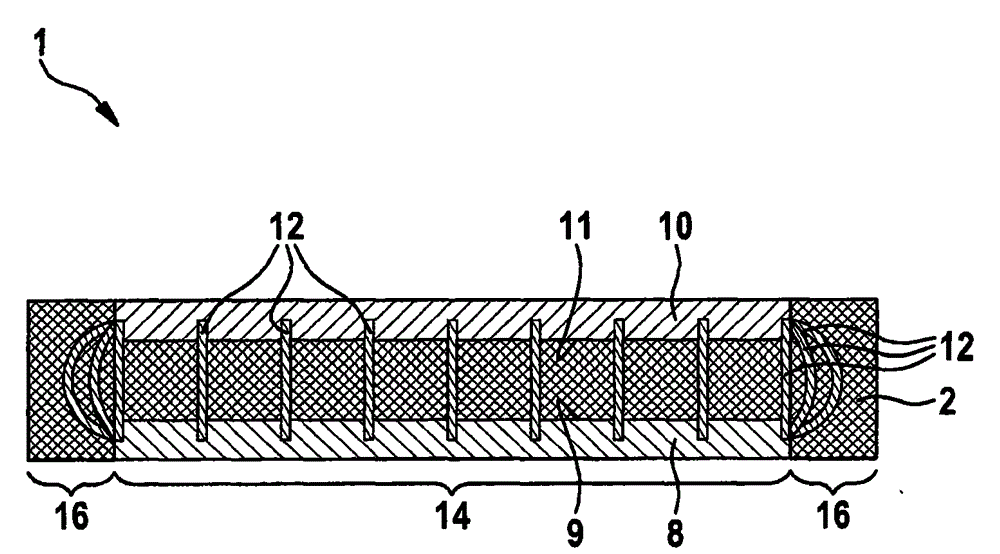
Figure 1 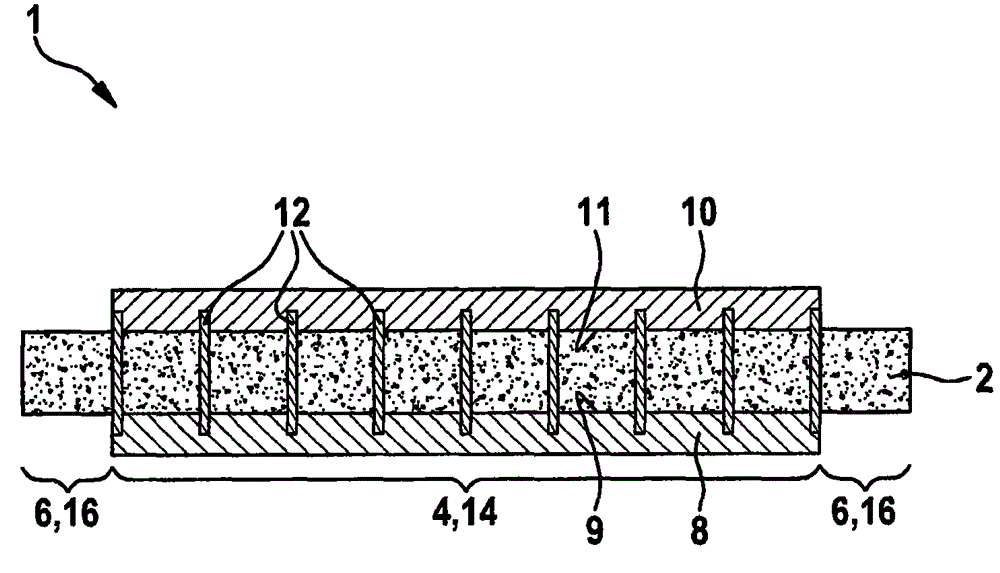
Figure 2
Abstract
Description
technical field
[0001] The present invention relates to a galvanic cell comprising a positive electrode, a negative electrode and a separator which is impregnated with an electrolyte and arranged between the positive electrode and the negative electrode. Furthermore, the invention relates to a battery comprising such a galvanic cell and a method for producing such a galvanic cell. Background technique
[0002] Lithium-ion batteries are characterized in particular by a very high specific energy and an extremely low self-discharge. The lithium-ion individual cells of such a battery have at least one positive electrode and at least one negative electrode (cathode or anode), which can reversibly store (intercalate) or redistribute (intercalate) lithium ions. Furthermore, the lithium-ion cell comprises at least one separator, which separates the positive electrode and the negative electrode from each other both spatially and electrically. Lithium ion conductors are required for...
Examples
Embodiment Construction
[0044] figure 1 Denotes a primary cell 1 according to the prior art. Galvanic cell 1 comprises a layer sequence with positive electrode 8 , separator 2 and negative electrode 10 . The positive electrode 8 is connected by its active face 9 to the separator 2 and the negative electrode 10 is also connected by its active face 11 to the separator 2 .
[0045] The positive electrode 8 comprises, for example, an aluminum film as a support, on which an active material based on a combination of different lithium metal oxides is applied. Negative electrode 10 is, for example, a copper foil on which an active material based on natural and / or synthetic graphite is applied.
[0046] The material of the separator 2 is, for example, polyolefin and has many micropores through which electrolyte can penetrate into the separator 2 . The electrolyte is, for example, a lithium conducting salt dissolved in an organic solvent, such as lithium hexafluorophosphate (LiPF 6 ). Separator 2 is itsel...