
Multi-shaft motion controller and control method of closed-loop PWM pulse
A multi-axis motion and control method technology, applied in the direction of program control, computer control, general control system, etc., can solve the problems that it is difficult to ensure timely response to interrupt events, cannot achieve high-precision pulse output, and poor high-speed control capabilities. Achieve the effects of easy expansion of applications, simplified board peripheral circuits, and low hardware costs
Patent Information
- Authority / Receiving Office
- CN · China
- Patent Type
- Applications(China)
- Current Assignee / Owner
- Publication Date
- 2016-08-03
Smart Images
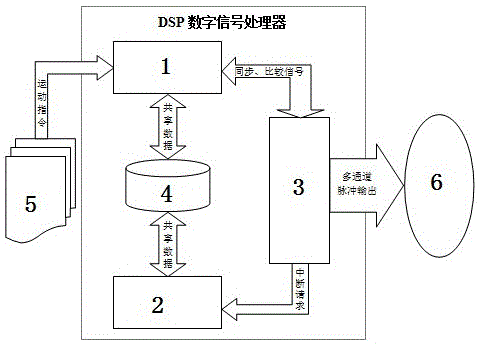
Figure 1 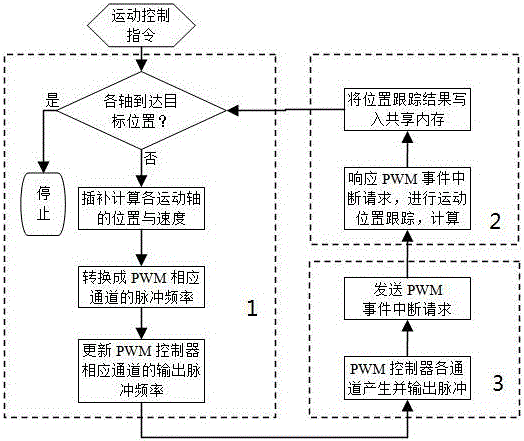
Figure 2
Abstract
Description
technical field
[0001] The invention relates to a motion controller and a control method in the technical field of numerical control, in particular to a multi-axis motion controller and a closed-loop PWM pulse control method based on a dual-core processor. Background technique
[0002] Motion control is an important branch of numerical control technology. After years of development, a variety of technical solutions have been produced, each with its own advantages and disadvantages. At present, the commonly used solutions are: (1) CPU+FPGA scheme, CPU performs interpolation calculation processing, and FPGA outputs control pulses to control motor movement according to the results of interpolation calculation processing. This scheme has reasonable division of labor and flexible control. However, it needs to maintain data synchronization between CPU and FPGA, there is a large delay error, and the output pulse accuracy is limited, resulting in unsatisfactory control performance a...
Examples
Embodiment Construction
[0021] Preferred embodiments of the present invention will be further described below in conjunction with the accompanying drawings, referring to the appended Figures 1 to 2 As shown, the present invention is realized by the following technical solutions, including main processor core 1, upper computer 5, servo drive 6, connected by serial bus between upper computer 5 and main processor core 1, and motion instruction data is transmitted to the main computer. The processor core 1 also includes a coprocessor core 2 and an integrated multi-channel PWM controller 3, and a shared memory 4, the PWM controller 3 and the coprocessor core 2 jointly complete position tracking; the shared memory 4 1, the main processor core 1, the PWM controller 3, and the coprocessor core 2 are sequentially connected to form a closed loop.
[0022] The main processor core 1 and the coprocessor core 2 work in parallel, have their own independent running memory spaces, and exchange data through the share...