
Use of 7-azaindole for sedation, anesthesia or euthanasia of aquatic organisms
An aquatic organism, azaindole technology, applied in the application of anesthesia or euthanasia, 7-azaindole in the field of sedation of aquatic organisms, can solve the problem of unsuitability for sedation or anesthesia, and achieve good sedation effect, short time Recovery time, the effect of strong practicality
Patent Information
- Authority / Receiving Office
- CN · China
- Patent Type
- Patents(China)
- Current Assignee / Owner
- Publication Date
- 2019-04-19
Smart Images
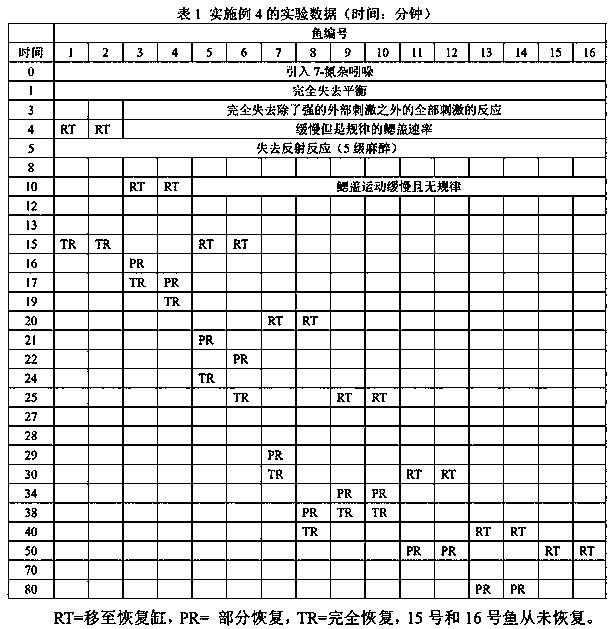
Figure 1 
Figure 2
Abstract
Description
technical field
[0001] The invention belongs to the technical field of aquaculture and relates to the application of 7-azaindole in sedation, anesthesia or euthanasia of aquatic organisms. Background technique
[0002] 7-Azaindole is an important class of heterocyclic compounds. 7-Azaindole is widely used in medicine, such as antitumor, antibacterial, antiviral, antidepressant and treatment of hypertension. At present, there is no report on the application of 7-azaindole in aquatic products, especially the application in the aspects of keeping aquatic organisms alive, sedation, anesthesia or euthanasia in aquatic products.
[0003] With the improvement of people's living standards, the demand for aquatic products has not only focused on the types of aquatic products, but also put forward higher requirements for the quality and freshness of aquatic products, prompting people to pay more and more attention to aquatic products The transportation process and its impact on the q...
Examples
preparation example Construction
[0039] The product preparation method of the above-mentioned fish active ingredient comprises the following steps of mixing ingredients according to the ratio of 7-azaindole and solvent, stirring evenly, and making a preparation after completely dissolving to obtain the product of the present invention.
[0040] If one portion of this product is mixed with a solvent, dilute 100-500 times with water, stir well before use. The solution of white powdery crystals diluted with water can be used directly without mixing with solvent. Generally speaking, if it is found that the fish is anesthetized too quickly during fishing and transportation, add new water to reduce the concentration of the liquid medicine. If it is found that the fish is anesthetized too slowly, then increase the dosage of this product. The specific dosage is used after obtaining the exact dosage according to the experiment.
Embodiment 1
[0043] Healthy koi and goldfish with a body length of 4 to 5 cm were placed in a 1-liter tank filled with water at 25° C., and the water was circulated therein by aeration. The formulation containing 7-azaindole was added to the tank and manually mixed with water such that the concentration of 7-azaindole in the water was 50 mg / L. This is the starting time of the experiment; thereafter, observations are made at regular intervals to determine the behavior of the fish in the water. This was continued until no response to external stimuli and complete loss of balance was observed, at which point the fish were transferred to a recovery tank with aerated tap water and the time until the fish swam again and responded normally to external stimuli was recorded.
[0044]Results: After 5 minutes of exposure to 7-azaindole, fish were in a state of mild stress (fish frequently jerked and surfaced when panting). At 8 minutes, the fish appeared partially out of balance and lay on the botto...
Embodiment 2
[0046] Place healthy koi and goldfish with a body length of 4-5 cm in a 1-liter tank filled with 25°C water, and add 7-azaindole preparation to 75 mg / L water to repeat the experiment of Example 1 . After 2 minutes of exposure, the fish appeared to be in a mildly stressed state. At 5.5 minutes it appeared to be partially off balance and lying on the bottom of the tank. At 7 minutes it showed complete loss of balance and at 10 minutes it showed no response to external stimuli. At 20 minutes, fish were moved to recovery tanks with clean water. Afterwards, it slowly recovered, and after 20 minutes it was swimming around the tank and appeared to have resumed normal activity.