
A device and method for full-color 3D printing
A 3D printing, full-color technology, applied in the field of 3D printing technology, can solve the problems of difficult color switching, small amount of glue, etc., and achieve the effect of less usage, low cost and wide color gamut
Patent Information
- Authority / Receiving Office
- CN · China
- Patent Type
- Patents(China)
- Current Assignee / Owner
- Publication Date
- 2019-11-26
Smart Images
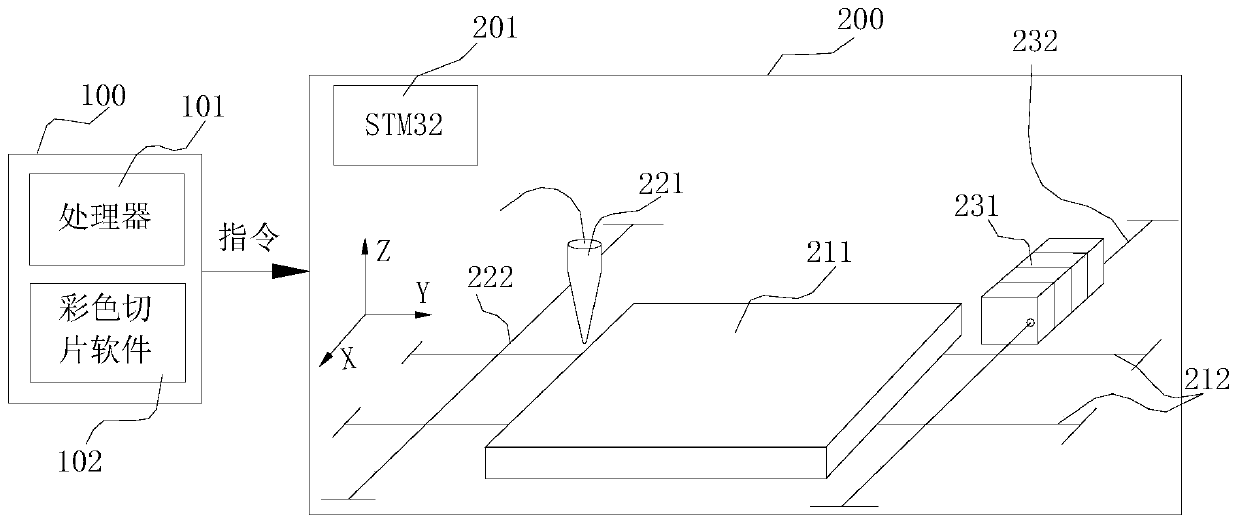
Figure 1 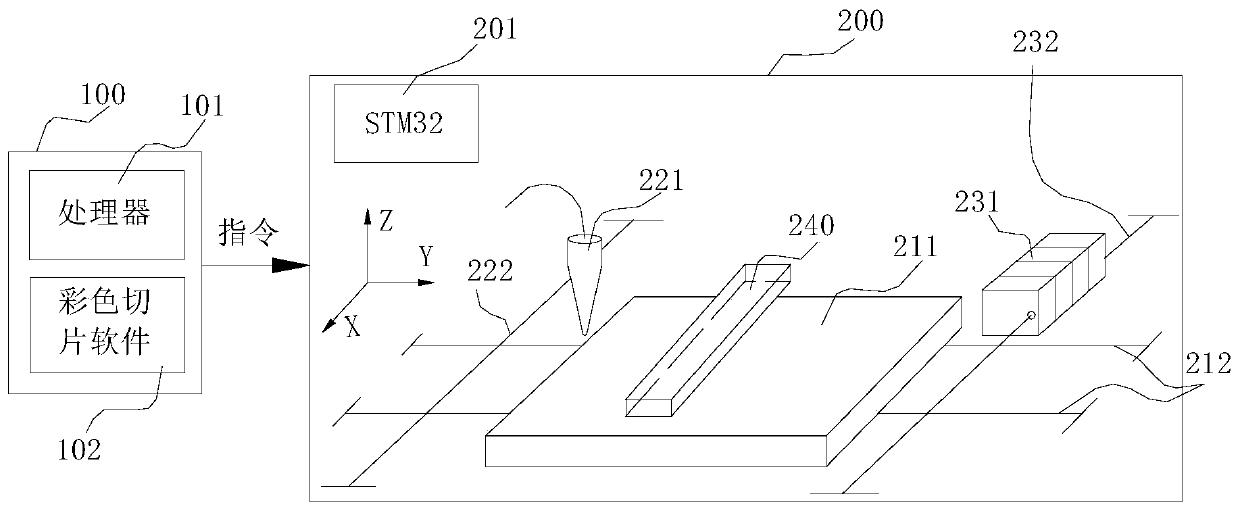
Figure 2 
Figure 3
Abstract
Description
Technical field
[0001] The invention relates to a 3D printing technology; a full-color 3D printing device and a full-color 3D printing method are specially designed.
Background technique
[0002] Fused deposition manufacturing, also known as melt line deposition manufacturing, is a processing method that does not use lasers. The FDM process was first successfully developed in 1988 by Dr. Scott Crump, an American scholar. The FDM forming system mainly includes five parts: extrusion head, wire feeding mechanism, motion mechanism, heating studio, and working table. The nozzle is scanned in XY linkage under computer control, and the wire is heated to slightly higher than its melting point in the nozzle. The spray head ejects the molten material in the scanning motion, rapidly cools to form a processing layer and is firmly connected with the previous layer. In this way, layers of scanning superposition form a spatial entity.
[0003] At present, the objects printed by FDM...
Examples
Embodiment 1
[0046] Such as figure 1 As shown, a color 3D printing device mainly includes: a computer system 100, a processor 101, a color slicing module 102, a control board (not shown), a working platform 211, a working platform transmission mechanism 212, a wire extrusion head 221, a wire Extrusion head transmission mechanism 222, color inkjet head 231, inkjet head transmission mechanism 232, color ink cartridge (not shown).
[0047] A processor (i.e. CPU) 101, a memory (not shown), a USB interface (not shown), a keyboard and a mouse (not shown) are included in the computer system 100, and a color slice module 102 is installed in the computer system, The processor 101 completes the slicing of the color model by executing functions or instructions in the color slicing module 102 .
[0048] Input the color model into the color slicing module 102, and the software can process the model in layers according to the layer thickness and the three-dimensional size of the model, obtain the cross...
Embodiment 2
[0053] Such as figure 2 As shown, on the basis of Embodiment 1, a color ink curing device 240 is further installed. The curing device 240 uses an infrared light source to cure the ink after the surface of each layer of material is colored to enhance the coloring effect.
Embodiment 3
[0055] On the basis of Embodiment 1, a state feedback mechanism is added, such as Figure 6 shown. The control board switches between physical printing and coloring according to the state information, and completes alternate 3D printing and inkjet coloring.