
Sensitive probe as well as preparation method and method for detecting salmonella enteritidis by virtue of sensitive probe
A Salmonella Enteritidis and probe detection technology, which is applied to measurement devices, instruments, scientific instruments, etc., can solve the problems of expensive probes, easy inactivation of antibodies, sensitivity, instability, etc., and achieves simple structure, good optical properties, and cost-effectiveness. high effect
Patent Information
- Authority / Receiving Office
- CN · China
- Patent Type
- Applications(China)
- Current Assignee / Owner
- Publication Date
- 2017-12-15
Smart Images
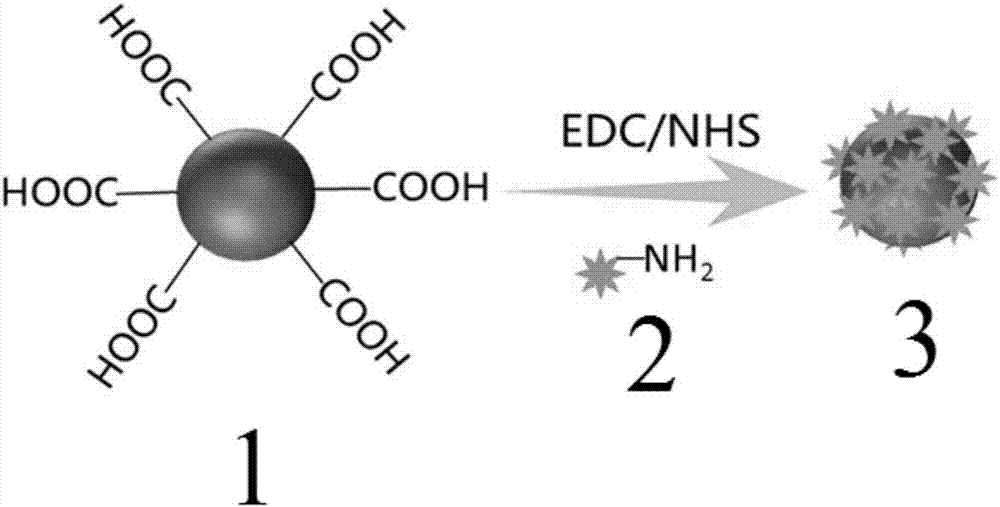
Figure 1 
Figure 2 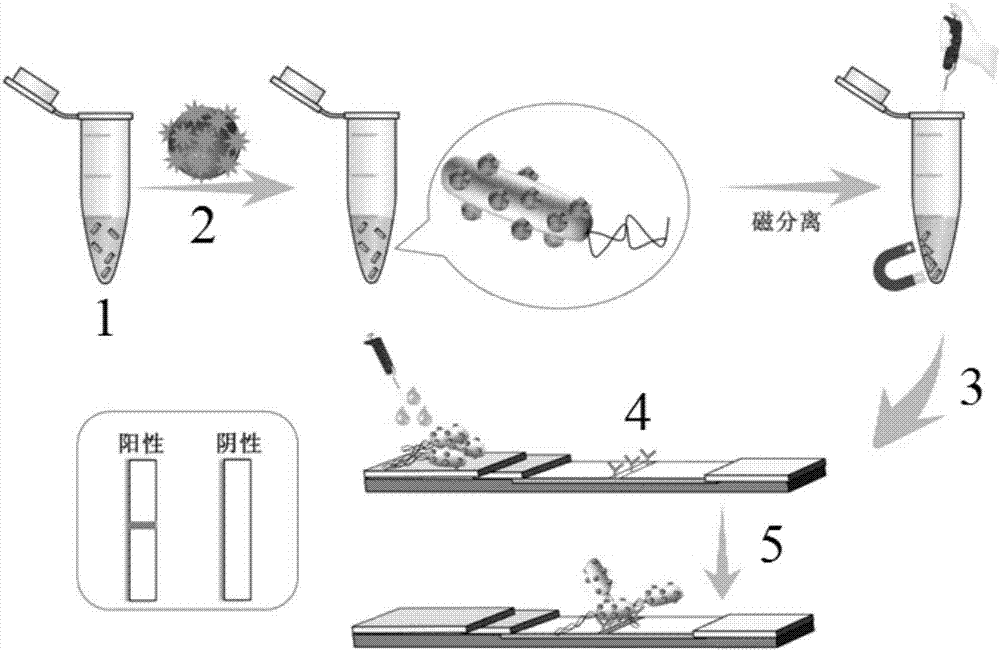
Figure 3
Abstract
Description
technical field
[0001] The invention relates to a probe, a preparation method and an application of the probe. Background technique
[0002] Bacterial infectious diseases account for one-third of all deaths worldwide and remain a major public health concern. Therefore, early identification of bacterial infections through point-of-care detection (POC) is crucial for the safety of water, food and clinical diagnosis. Immunochromatography test strips, due to their advantages of convenient preparation and operation, low cost, one-time use, short detection time, intuitive and reliable results, etc., do not require special equipment, and are the most common instant detection and diagnostic tools for various Detection of proteins, antibiotics, metal ions, toxins, etc. Typical sandwich test strips use specific biological components, such as antibodies, based on the principle of antigen-antibody specific binding, the target molecule in the sample reacts with the gold-labeled antibod...
Examples
specific Embodiment approach 1
[0060] Embodiment 1: This embodiment is a sensitive probe, which is prepared from an antibiotic and a signal carrier; the antibiotic is ampicillin; and the signal carrier is carboxylated immunomagnetic beads.
specific Embodiment approach 2
[0061] Embodiment 2: This embodiment differs from Embodiment 1 in that: the particle size of the carboxylated immunomagnetic beads is 150nm-200nm. Other steps are the same as in the first embodiment.
specific Embodiment approach 3
[0062] Embodiment 3: The difference between this embodiment and Embodiment 1 or 2 is that the carboxylated immunomagnetic beads are specifically prepared according to the following steps:
[0063] 1. FeCl 3 ·6H 2 Add O and trisodium citrate dihydrate into ethylene glycol, then dissolve in an air-bath shaker at a temperature of 36°C to 37°C and a speed of 200r / min to 300r / min for 30min to 60min, then add sodium acetate, Dissolve in an air bath shaker at a temperature of 36°C-37°C and a rotation speed of 200r / min-300r / min for 30min-60min to obtain a yellow-brown emulsion;
[0064] FeCl as described in step 1 3 ·6H 2 The volume ratio of the mass of O to ethylene glycol is (0.5g~1g):(10mL~30mL);
[0065] FeCl as described in step 1 3 ·6H 2 The mass ratio of O and trisodium citrate dihydrate is (0.5~1):(0.1~0.4);
[0066] FeCl as described in step 1 3 ·6H 2 The mass ratio of O and sodium acetate is (0.5~1):(1~2);
[0067] 2. Transfer the yellow-brown emulsion obtained in ...