
A Method for Suppressing Vehicle Shadow Interference in Open-air Expressway Scenes Based on Feature Fusion
A highway and feature fusion technology, applied in the field of image processing, can solve problems such as lack of solutions, noise interference, and lack of targeted solutions
Patent Information
- Authority / Receiving Office
- CN · China
- Patent Type
- Patents(China)
- Current Assignee / Owner
- Publication Date
- 2021-02-12
Smart Images
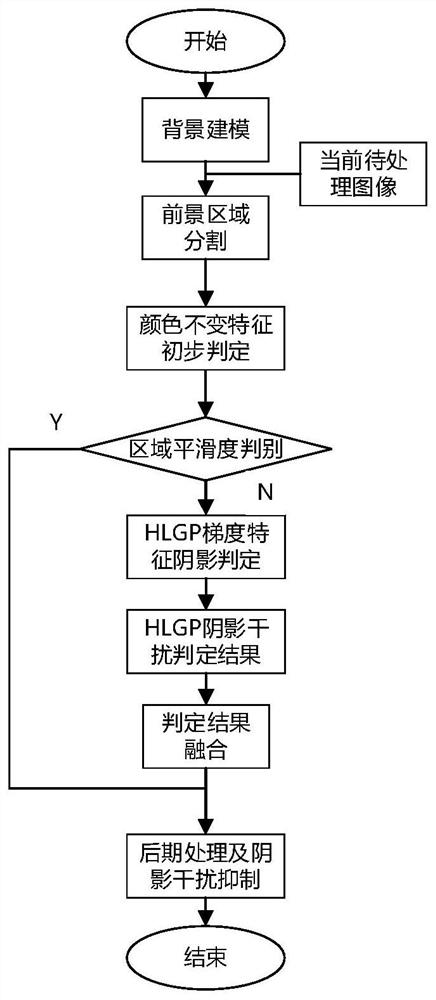
Figure 1 
Figure 2 
Figure 3
Abstract
Description
technical field
[0001] The invention relates to the technical field of image processing, in particular to a feature fusion-based method for suppressing vehicle shadow interference in an open-air highway scene. Background technique
[0002] Accurate extraction of vehicle target areas is the key to abnormal event detection on expressways based on video surveillance. However, the vehicle shadow interference in the open-air highway scene makes the extracted vehicle target area distorted, enlarged, connected or even lost. At the same time, noise and other disturbances in the scene image increase the difficulty of shadow suppression, making traditional shadow suppression methods difficult to apply. Therefore, it is of great theoretical and practical significance to study the vehicle shadow interference suppression method in the highway scene, and then improve the vehicle target detection accuracy.
[0003] Expressway is not only an important symbol of transportation modernizatio...
Examples
Embodiment 1
[0066] As shown in the figure, this embodiment provides a method for suppressing vehicle shadow interference in an open-air highway scene based on feature fusion, which can overcome the noise existing in the actual engineering application environment and realize accurate extraction of vehicle target areas. Aiming at the problem of scene noise interference, a shadow suppression method that combines color grayscale features and local gradient pattern direction histogram (Histogram of Local Gradient Patterns, HLGP) features is proposed.
[0067] First, the chroma and brightness similarity are used to preliminarily determine the shadow; then, for the local area with rich texture information, the local gradient pattern (Local Gradient Patterns, LGP) feature with noise robustness is used to extract the local texture, and the local gradient histogram is fused Consists of HLGP features. On this basis, the result of color shadow discrimination is corrected to reduce its false detection...
Embodiment 2
[0073] Step 1. Preliminary identification of shaded areas based on grayscale color features; for chromaticity and brightness characteristics, HSV space can decouple the coupling relationship between the two in RGB space. Therefore, the image in RGB space can be converted to HSV space for detection by means of color space conversion.
[0074] The shadow feature can be used to judge the color consistency from the brightness and chroma according to the following formula:
[0075]
[0076] Among them, c represents the color components in the current frame, here represent the components of the H channel and the S channel respectively, Ω 1 (x,y) is the neighborhood space of pixel I(x,y). In order to reduce the interference of noise, the color consistency of the local area of the target pixel is used for discrimination. Therefore, the color consistency of the pixel in the local area can be obtained by the following formula:
[0077]
[0078] It can be seen from the above fo...