

Reactive polyurethane hot melt adhesive and preparation method thereof
A polyurethane hot melt adhesive, reactive technology, applied in the direction of polyurea/polyurethane adhesives, adhesives, adhesive types, etc., can solve the problem of increased PUR melt viscosity, poor PUR bonding performance, and poor PUR flame retardant performance. and other problems, to achieve excellent flame retardancy and adhesion, improve initial adhesion, and good environmental resistance.
Patent Information
- Authority / Receiving Office
- CN · China
- Current Assignee / Owner
- Publication Date
- 2018-09-21
Smart Images
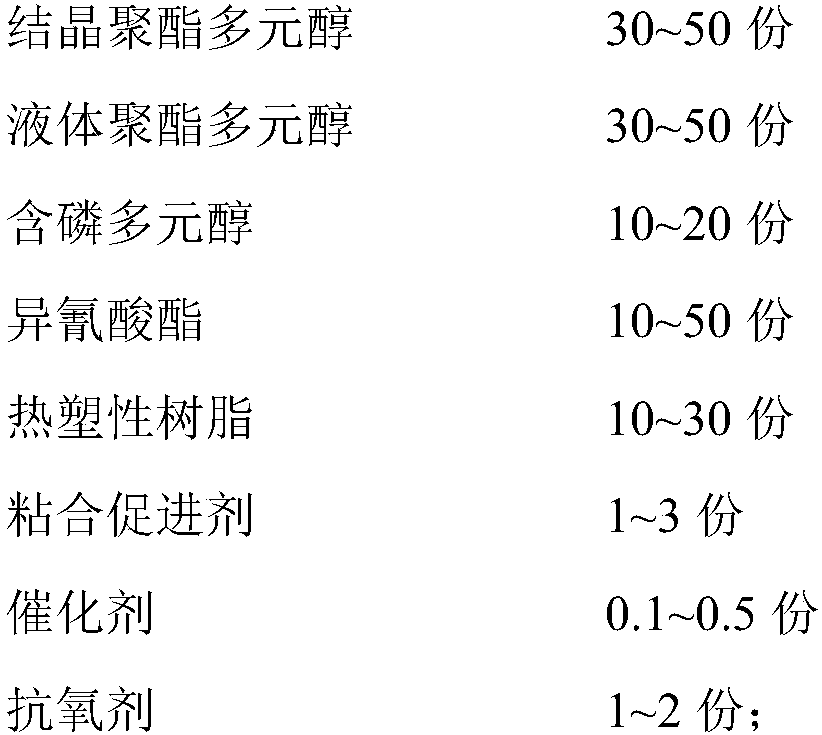
Figure 1 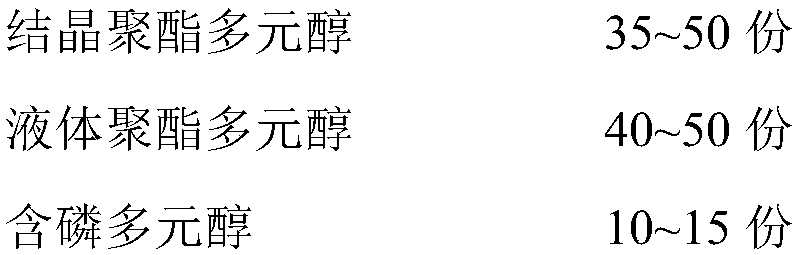
Figure 2 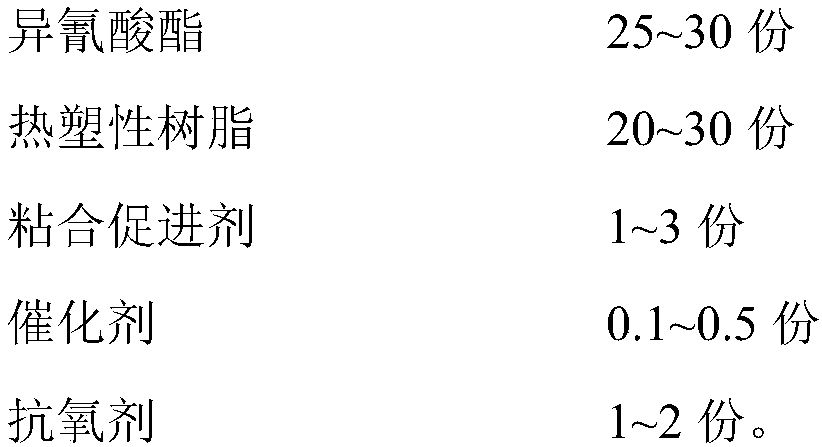
Figure 3
Abstract
Description
technical field
[0001] The invention relates to a hot melt adhesive, in particular to a reactive polyurethane hot melt adhesive and a preparation method thereof. Background technique
[0002] Reactive polyurethane hot-melt adhesives (PUR) have developed rapidly in recent years in the automotive, electronic appliances, wood processing, book binding and food packaging industries due to their simple operation, excellent performance, and environmental friendliness. However, the flame retardant properties of the existing PUR are relatively poor, which limits its application in some specific fields.
[0003] Generally, flame retardant polymers are prepared by adding flame retardants. The flame retardants are divided into inorganic flame retardants and organic flame retardants. If PUR achieves a better flame retardant effect, the addition amount of inorganic flame retardants is generally If it is larger, this will lead to a significant increase in the melt viscosity of PUR and poo...
Examples
Embodiment 1-3
[0056]Three kinds of reactive polyurethane hot-melt adhesives of the present embodiment, in parts by weight, the raw material components are as follows (Table 1):
[0057] Table 1
[0058]
[0059]
[0060] The preparation method of above-mentioned reactive polyurethane hot-melt adhesive is as follows:
[0061] (1), put crystalline polyester polyol, liquid polyester polyol, phosphorus-containing polyol, thermoplastic resin into the reaction kettle, heat to 100~130 ℃, vacuum dehydration under stirring for 2 hours, the vacuum degree is -0.095~ 0.05MPa;
[0062] (2) Cool down to 80-90°C, put in the isocyanate preheated to 60°C, put in N 2 The reaction was stirred at 75-85°C for 1.5 hours under the protection;
[0063] (3), add adhesion promoter, catalyst, antioxidant in turn, in N 2 Stir and mix for 1 hour at 75-85°C under protection;
[0064] (4), heat up to 100~130 ℃, vacuumize until no bubbles appear, and discharge the material.