
Application of α-mangostin in the preparation of medicaments for the prevention and treatment of gout and hyperuricemia
A technology of hyperuricemia and mangostin, applied in the field of medicine, can solve the problems such as the prevention and treatment of gout and hyperuricemia that have not been seen, and achieve the effect of strong activity
Patent Information
- Authority / Receiving Office
- CN · China
- Patent Type
- Patents(China)
- Current Assignee / Owner
- Publication Date
- 2020-11-20
- Estimated Expiration
- Not applicable · inactive patent
Smart Images
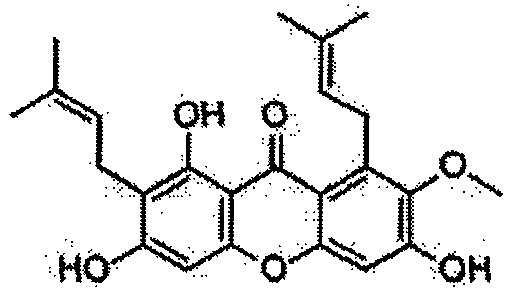
Figure 1 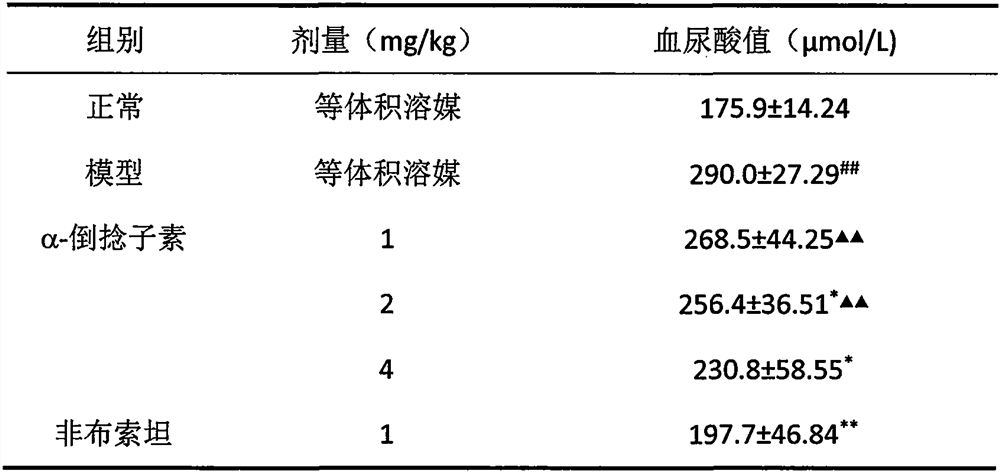
Figure 2 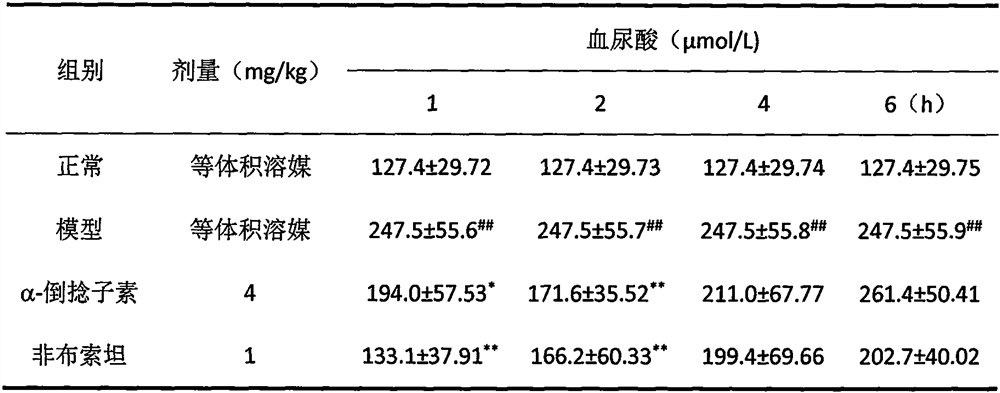
Figure 3
Abstract
Description
technical field
[0001] The invention relates to the new application of α-mangostin in the prevention and treatment of hyperuricemia and gout, and belongs to the technical field of medicine. Background technique
[0002] Gout is a group of metabolic diseases caused by the excessive production of uric acid due to purine metabolism disorder and / or the decrease of uric acid excretion, which leads to the increase of uric acid level and the formation of uric acid crystals deposited in joints, soft tissues, and kidneys. Uric acid is the end product of human purine metabolism, and hyperuricemia is usually considered a sign of gout. According to statistics, about 5% to 12% of patients with hyperuricemia will eventually develop gout [1] . In Europe, North America, Japan and other regions and countries, the incidence of gout is relatively high, but with the improvement of people's living standards in our country, the extension of life span, the change of diet structure, and the increa...
Examples
Embodiment 1
[0023] The dose-effect relationship of the inventive compound in reducing blood uric acid in mice with hyperuricemia induced by potassium oxonate
[0024] Healthy male Kunming mice (body weight 18-22g) were provided by Beijing Huafukang Biotechnology Co., Ltd., certificate number: SCXK (Beijing) 2014-0004. Animals were randomly divided into normal control group, hyperuricemia model group, inventive compound 1.0, 2.0 and 4.0 mg / kg dosage groups, febuxostat 1.0 mg / kg group mg / kg. The test compound was formulated with 0.5% sodium carboxymethylcellulose (0.5% CMC-Na) to an appropriate concentration, administered orally, twice a day, 5 doses in total. Reference [Hall IH, Scoville JP, Reynolds DJ, Simlot R, Duncan P. Substituted cyclic imides aspotencial anti-gout agents. Life Sciences. 1990, 46: 923-1927.Stavric B, ClaymanS, Gradd REA, Hebert D.Some in vivo effects in the rat induced by chlorprothixene and potassium oxonate Pharmacology Research, 1975, 7: 117-124] using the uricas...
Embodiment 2
[0030] The time-effect relationship of the inventive compound in reducing blood uric acid in mice with hyperuricemia induced by potassium oxonate
[0031] Healthy male Kunming mice (body weight 18-22g) were provided by Beijing Huafukang Biotechnology Co., Ltd., certificate number: SCXK (Beijing) 2014-0004. The animals were randomly divided into 10 groups, 10 animals in each group, which were normal group, hyperuricemia model group, 1, 2, 4, 6h groups administered with 4.0 mg / kg of the inventive compound, and febuxostat 1.0 mg / kg administered 1, 2, 4, 6h groups. The administration volume was 10ml / kg, and the administration was once. One hour before intragastric administration, 2 hours after intraperitoneal injection of potassium oxonate 500mg / kg (20ml / kg), blood was taken from the orbital vein, centrifuged at 3600rpm / min for 10min, the supernatant was taken, and the blood uric acid level was measured by the phosphotungstic acid method. The results are shown in the table 2.
...
Embodiment 3
[0037] Effects of Invented Compounds on the Activities of Xanthine Oxidase (XOD) and Xanthine Dehydrogenase (XDH) in Vivo
[0038] Get example 1 animal serum 100 μ l and the liver of example 2 animal according to mass: volume=1: 9, make 10% liver homogenate with sonicator under ice-bath condition, 3600rpm / min 4 ℃ centrifugation 10min, get liver homogenate Serum and liver homogenates were used to measure XOD activity in 100 μl of serum according to the instructions of the xanthine oxidase kit. Serum and liver XOD activities were calculated according to the formula.
[0039] Serum XOD activity (U / L) = (measured OD value - blank OD value) × total reaction volume × 1 ÷ (12.6 × 10 -3 × sampling amount × 1 × reaction time 20min);
[0040] Liver XOD activity (U / gprot) = (measured OD value - blank OD value) × total reaction volume × 1 ÷ (12.6 × 10 -3 × sample volume × 1 × reaction time 20min) ÷ protein concentration (g.prot / L)
[0041] Another 20 μl of animal serum from Example 1 ...