

High heat-shrinkable polyamide fiber and blended yarn and fabric using the polyamide fiber
A polyamide fiber, shrinkage technology, applied in the direction of single-component polyamide rayon, fabric, knitting, etc., can solve the problems of high Young's modulus, hard hand feeling, etc., and achieve the effect of excellent shrinkage characteristics
Patent Information
- Authority / Receiving Office
- CN · China
- Patent Type
- Patents(China)
- Current Assignee / Owner
- Publication Date
- 2021-10-29
Smart Images
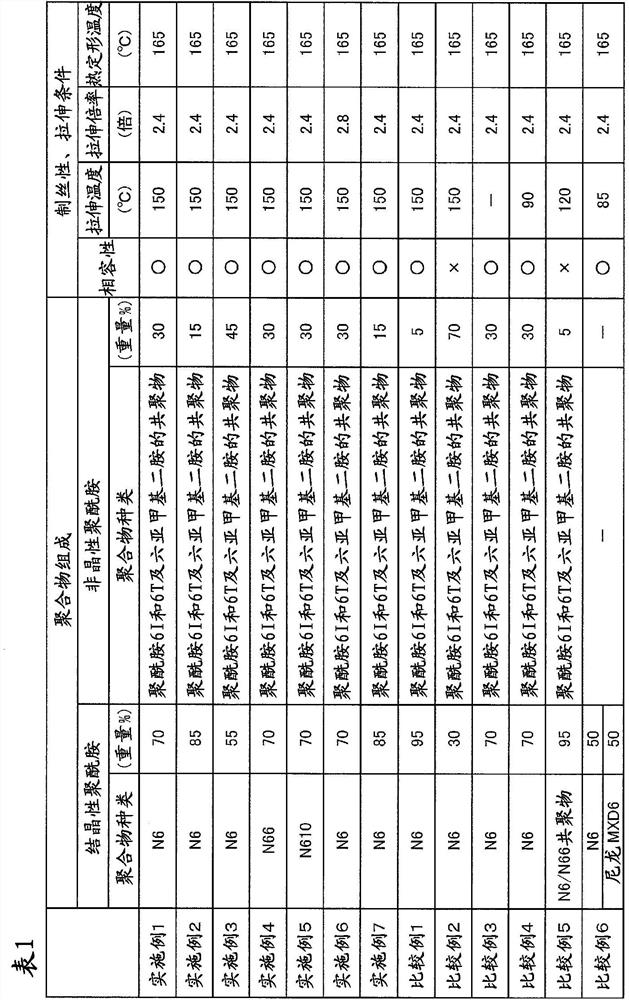
Figure 1 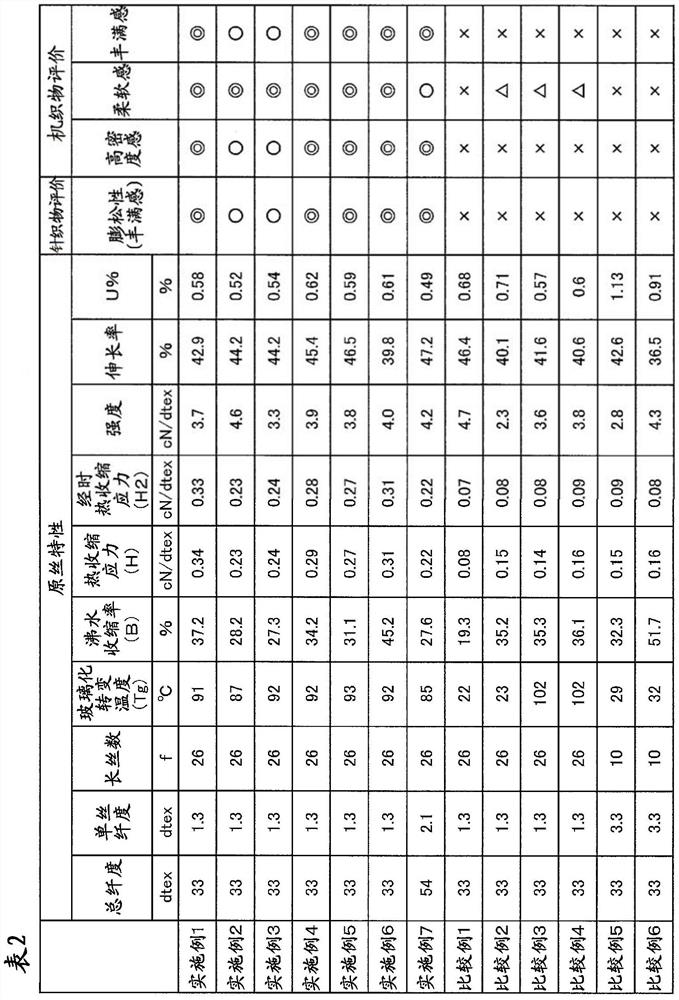
Figure 2
Abstract
Description
technical field
[0001] The present invention relates to a polyamide fiber having high heat shrinkability, and a blended yarn and fabric using the polyamide fiber. Background technique
[0002] In recent years, the development of sewn products such as woven fabrics using special fibers that have not been seen so far has been active. Among them, there are many examples of using fibers endowed with high shrinkage properties. For example, after weaving a mixed fiber yarn mixed with two types of fibers with different heat shrinkage properties, a raw yarn with high heat shrinkage properties is heat-treated with boiling water, steam, etc. to make it have The development of woven fabrics with improved bulkiness, fullness, hand feeling and surface properties has been extensively carried out.
[0003] As a representative example of high-shrinkage fibers, there is high-shrinkage polyester fiber, but polyester fiber has a higher Young's modulus than polyamide fiber, so heat treatment m...
Examples
Embodiment 1
[0116] Polycaprolactam (N6) (relative viscosity ηr: 2.62, melting point 222°C) as a crystalline polyamide and isophthalic acid / terephthalic acid as a non-crystalline polyamide at a copolymerization ratio of 7 / 3 Polycondensate of phthalic acid (6I) / terephthalic acid (6T) / hexamethylenediamine (relative viscosity ηr: 2.10), the weight ratio of crystalline polyamide / non-crystalline polyamide is 70 / 30 Melt-kneading was carried out at 265° C. using a single-screw extruder, and melt discharge was carried out using a spinneret having 26 circular discharge holes (spinning temperature: 265° C.). After being melted and discharged, the filaments are cooled, oiled, and interwoven, and then drawn with the first godet roller (stretching temperature: 150°C) at 1500m / min, and then stretched to 2.4 times and then heat-set at 165°C. A polyamide yarn of 33 dtex26 filaments (relative viscosity ηr: 2.46, glass transition temperature (Tg): 91° C.) was obtained at a winding speed of 3500 m / min.
Embodiment 2
[0118] Except that the weight ratio of crystalline polyamide / non-crystalline polyamide was 85 / 15, spinning was carried out in the same manner as in Example 1 to obtain polyamide filaments of 33 dtex26 filaments (relative viscosity ηr: 2.54, Glass transition temperature (Tg): 87°C).
Embodiment 3
[0120] Except that the weight ratio of crystalline polyamide / non-crystalline polyamide was 55 / 45, spinning was carried out in the same manner as in Example 1 to obtain polyamide filaments of 33 dtex26 filaments (relative viscosity ηr: 2.39, Glass transition temperature (Tg): 92°C).