
Train control system risk assessment method
A train control system and risk assessment technology, applied in the direction of instruments, data processing applications, resources, etc., can solve the problems of loss of accuracy of assessment results, great influence of subjective factors, and inability to guarantee the reliability and accuracy of risk assessment results, etc.
Patent Information
- Authority / Receiving Office
- CN · China
- Current Assignee / Owner
- Publication Date
- 2019-11-22
Smart Images
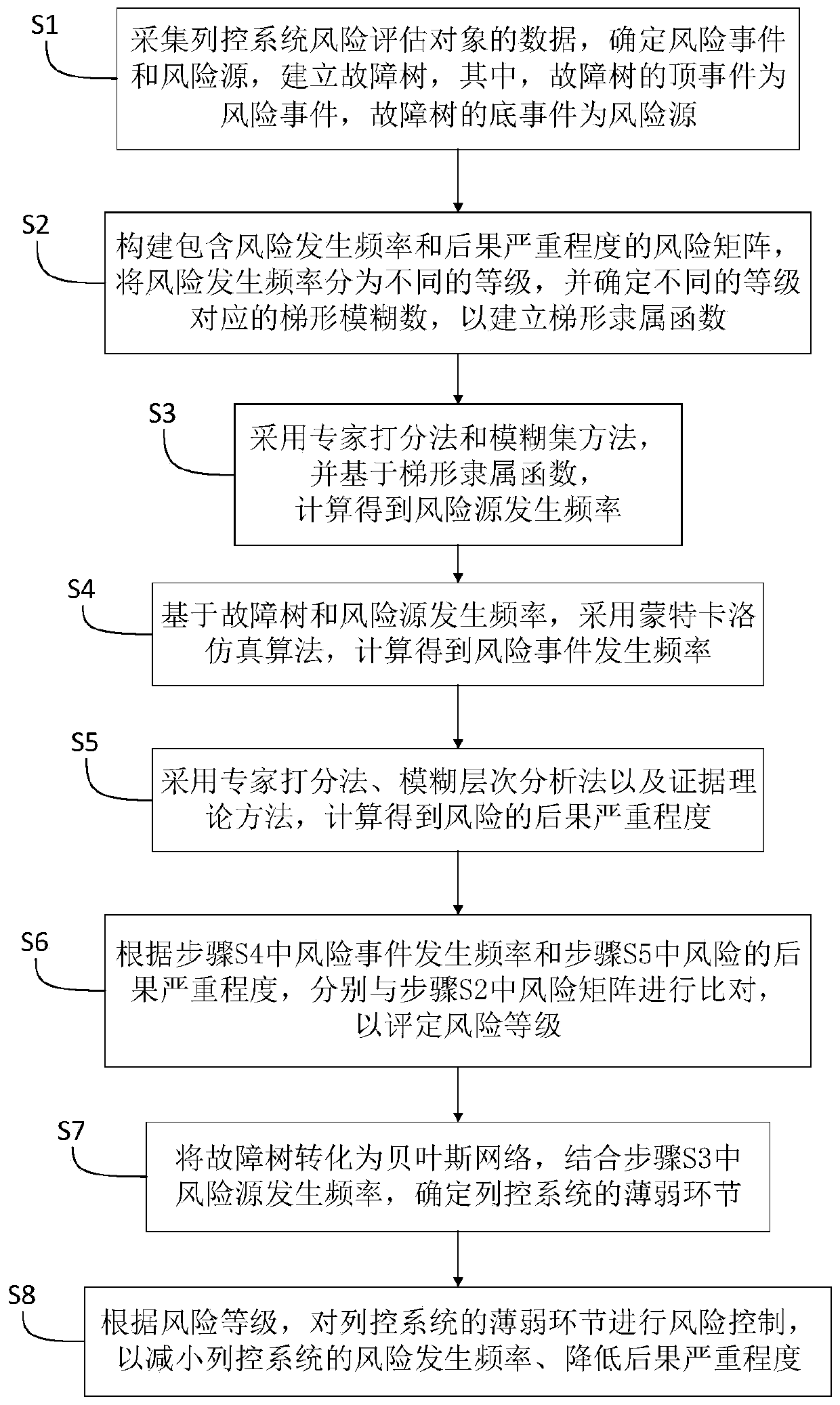
Figure 1 
Figure 2 
Figure 3
Abstract
Description
technical field
[0001] The invention relates to the technical field of train control system risk assessment, in particular to a train control system risk assessment method. Background technique
[0002] The train operation control system, that is, the train control system, is a safety-critical system integrating control, communication and other technologies. It is mainly used to control the running speed of the train, ensure the safety of the train and improve the transportation efficiency. It can control the running interval of the train in real time and prevent the train from overspeeding. Operation is the core technical equipment and key safety system to ensure the high-speed, safe and reliable operation of trains. Compared with the traditional signal system, the train control system has more stringent safety requirements, and its own safety hazards will seriously endanger the safety and efficiency of train operation. Whether in theory or in actual production, it is of g...
Examples
Embodiment Construction
[0121] The present invention will be described in detail below in conjunction with the accompanying drawings and specific embodiments.
[0122] Such as figure 1 As shown, a train control system risk assessment method includes the following steps:
[0123] S1. Collect the data of the risk assessment object of the train control system, determine the risk event and risk source, and establish a fault tree, wherein the top event of the fault tree is the risk event, and the bottom event of the fault tree is the risk source;
[0124] S2. Construct a risk matrix including risk occurrence frequency and consequence severity, divide risk occurrence frequency into different levels, and determine trapezoidal fuzzy numbers corresponding to different levels, so as to establish trapezoidal membership function;
[0125] S3. Using the expert scoring method and fuzzy set method, and based on the trapezoidal membership function, calculate the occurrence frequency of risk sources;
[0126] S4. Bas...