
Preparation method of rapid repairing coating for wind turbine blade
A wind turbine blade, fast technology, applied in the field of coatings, can solve the problems of short construction time, low adhesion, and increased efficiency of polyurea coatings, and achieve the improvement of physical and mechanical properties and construction properties, impact strength, and excellent performance. Effect
Patent Information
- Authority / Receiving Office
- CN · China
- Patent Type
- Applications(China)
- Current Assignee / Owner
- Publication Date
- 2020-06-26
- Estimated Expiration
- Not applicable · inactive patent
Smart Images
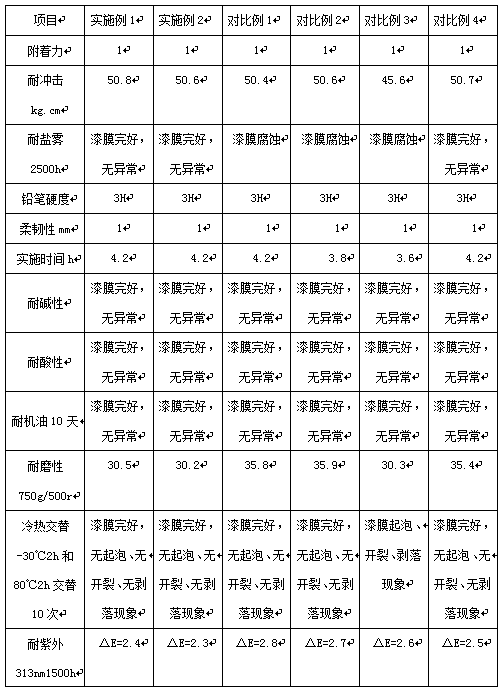
Figure 1
Abstract
Description
technical field
[0001] The invention belongs to the technical field of coatings, and in particular relates to a preparation method of a wind power blade rapid repair coating. Background technique
[0002] When it comes to wind power generation, what many people think of is the blue sea, white windmills, beautiful foothills, and neat lanes. However, the vast majority of wind farms are actually built in inaccessible areas, and the operating environment is harsh: my country Wind turbines are generally installed in high mountains, wastelands, Gobi, islands, etc., and are often affected by irregular, changing directions, variable load winds and strong gusts of wind. The wind turbines start and stop frequently and suffer large impacts. In addition, there is a large climate difference between the north and the south of my country, and the winter temperature in the north is low. For the low-temperature units in the north, in addition to meeting the mechanical performance requirements...
Examples
Embodiment 1
[0021] A method for preparing a quick repair coating for wind turbine blades, comprising the following steps:
[0022] (1) In parts by weight, first inject 85 parts of deionized water into the reactor, add 0.05 parts of initiator, then pass 90 mL / min nitrogen gas into the water for 25 minutes, then add 0.1 part of compound emulsifier into it, and stir Under the conditions, a mixture of 23 parts of dicyclopentadiene dioxide, 31 parts of vinyl ester resin, 8 parts of butyl acrylate and 14 parts of methyl methacrylate was dropped into the reactor, and the polymerization reaction was carried out in the reactor, stirring After 20 minutes, transfer to a constant temperature water bath at 80°C and react for 2 hours, then demulsify, precipitate, and dry to obtain interpenetrating latex particles; (2) 40 parts of vinyl ester resin, 31 parts of interpenetrating latex particles, 6 parts of pigments, Add 6 parts of additives into the paint mixing tank in turn, disperse at high speed for 3...
Embodiment 2
[0024](1) In parts by weight, first inject 80 parts of deionized water into the reactor, add 0.02 parts of initiator, then pass 80 mL / min nitrogen gas into the water for 20 minutes, then add 0.02 parts of compound emulsifier into it, and stir Under the conditions, a mixture of 12 parts of dicyclopentadiene dioxide, 24 parts of Novolac vinyl ester resin, 5 parts of butyl acrylate and 12 parts of methyl methacrylate was dropped into the reactor, and the polymerization reaction was carried out in the reactor. After stirring for 10 minutes, transfer to a constant temperature water bath at 75°C and react for 2 hours, then demulsify, precipitate, and dry to obtain interpenetrating latex particles; (2) 35 parts of Novolac vinyl ester resin, 24 parts of interpenetrating latex particles, 4 parts of pigment, Add 4 parts of rheological additives into the paint mixing tank in turn, disperse at high speed for 30 minutes, and then grind and disperse to a fineness of 40 μm with a sand mill to...