
Method for artificially feeding riptortus pedestris in whole growth period
A technology of full growth period and stinkbug, which is applied in animal feed, animal feed, application, etc., to achieve the effect of prolonging the spawning period, increasing the hatching rate, and promoting normal growth and development
Patent Information
- Authority / Receiving Office
- CN · China
- Patent Type
- Applications(China)
- Current Assignee / Owner
- Publication Date
- 2021-02-05
- Estimated Expiration
- Not applicable · inactive patent
Smart Images
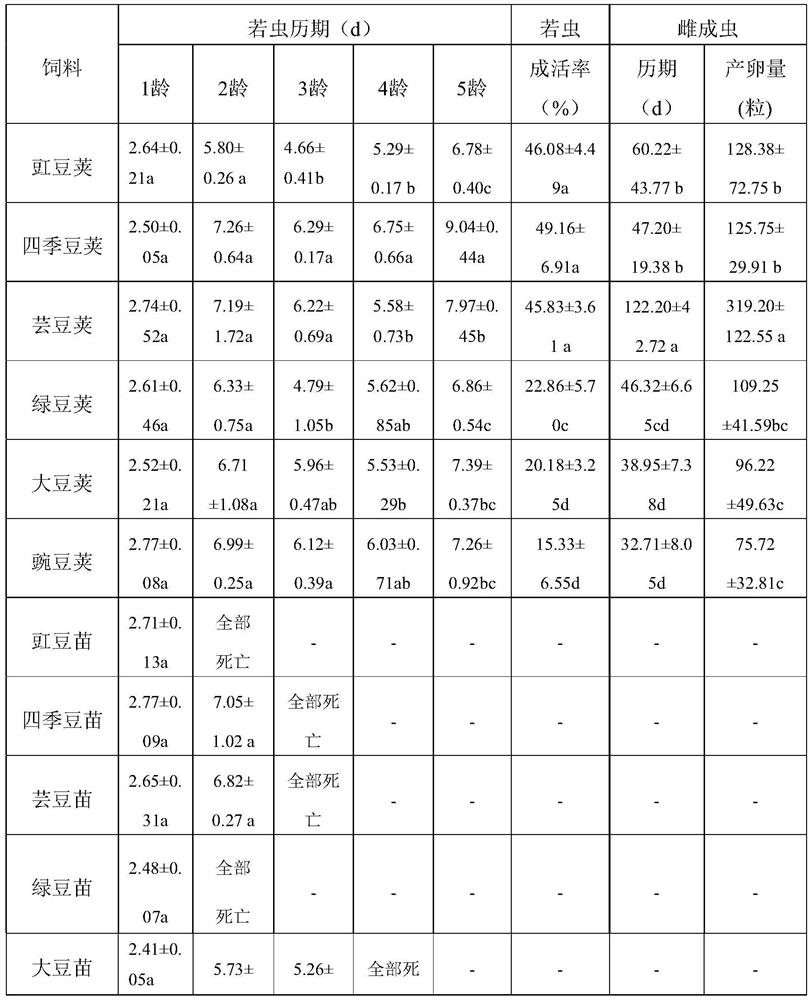
Figure 1 
Figure 2 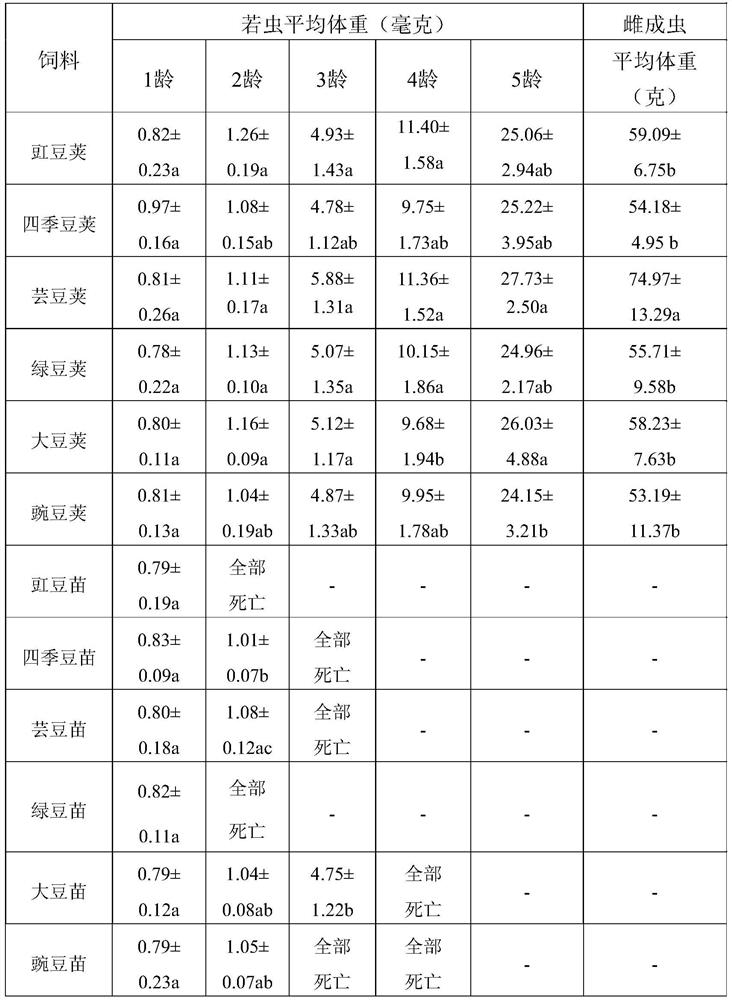
Figure 3
Abstract
Description
technical field
[0001] The invention relates to the technical field of insect rearing, in particular to a method for artificially rearing the important soybean pest stinkbug during the whole growth period. Background technique
[0002] Riptortus pedestris (Fabricius) belongs to the order Hemiptera and belongs to the family Riptestidae. Also known as white-striped stink bug, bean stink bug. Host of the stinkbug: It mainly damages leguminous plants such as broad beans, peas, kidney beans, mung beans, soybeans, cowpeas, Kunming spatholobus, and twig beans, as well as rice, wheat, sorghum, corn, sweet potatoes, cotton, sugarcane, loofah, etc. . Both adults and nymphs of the stink bug can harm soybeans, and the adults are more harmful. The harm method is to suck the juice of soybean flowers, fruits, pods, tender stems and leaves. When soybeans are flowering and fruiting, it is the peak time when stink bugs emerge into adults, and they often cluster and cause damage. There can ...
Examples
Embodiment 1
[0068] Example 1: Screening of suitable feed for adult and nymph artificial rearing of stink bugs
[0069] In a constant temperature room with a temperature of 25° C., a relative humidity of 40%, and a photoperiod of (fluorescent tubes, close to natural light) L:D=16:8, different feeds were used to feed the nymphs and adults of the stink bug. Green and tender pods of cowpea, kidney bean, kidney bean, soybean, mung bean, pea, etc. are purchased from the market, and are sterilized and kept fresh in the laboratory. The bean sprouts are sown in the greenhouse, and seedlings aged 7 to 10 days after emergence are used. The average body weight of nymphs and adults of different ages of the stinkbug at the measuring point was taken within 24 hours after moulting. The results are shown in Table 1 and Table 2.
[0070] Table 1 Example 1 The developmental duration and adult oviposition of the adults and nymphs of the stinkbug stinkbug in different feeding sites
[0071]
[0072]
[...
Embodiment 2
[0076] Example 2: Screening of the suitable temperature for artificial rearing of stinkbug adults and nymphs
[0077] The relative humidity in the thermostatic chamber is set to be 40%, and the photoperiod is (fluorescent tube, close to natural light) L: D=16:8, with kidney bean pods (purchased on the market, disinfected and fresh-keeping treated in the laboratory) as feed. The temperature is respectively 15 ℃, 20 ℃, 25 ℃, 30 ℃, 35 ℃ in the thermostatic chamber to rear the nymphs and adults of the stink bug. The results are shown in Table 3 and Table 4.
[0078] Table 3 Example 2 The developmental duration and adult oviposition of the adults and nymphs of the stink bug at different temperature feeding points
[0079]
[0080] Table 4 Example 2 The average body weight of the adults and nymphs of stink bugs at different temperature feeding points
[0081]
[0082]
[0083] Conclusion: With the increase of temperature, the duration of nymphs and adults of stinkbug is s...
Embodiment 3
[0084] Example 3: Screening of optimum temperature for hatching of stinkbug eggs
[0085] The relative humidity in the constant temperature room is set to be 40%, the light cycle is (fluorescent tube, close to natural light) L: D=16:8, and the kidney bean pods (purchased on the market, disinfected and kept fresh in the laboratory) are used as feed, and the collection point The eggs laid within 24 hours by the adult stinkbugs are hatched in thermostatic chambers with temperatures set at 15°C, 20°C, 25°C, 30°C, and 35°C. The results are shown in Table 5.
[0086] Table 5 Example 3 The hatching duration and egg hatching rate of stink bug eggs under different temperatures
[0087] temperature Egg incubation period (d) Egg hatching rate (%) 15℃ 35.83±0.95a 70.27±11.45c 20℃ 15.07±0.68b 88.41±10.36b 25℃ 10.23±0.36c 98.12±1.74a 30℃ 6.69±0.25d 98.70±1.12a 35℃ 5.23±0.44e 95.08±3.29ab
[0088] Conclusion: The duration of eggs shortens wit...