
A kind of preparation method of thin-walled part
A technology for thin-walled parts and blanks, which is applied in the field of thin-walled parts preparation, can solve the problems of self-heavy, deformation, and low product yield of thin-walled pads, and can eliminate defects, improve wear resistance, and achieve stable and reliable quality. Effect
Patent Information
- Authority / Receiving Office
- CN · China
- Patent Type
- Patents(China)
- Current Assignee / Owner
- Publication Date
- 2022-06-17
Smart Images
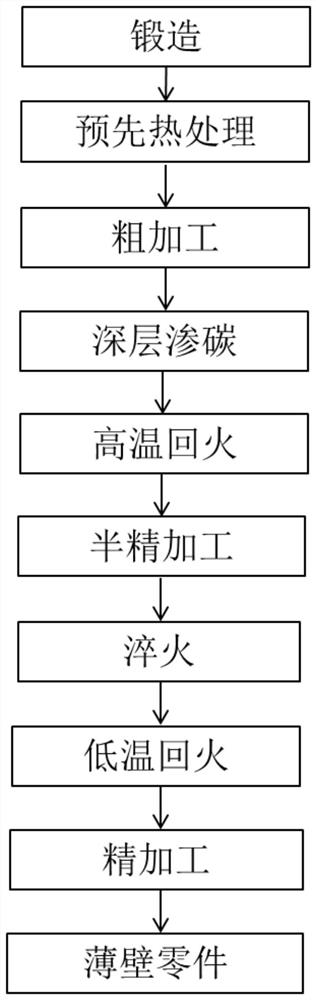
Figure 1 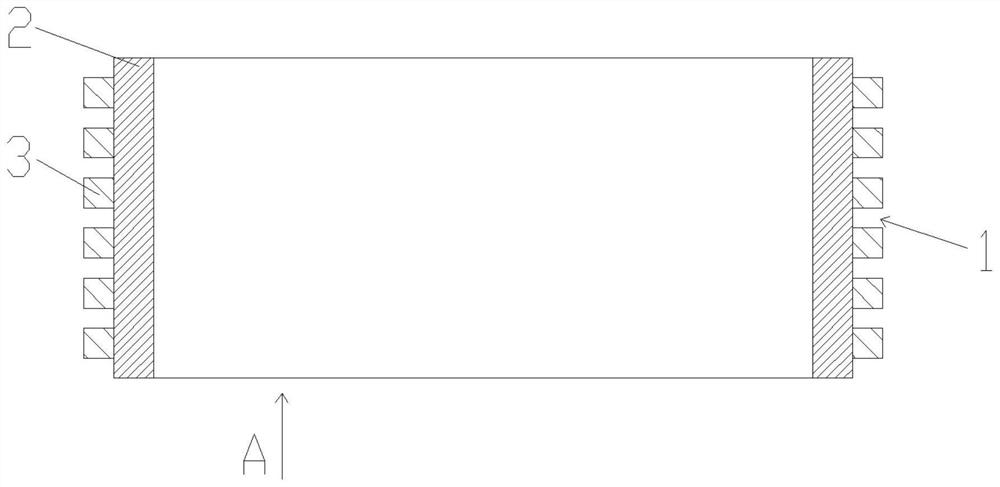
Figure 2 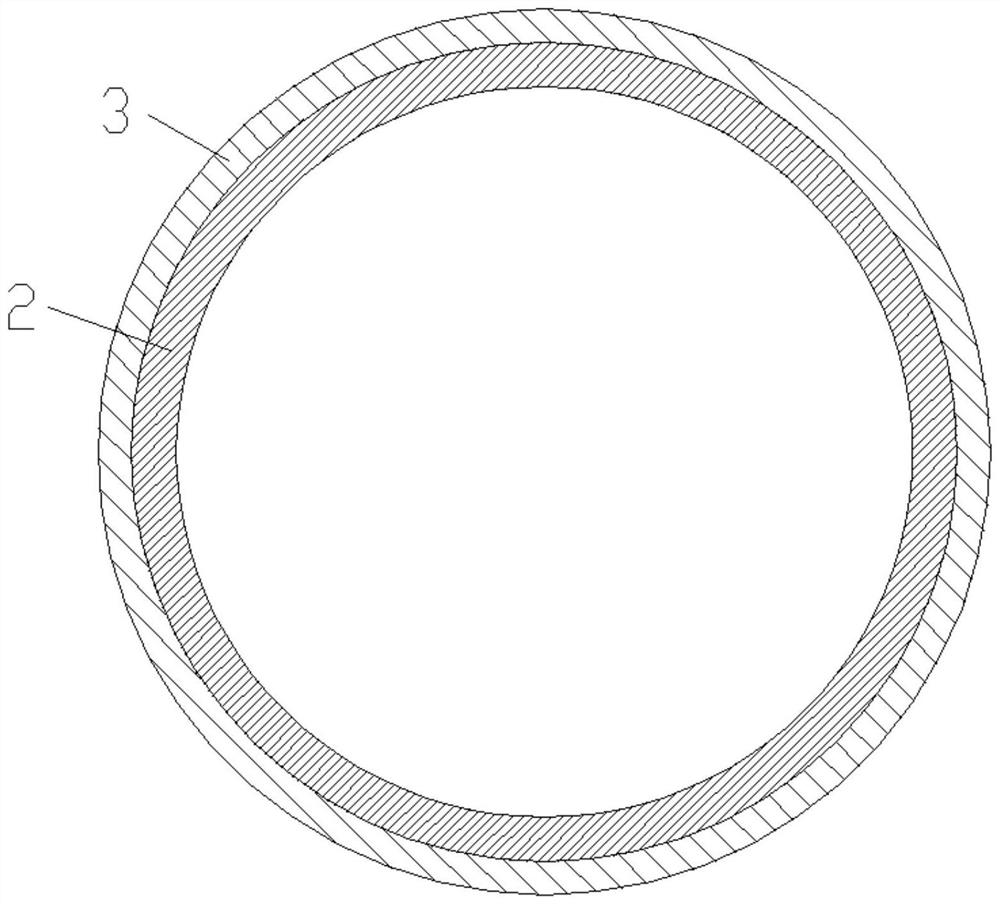
Figure 3
Abstract
Description
technical field
[0001] The invention belongs to the technical field of thin-walled parts, and in particular relates to a preparation method of thin-walled parts. Background technique
[0002] The planetary deceleration structure is used in the transmission mechanism of the shearer to transmit torque and achieve the purpose of deceleration. Its structure is divided into two-stage planetary deceleration structure, and the two-stage planetary deceleration structure has a certain axial displacement and has a great impact. In order to solve this problem, Wear-resistant and impact-reducing thin-walled parts are designed between the two-stage planetary deceleration structure. In order to ensure service characteristics, high-quality carburized steel is selected for deep carburizing and quenching treatment to meet the requirements of high wear resistance on the surface and good toughness in the core. technical features.
[0003] Since thin-walled parts require carburizing on both en...
Examples
Embodiment 1
[0043] This embodiment includes the following steps:
[0044] Step 1: Forging: Die forging and punching are performed in sequence after heating the steel raw material to obtain a cylindrical forging billet; the material of the steel raw material is 18Cr2Ni4WA; the initial forging temperature in the die forging process is 1180 ° C, and the final forging temperature is 850℃;
[0045] Step 2, pre-heat treatment: normalizing and high temperature tempering are carried out successively to the cylindrical forging blank obtained in step 1 to obtain a blank; the temperature of the normalizing is 920 ℃, and the temperature of the high temperature tempering is 670 ℃;
[0046] Step 3: Rough machining: rough machining the blank obtained in step 2 to obtain a blank; the rough machining process is: opening a plurality of annular grooves on the outer surface of the blank in a direction perpendicular to the height of the blank; the The blank consists of a support structure and a plurality of ...
Embodiment 2
[0055] This embodiment includes the following steps:
[0056] Step 1: Forging: Die forging and punching are performed in sequence after heating the steel raw material to obtain a cylindrical forging billet; the material of the steel raw material is 20CrNi2Mo; the initial forging temperature in the die forging process is 1140 ° C, and the final forging temperature is 880℃;
[0057] Step 2, pre-heat treatment: normalizing and high temperature tempering are carried out successively to the cylindrical forging blank obtained in step 1 to obtain a blank; the temperature of the normalizing is 950 ℃, and the temperature of the high temperature tempering is 640 ℃;
[0058] Step 3: Rough machining: rough machining the blank obtained in step 2 to obtain a blank; the rough machining process is: opening a plurality of annular grooves on the outer surface of the blank in a direction perpendicular to the height of the blank; the The blank is composed of a support structure and a plurality o...
Embodiment 3
[0067] This embodiment includes the following steps:
[0068] Step 1. Forging: Die forging and punching are performed in sequence after heating the steel raw material to obtain a cylindrical forging blank; the material of the steel raw material is 12Cr2Ni4A; the initial forging temperature in the die forging process is 1160 ° C, and the final forging temperature is 12Cr2Ni4A. 860℃;
[0069] Step 2, pre-heat treatment: normalizing and high temperature tempering are carried out successively to the cylindrical forging blank obtained in step 1 to obtain a blank; the temperature of the normalizing is 920 ℃, and the temperature of the high temperature tempering is 670 ℃;
[0070] Step 3: Rough machining: rough machining the blank obtained in step 2 to obtain a blank; the rough machining process is: opening a plurality of annular grooves on the outer surface of the blank in a direction perpendicular to the height of the blank; the The blank is composed of a support structure and a p...