
Near field optical virtual optical probe
A near-field optics and virtual light technology, applied in the fields of near-field optics and nano-optics, can solve the problem of low light-passing efficiency of fiber probes
Patent Information
- Authority / Receiving Office
- CN · China
- Patent Type
- Patents(China)
- Current Assignee / Owner
- Publication Date
- 2004-02-25
- Estimated Expiration
- Not applicable · inactive patent
Smart Images
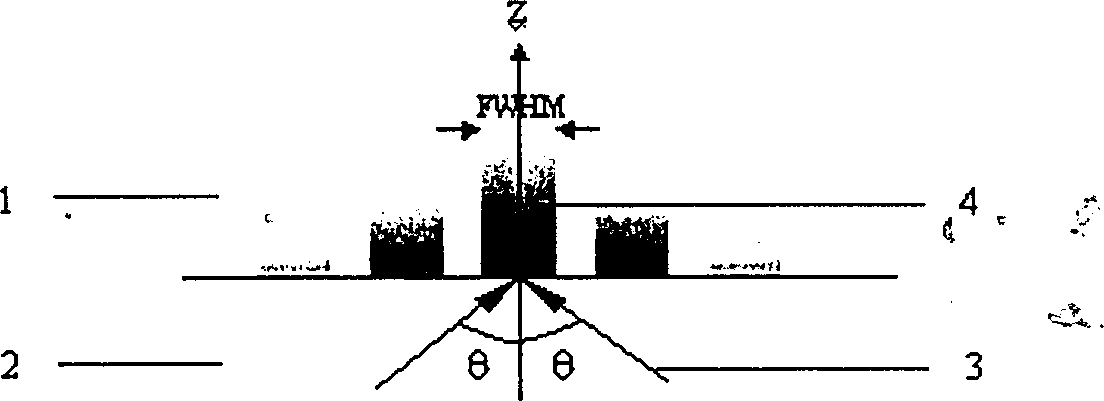
Figure 1 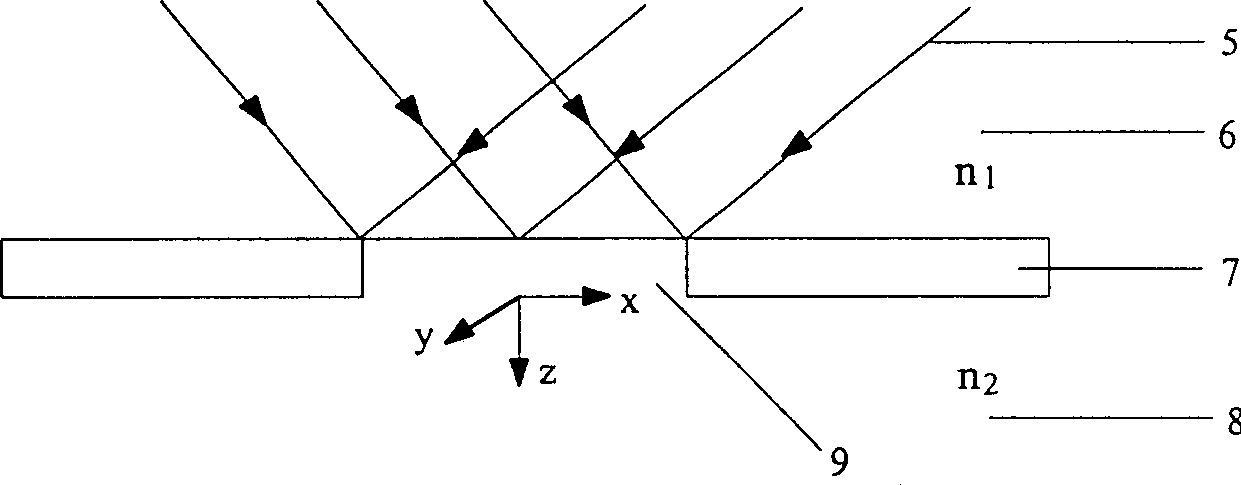
Figure 2 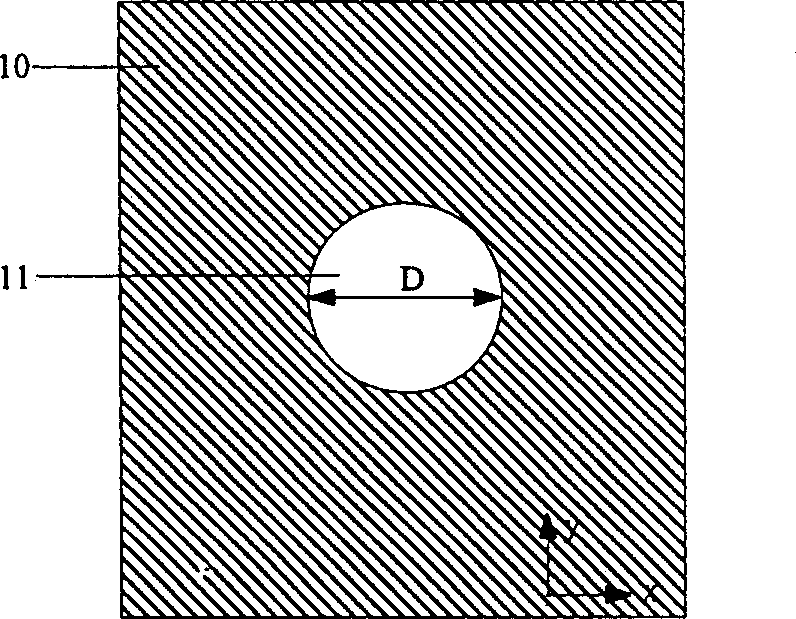
Figure 3
Abstract
Description
Technical field
[0001] The invention belongs to the technical fields of near-field optics and nano-optics, and particularly relates to the design of a constrained light field formed by the interference superposition of an evanescent field and a nano-scale near-field optical virtual optical probe. Background technique
[0002] Obtaining nano-scale light sources is one of the key technologies in near-field optical imaging, detection, nanolithography, and near-field optical storage systems. Metal-coated fiber probes with nano-aperture have been widely used in the past ten years. However, the light-passing efficiency of fiber probes is very low, usually 10 -4 ~10 -6 . Later, in the field of near-field optical imaging and near-field optical storage, the use of solid immersion lenses (Solid Immersion Lens, SIL) greatly improved the light transmission efficiency. However, this method and the fiber probe have a common disadvantage that the distance between the bottom surface of the SIL o...
Examples
Embodiment 1
[0026]Embodiment 1 is a near-field optical virtual optical probe system using isosceles right-angled triangular prisms, and its principle structure is as follows Picture 10 Shown. The system is mainly composed of Picture 10 The illustrated isosceles right-angled triangular prism 13 placed in the air 15 and a square aperture diaphragm 14 located at the interface between the prism and the air. The two acute angles θ of the isosceles right-angled triangular prism are both 45 degrees, the length of the hypotenuse is 1 cm, and the thickness of the prism is 0.7 cm. The prism material uses K9 glass with a refractive index n=1.5163. A silver film with a thickness of 100 nm is plated on the inclined surface of the prism, and a square hole 16 is opened in the center of the film layer, that is, a square aperture diaphragm 14 is formed. Its cross-sectional view is as Picture 11 As shown, 17 is a metal film, 18 is a square small hole, and its length L and width H are both 1.5 μm. When two p...
Embodiment 2
[0027] Embodiment 2 is a near-field optical virtual optical probe system using a hemispherical solid immersion lens, and its principle structure is as follows Picture 12 Shown. The system is mainly composed of Picture 12 The illustrated annular diaphragm 21, focusing objective lens 22, hemispherical solid immersion lens (SIL) 23 and square aperture diaphragm 24 are composed. The hemispherical solid immersion lens is made of ZF6 glass with a refractive index of 1.8, and its radius is 1mm. A gold film with a thickness of 150 nm is plated on the bottom surface of the solid immersion lens, and a square hole 25 is opened in the center of the film layer, that is, a square aperture diaphragm 24 is formed. Its cross-sectional view is as Figure 13 As shown, 29 is a metal film, and 30 is a square small hole, the length L and width H of which are both 1.5 μm. The annular diaphragm 21 is placed in front of the focusing objective lens, and the circular light blocking part 20 at the center t...