
Optical camera lens
A camera lens, optical technology, applied in optics, optical components, instruments, etc., can solve the problem of autofocus and miniaturization being difficult to take into account at the same time
Patent Information
- Authority / Receiving Office
- CN · China
- Current Assignee / Owner
- Publication Date
- 2022-04-29
Smart Images
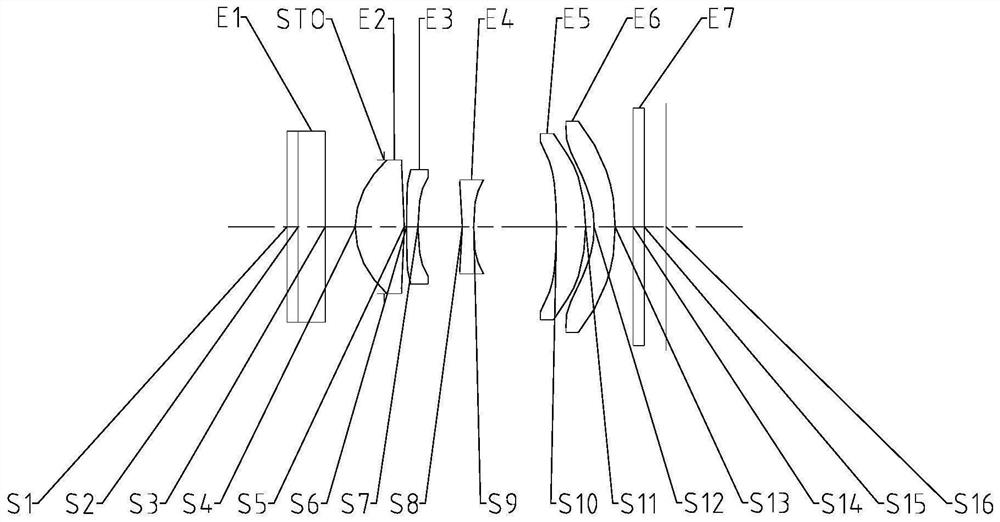
Figure 1 
Figure 2 
Figure 3
Abstract
Description
technical field
[0001] The present invention relates to the technical field of optical imaging equipment, in particular to an optical camera lens. Background technique
[0002] With the development of science and technology, the optical camera lens continues to progress in the direction of miniaturization. There are various types of optical camera lenses. Take the auto focus AF lens as an example. In the AF lens, it needs to rely on the focus motor to focus. The stroke of the motor focus increases with the increase of the focus distance. Leave a larger focus space, which is not conducive to the miniaturization of the lens.
[0003] That is to say, the optical camera lens in the prior art has the problem that it is difficult to balance autofocus and miniaturization at the same time. Contents of the invention
[0004] The main purpose of the present invention is to provide an optical camera lens to solve the problem that the optical camera lens in the prior art is difficul...
Examples
Embodiment 1
[0066] Such as Figure 1 to Figure 47 As shown, the optical camera lens includes a first lens with continuously variable refractive power, a second lens with positive refractive power, and a third lens with negative refractive power along the optical axis from the light incident side to the light output side. , a fourth lens with power, a fifth lens with power and a sixth lens with power; the first lens is a liquid lens; the surface of the second lens toward the exit side is a convex surface; the fifth lens The surface facing the incident side is a concave surface; wherein, the air gap T34 between the third lens and the fourth lens on the optical axis and the central thickness CT3 of the third lens on the optical axis satisfy: 3.5<T34 / CT3<5.0.
[0067] Preferably, 3.6
[0068] By effectively distributing the focal power and surface shape of each lens, it is conducive to the smooth transition of light, and at the same time, it is beneficial to improve the resoluti...
Embodiment 2
[0085] Such as Figure 1 to Figure 47 As shown, the optical camera lens includes a first lens with continuously variable refractive power, a second lens with positive refractive power, and a third lens with negative refractive power along the optical axis from the light incident side to the light output side. , a fourth lens with power, a fifth lens with power and a sixth lens with power; the first lens is a liquid lens; the surface of the second lens toward the exit side is a convex surface; the fifth lens The surface facing the incident side is a concave surface; wherein, the effective focal length f of the optical camera lens and the entrance pupil diameter EPD of the optical camera lens satisfy: 2.5<f / EPD<3.0.
[0086] Preferably, 2.5
[0087] By effectively distributing the focal power and surface shape of each lens, it is conducive to the smooth transition of light, and at the same time, it is beneficial to improve the resolution capability of the optical cam...