
Spunlace non-woven fabric, composite non-woven fabric and sanitary absorption product
A spunlace non-woven fabric and non-woven fabric technology, applied in the field of fiber products, can solve the problems of easy delamination, high cost, and poor bulkiness
Patent Information
- Authority / Receiving Office
- CN · China
- Patent Type
- Applications(China)
- Current Assignee / Owner
- Publication Date
- 2022-05-13
Smart Images

Figure 1 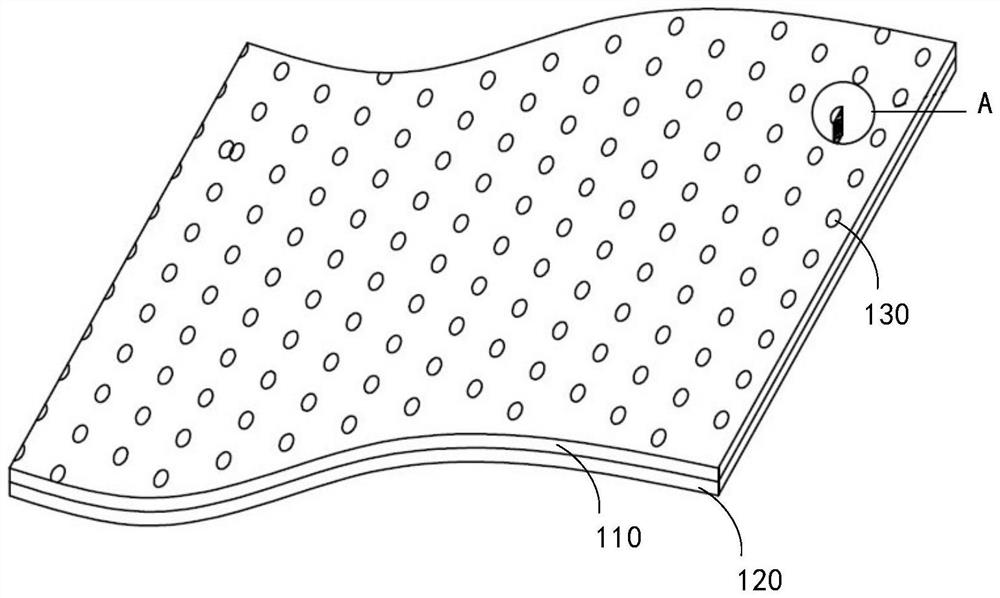
Figure 2 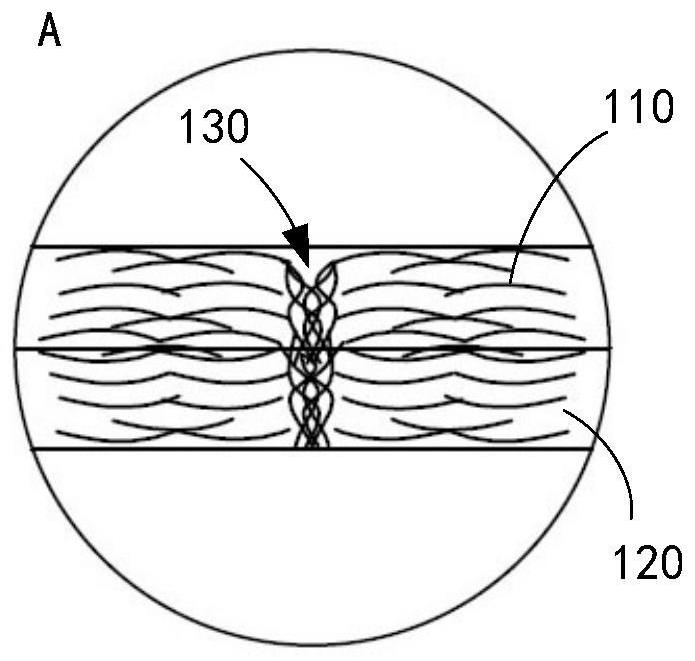
Figure 3
Abstract
Description
technical field
[0001] The application relates to the technical field of fiber products, in particular to a spunlace nonwoven fabric, a composite nonwoven fabric and a hygienic absorbent product. Background technique
[0002] With the development of hygienic absorbent products, people have higher and higher requirements on the wearing comfort of hygienic absorbent products.
[0003] Spunlace non-woven fabric is to spray high-pressure fine water onto one or more layers of fiber nets to entangle the fibers together, so that the fiber nets can be reinforced and have a certain strength. The obtained fabric is spunlace non-woven fabric ( Splunlace Non-woven). The fiber raw materials of spunlace non-woven fabrics come from a wide range of sources, such as cotton fiber, polyester, nylon, polypropylene fiber, viscose fiber, chitin fiber, microfiber, tencel, silk, bamboo fiber, wood pulp fiber, seaweed fiber, etc. Cotton fibers are widely used as non-woven materials in spunlace non...
Examples
Embodiment 1
[0066] This example provides a method for preparing pure cotton fiber and bicomponent short fiber spunlace nonwoven fabric.
[0067] Such as figure 1 As shown, the upper surface fiber layer 110 is a 100% bleached absorbent cotton fiber layer. As a preference, the pure cotton fiber is selected from Xinjiang cotton, European cotton, Australian cotton or American cotton, and the pure cotton fiber is opened, mixed, After carding, the web is laid and formed. The carding method of the fiber layer 110 on the upper surface is to use continuously arranged cover plates to card the fibers, and the number of cover plates (carding units) is 25-40. The fiber length of cotton fiber is 33mm-39mm, and the fineness of cotton fiber is 1.1dtex-1.4dtex.
[0068] The lower surface fiber layer 120 is formed by using about 100% bi-component short fibers, preferably: the bi-component short fibers are selected from sheath-core type composite fibers, the skin layer is PE (melting point is 126~129 ° C)...
Embodiment 2
[0077] This example provides a method for preparing a spunlace nonwoven fabric containing cotton fibers and bicomponent short fibers.
[0078] Such as figure 1 As shown, the upper surface fiber layer is 100% bleached absorbent cotton fiber layer, as preferably, the cotton fiber is selected from Xinjiang cotton, European cotton, Australian cotton or American cotton, and the cotton fiber is laid after opening, mixing and carding. Web forming.
[0079] The lower surface fiber layer is formed by blending about 20% of the bleached absorbent cotton fiber and about 80% of the two-component staple fiber, preferably: the cotton fiber is selected from Xinjiang cotton, European cotton, Australian cotton or American cotton ; As a preference: the bicomponent short fiber is selected from sheath-core type composite fiber, the cortex is PE (melting point is 126~129 ℃), the core layer is PP (melting point is 163~170 ℃), fiber fineness is 2.5D, fiber length The fiber is 38mm, the number of cr...
Embodiment 3
[0083] This embodiment provides a double-layer composite non-woven fabric, such as Figure 4 shown.
[0084] The first layer of the double-layer composite non-woven fabric is selected from the spunlace non-woven fabric of Example 1.
[0085] The second layer of the double-layer composite non-woven fabric is made of hot-air non-woven fabric, which is made of 100% bi-component short fibers through opening, mixing, carding, hot-air reinforcement, ironing, and winding. , as a preference: bi-component short fibers are selected from sheath-core composite fibers, the skin layer is PE (melting point is 126-129°C), the core layer is PP (melting point is 163-170°C), the fiber fineness is 4.0D, and the fiber length The fiber is 51mm, the oil content is 0.45%, the number of crimps is 18 / inch, the fiber is weak acid fiber, and the basis weight of the hot-air non-woven fabric is 18g / m 2 .
[0086] The double-layer composite non-woven fabric is made by spunlace non-woven fabric through rh...