
High-dielectric composite material containing carbon nanotube and its prepn process
A technology of carbon nanotubes and composite materials, which is applied in the field of high dielectric materials, can solve the problems of lack of toughness, limited use, and low flexibility of materials, and achieve the effects of good material toughness, lower molding temperature, and simple preparation process
Patent Information
- Authority / Receiving Office
- CN · China
- Current Assignee / Owner
- Publication Date
- 2003-07-30
- Estimated Expiration
- Not applicable · inactive patent
Smart Images
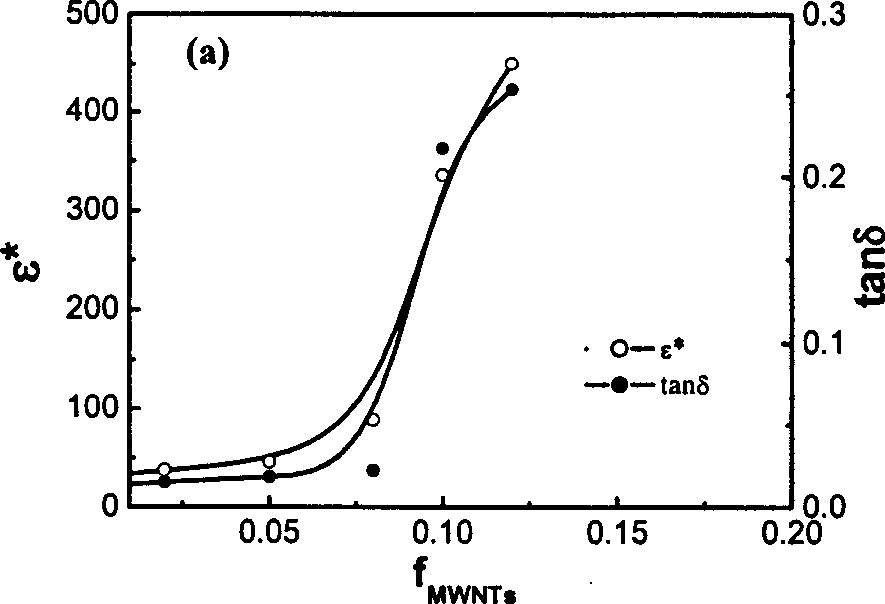
Figure 1 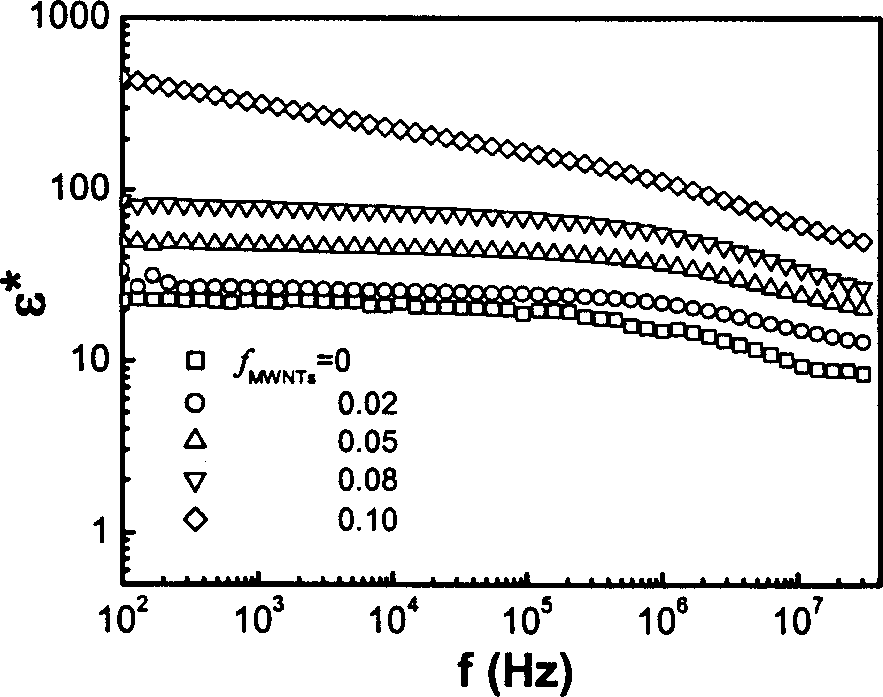
Figure 2 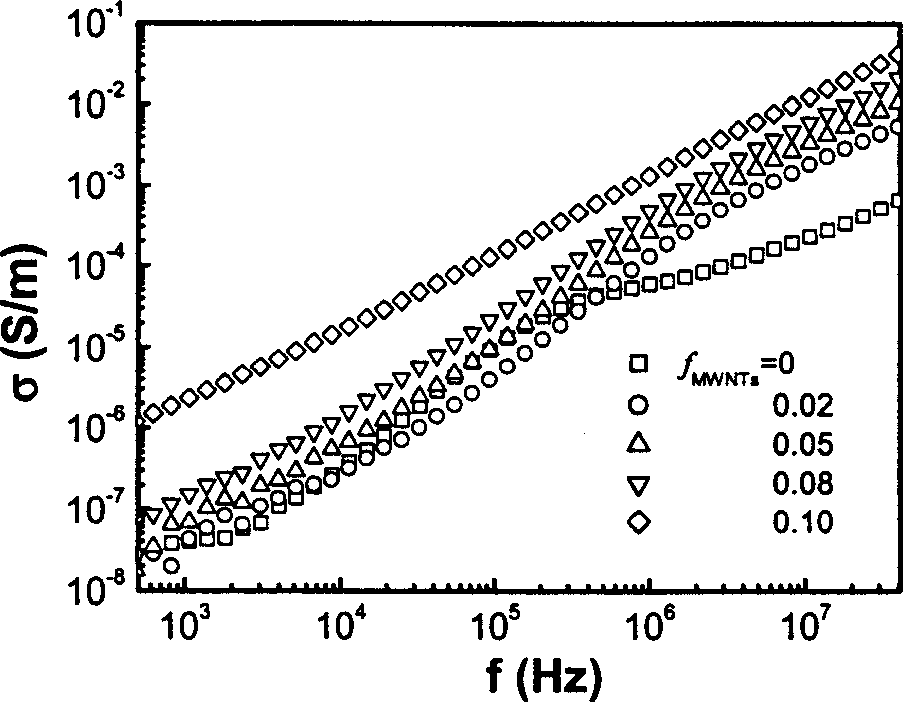
Figure 3
Abstract
Description
technical field
[0001] The invention relates to a high dielectric constant composite material containing carbon nanotubes and a preparation method thereof. It belongs to the technical field of high dielectric materials. Background technique
[0002] High dielectric composite materials are widely used in electronics and power engineering technology. Surface Mount Components (SMC) or overall packaging technology is the key technology to realize the miniaturization, light weight and thinning of electronic machines: the overall packaging technology requires the use of embedded capacitors, and the capacitor dielectric material must have a high dielectric constant. At present, the surface mount capacitors used are basically multilayer ceramic dielectric capacitors (MLCC). Although the inorganic ceramic capacitor material has a very high dielectric constant, the ceramic capacitor needs to be co-fired with the electrode at high temperature, and the process is complicated and consum...
Examples
Embodiment 1
[0026] Example 1 A1-A5
[0027] Different CNT according to the ratio of A1-A5 in Table 1 and 20vol.%, 0.5852 grams of BaTiO 3 , the three are fully mixed evenly, and hot-pressed on a hot press at 200°C (pressure 10MPa, time 20min) to form a series of samples, which are as follows: figure 1 The characteristic curves of the shown dielectric properties and dielectric loss, and the relationship curves of the dielectric constant (a) and conductivity (b) in Fig. 2 with the experimental frequency.
Embodiment 2
[0028] Example 2 A1-A5
[0029] The dielectric properties of the samples prepared in Example 1 as a function of the experimental temperature are shown in Figure 3. SEM of pristine carbon nanotubes as Figure 4 shown. The SEM morphology of the cross-section of the composite sample containing carbon nanotubes is as follows: Figure 5 shown.
[0030] Table 1 Ingredient formula
[0031] PVDF CNT