
T cell differentiation and function regulation by decreasing let7 expression
a technology of let7 and differentiation, applied in the field of t cell differentiation and function regulation by decreasing let7 expression, can solve the problems of severe defects, aberrant proliferation, differentiation, function, global regulation of these processes is not yet fully understood, etc., and achieves the effects of reducing let7 expression, improving cancer immunotherapies, and increasing cytotoxic activity of ctls
Patent Information
- Authority / Receiving Office
- US · United States
- Patent Type
- Patents(United States)
- Current Assignee / Owner
- Publication Date
- 2022-07-19
Smart Images
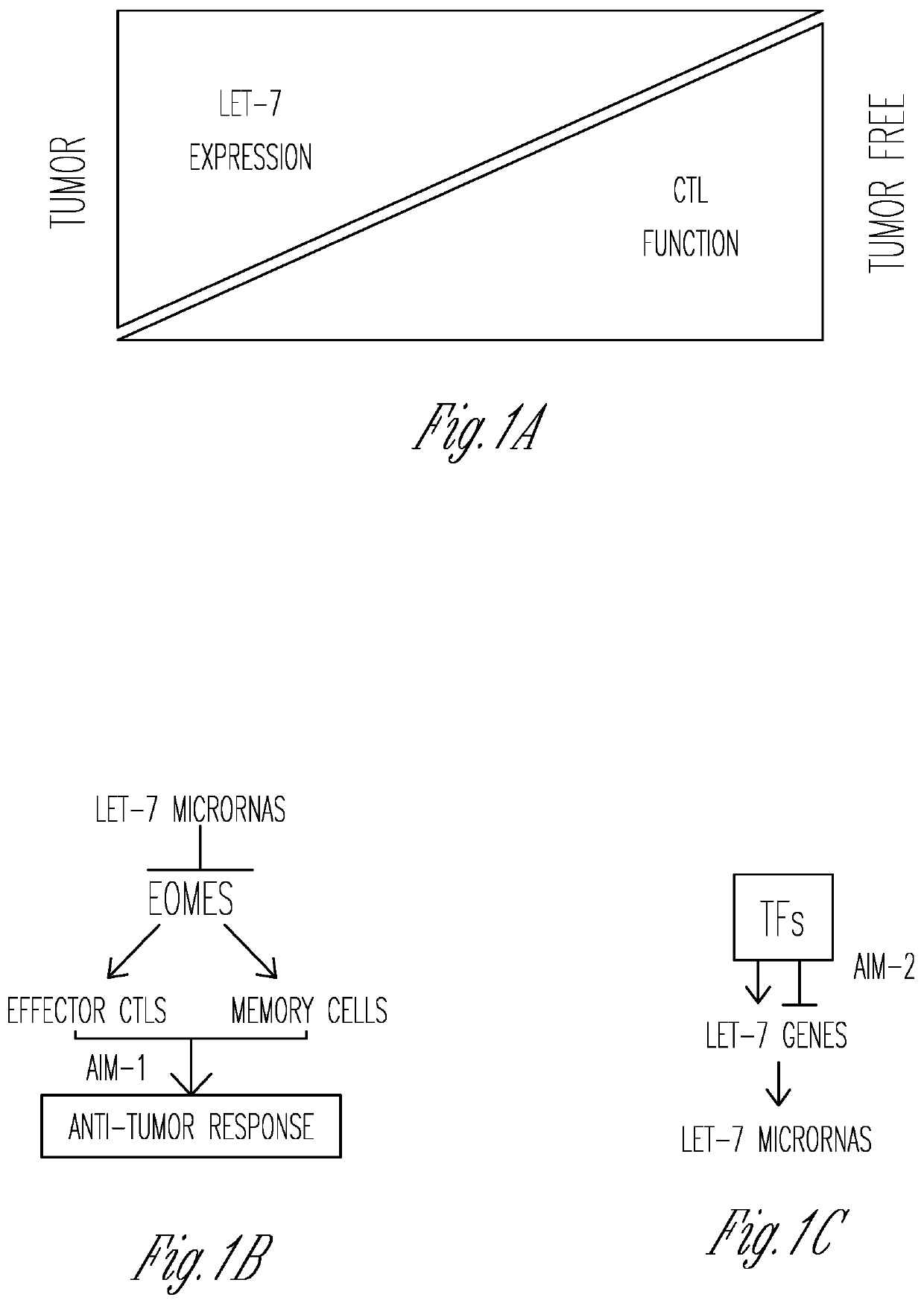
Figure 1 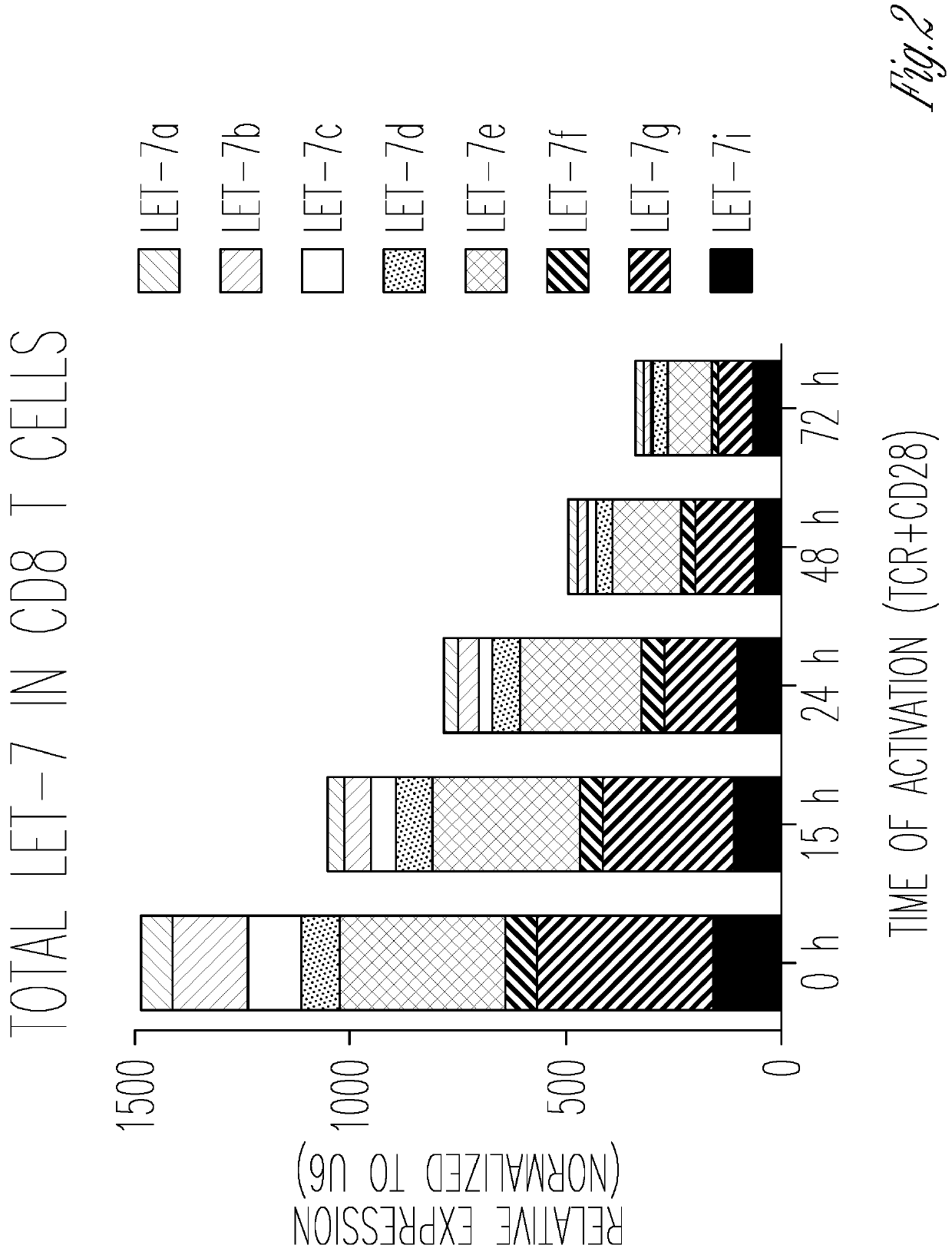
Figure 2 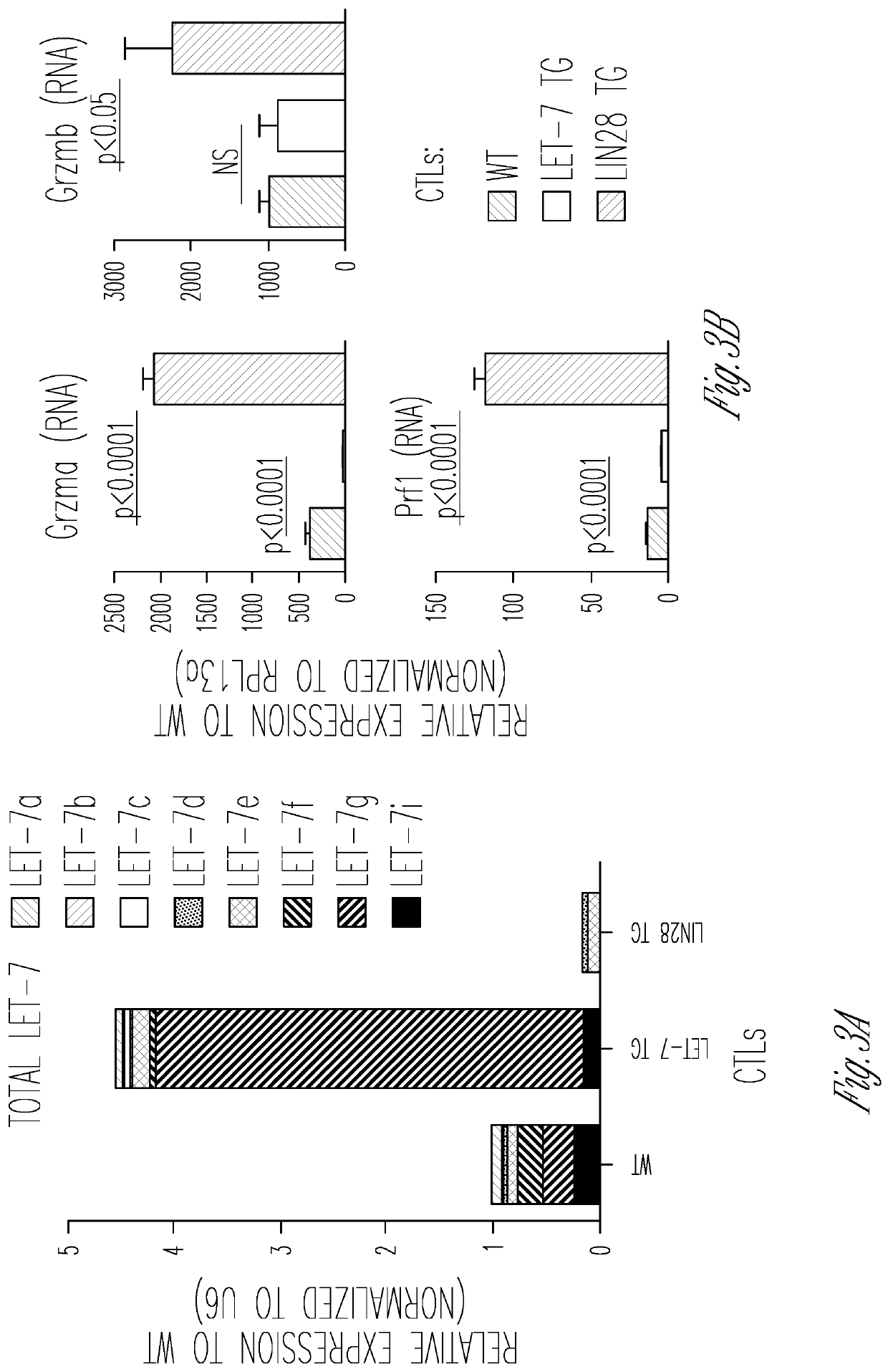
Figure 3
Abstract
Description
CROSS-REFERENCE TO RELATED APPLICATION
[0001] This application is a U.S. National Stage Filing under 35 U.S.C. 371 from International Application No. PCT / US2017 / 030657, filed on May 2, 2017, and published as WO 2017 / 192601, which claims the benefit of priority to U.S. Provisional Patent Application No. 62 / 330,668, filed on May 2, 2016. Both applications are incorporated herein by reference in their entireties.BACKGROUND OF THE INVENTION
[0002] The immune system provides the only known intrinsic mechanism that eliminates malignant cells from an organism. Cytotoxic CD8+ T Lymphocytes (CTLs), aided by T-helper cells, are the most potent killer-cells among all immuno-competent cell types involved in anti-tumor responses. Unfortunately, CTL-mediated immuno-surveillance is far from perfect. Malignant cells often escape the immune response by acquiring immunosuppressive properties or generating an immunosuppressive environment, making tumor-derived antigens less immunogenic than they might oth...
Examples
example 1
[0109]It was found that let-7 is the most abundantly expressed family of microRNAs in T lymphocytes (3) and is reduced in differentiating T cells (FIG. 2). These data suggest that a functional reduction of let-7 plays a role in the differentiation and function of effector T cells. In line with other published results (15), the data herein suggest that let-7 is a “master regulator” of T cell responses (including both T-helpers and CTLs) where a reduction of let-7 results in enhanced effector function, and overexpression diminishes the ability to respond.
[0110]Tools for Manipulation of Let-7 Levels.
[0111]Mice were generated with T cell-specific expression of the Lin28 protein, which selectively blocks let-7 microRNA biogenesis (3, 16-19). Lin28 protein binds to the extended loop region of let-7 precursor molecules and prevents them from being processed into functional mature microRNAs. Also, a doxycycline-inducible let-7 transgenic mouse line was generated to overexpress a single memb...
example 2
roRNA Expression can Control CTL-Mediated Anti-Tumor Responses
[0117]Genetic tools have been developed that allowed the investigation of the role of let-7 microRNAs in tumor-specific CTLs in vitro and in vivo. Based on the results demonstrating that let-7 microRNAs profoundly suppress the differentiation of CTLs, it is believed that let-7-deficient T cells differentiate into enhanced tumor-specific CTLs (FIG. 1B). To test this, mouse tumor models will be used to address the role of let-7 microRNAs in CTLs during anti-tumor responses in vivo. Specifically, the impact of the tumor immunosuppressive environment on let-7 regulated CTL functions with and without the synergistic effect of immune blockade therapy will be investigated. Furthermore, the role of let-7 in the generation of anti-tumor memory T cells will be investigated.
[0118]In vitro experiments (see above) have demonstrated that let-7 deficient CTLs have superior cytotoxic function (FIG. 5D). Based on data presented herein, it...
example 3
n of Let-7 miRNAs Controls the Differentiation of Effector CD8 T Cells Through Regulation of Myc and Eomesodermin
Abstract
[0214]The differentiation of naïve CD8 T cells into effector cytotoxic T lymphocytes upon antigen stimulation is necessary for successful anti-viral, and anti-tumor immune responses. Herein a dual role for the let-7 microRNAs in the regulation of CD8 T cell responses is described, where maintenance of the quiescent phenotype in naïve CD8 T cells requires high levels of let-7 expression, while generation of cytotoxic T lymphocytes depends upon T cell receptor mediated let-7 downregulation. Decrease of let-7 expression in activated T cells enhances clonal expansion, metabolic reprogramming, and acquisition of effector function through derepression of the let-7 targets, Myc and Eomesodermin. Ultimately, let-7 microRNAs has been identified as a novel molecular transmitter of TCR signaling, which controls the magnitude of CD8 T cell-mediated immunity.