
Rubber cure system and rubber composition incorporating same
a cure system and rubber technology, applied in the field of cure systems for rubber compositions, can solve the problems of reducing the adhesion force of polyester cords, etc., to achieve the effect of enhancing polyester cord adhesion, and increasing peeling adhesion for
Patent Information
- Authority / Receiving Office
- US · United States
- Patent Type
- Applications(United States)
- Current Assignee / Owner
- Publication Date
- 2006-07-06
- Estimated Expiration
- Not applicable · inactive patent
Smart Images
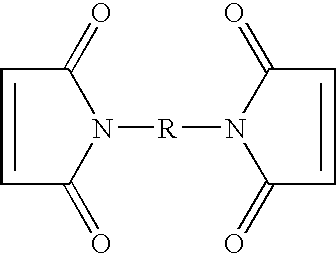
Figure 1 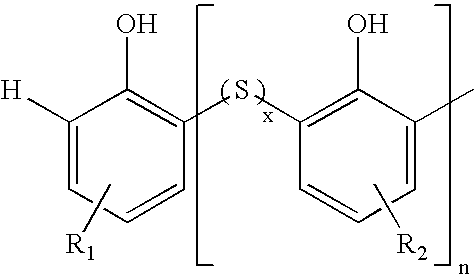
Figure 2 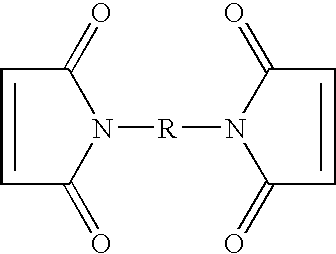
Figure 3
Abstract
Description
CROSS-REFERENCE TO RELATED APPLICATION
[0001] This patent document claims the benefit of the filing date of Provisional U.S. Patent Application No. 60 / 640,790 entitled “Amine Free Vulcanizable Rubber” and filed on Dec. 30, 2004. The entire disclosure of Provisional U.S. Patent Application No. 60 / 640,790 is incorporated into this patent document by reference.BACKGROUND OF THE INVENTION
[0002] 1. Field of the Invention
[0003] This invention is directed to cure systems for rubber compositions, and to rubber compositions incorporating such cure systems.
[0004] 2. Description of Related Art
[0005] In developing rubber compositions, cure systems have been proposed that include amine-containing curative compounds. Such curative compounds typically have been used because of their good scorch protection providing processing safety and fast cure rate behavior to rubber formulations.
[0006] While amine-containing curatives may provide good processing safety and fast cure rates, they do so at t...
Examples
examples
[0015]
TABLE ICompound FormulationsControlControlControlControlSample 1Sample 2Sample 3Sample 4Sample 5Sample 6Non-ProductiveTackifier111111Polybutadiene Rubber151515151515Natural Rubber606060606060Styrene-Butadiene Rubber34.3734.3734.3734.3734.3734.37Resorcinol111111Oil999999Stearic Acid0.250.250.250.250.250.25Zinc Oxide333333Carbon Black (N326)606060606060ProductiveCyrez ® CRA1001.391.391.391.391.391.39Santocure ® TBBS1.2Santocure ® TBSI0.841.2Perkacit ® MBTS0.35222HVA-211Vultac ® 711Sulfur2.22.22.22.21.252.2
Perkacit ® MBTS = Benzothiazole disulfide (Flexsys)
Cyrez ® CRA100 = dry liquid concentrate hexamethoxymethylmelamine (HMMM) on a free flowing silica carrier (Cytec)
HVA-2 = N,N′-m-Phenylenedimaleimide (Dupont)
Santocure ® TBSI = N-t-butyl-2-benzothiazole sulfenimide (Flexsys)
Vultac ® 7 = Flaked alkylphenol disulfide (Atofina / Sovereign)
Santocure ® TBBS = N-t-butyl-2-benzothiazole sulfenamide (Flexsys)
[0016]
TABLE IITest ResultsControlControlControlControlSample 1Sample 2Sampl...