

System and method for delivering a bifurcated stent
Patent Information
- Authority / Receiving Office
- US · United States
- Current Assignee / Owner
- Publication Date
- 2006-11-02
- Estimated Expiration
- Not applicable · inactive patent
Smart Images
Figure 1 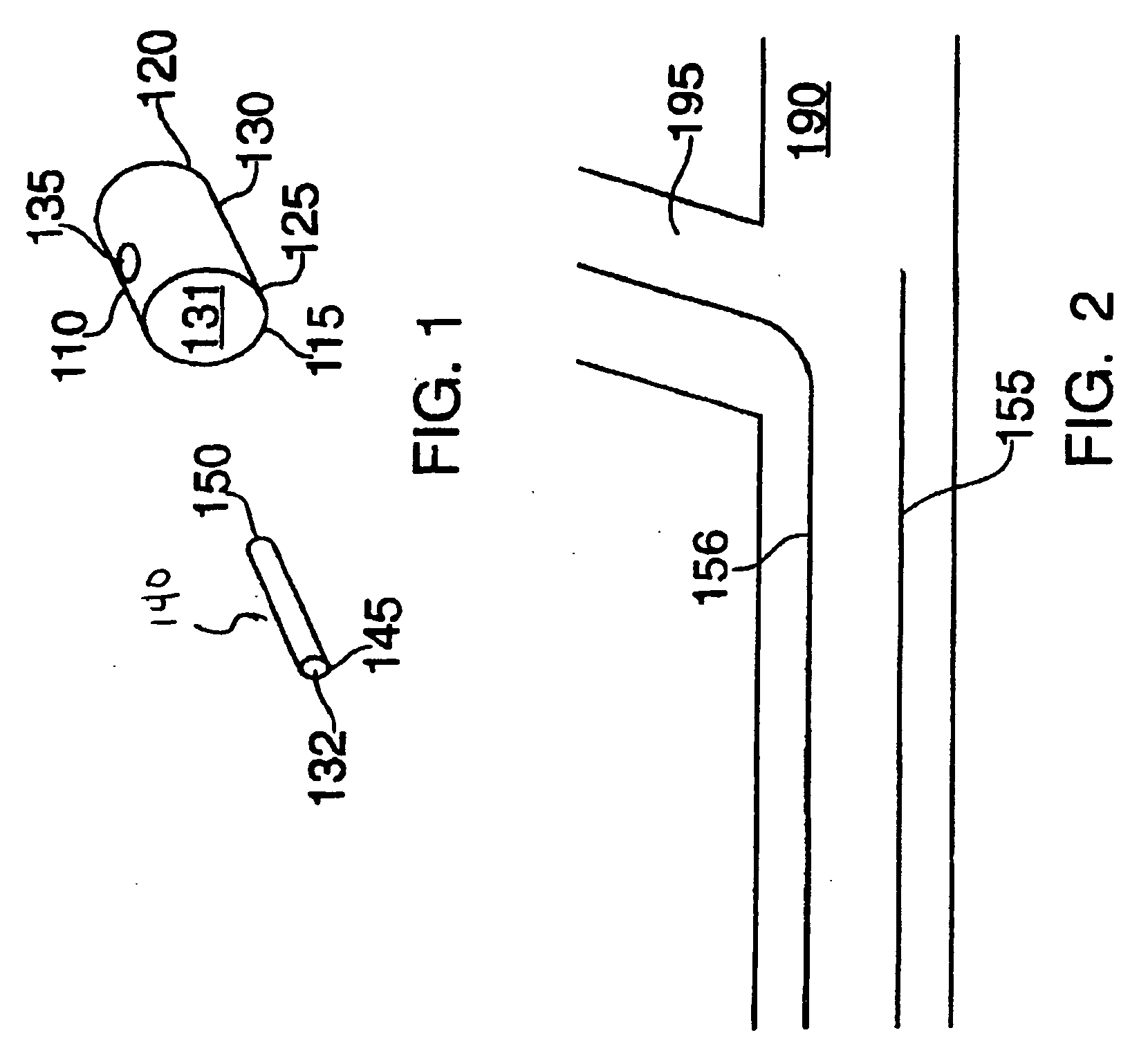
Figure 2 
Figure 3
Abstract
Description
CROSS-REFERENCE TO RELATED APPLICATIONS
[0001] This application is a continuation-in-part of application Ser. No. 11 / 339,317, filed Jan. 24, 2006, which is a continuation of application Ser. No. 10 / 066,755, filed Feb. 6, 2002, now U.S. Pat. No. 6,989,026, which is a division of application Ser. No. 09 / 575,957 filed May 23, 2000, now U.S. Pat. No. 6,440.165, which is a continuation-in-part of application Ser. No. 09 / 072,846, filed May 5, 1998, now U.S. Pat. No. 6,251,133, which is a continuation-in-part of application Ser. No. 09 / 049,842, filed Mar. 27, 1998, now U.S. Pat. No. 6,090,133, which is continuation of application Ser. No. 08 / 840,612, filed on Apr. 29, 1997, now U.S. Pat. No. 5,755,734, which is a division of application Ser. No. 08 / 642,297, filed May 3, 1996, now abandoned.FIELD OF THE INVENTION
[0002] The present invention relates to stents, and more particularly methods of delivering a bifurcated stent. BACKGROUND OF THE INVENTION
[0003] Stents are well known in the art....
Examples
Embodiment Construction
[0029]FIG. 1 is a general representation of one type of a stent with which the present invention may be used. The stent comprises two portions, which are deployed serially in two steps and assembled within the patient to form a bifurcated stent. FIG. 1 shows stem and first leg portion 110 provided with a longitudinal bore 131 and having a proximal end 115 defining a stem portion 125 and a distal end 120. Second leg portion 140 is provided with a longitudinal bore 132 and has a proximal end 145 and a distal end 150. Stem and first leg portion 110 and second leg portion 140 may be sized and patterned or etched as previously discussed. A branch aperture 135 is disposed between the proximal end 115 and the distal end 120 of stem and first leg portion 110. The branch aperture 135 is sized to receive second leg portion 140 and is adapted to engage and secure the second leg portion 140 when it has been expanded within the branch aperture 135. Second leg portion 140 is sized and adapted to ...