
Array speaker system
a speaker system and array technology, applied in the direction of stereophonic arrangments, transducer casings/cabinets/supports, electrical transducers, etc., can solve the problem of rapid damped high-frequency sound
Patent Information
- Authority / Receiving Office
- US · United States
- Current Assignee / Owner
- Publication Date
- 2007-02-08
Smart Images
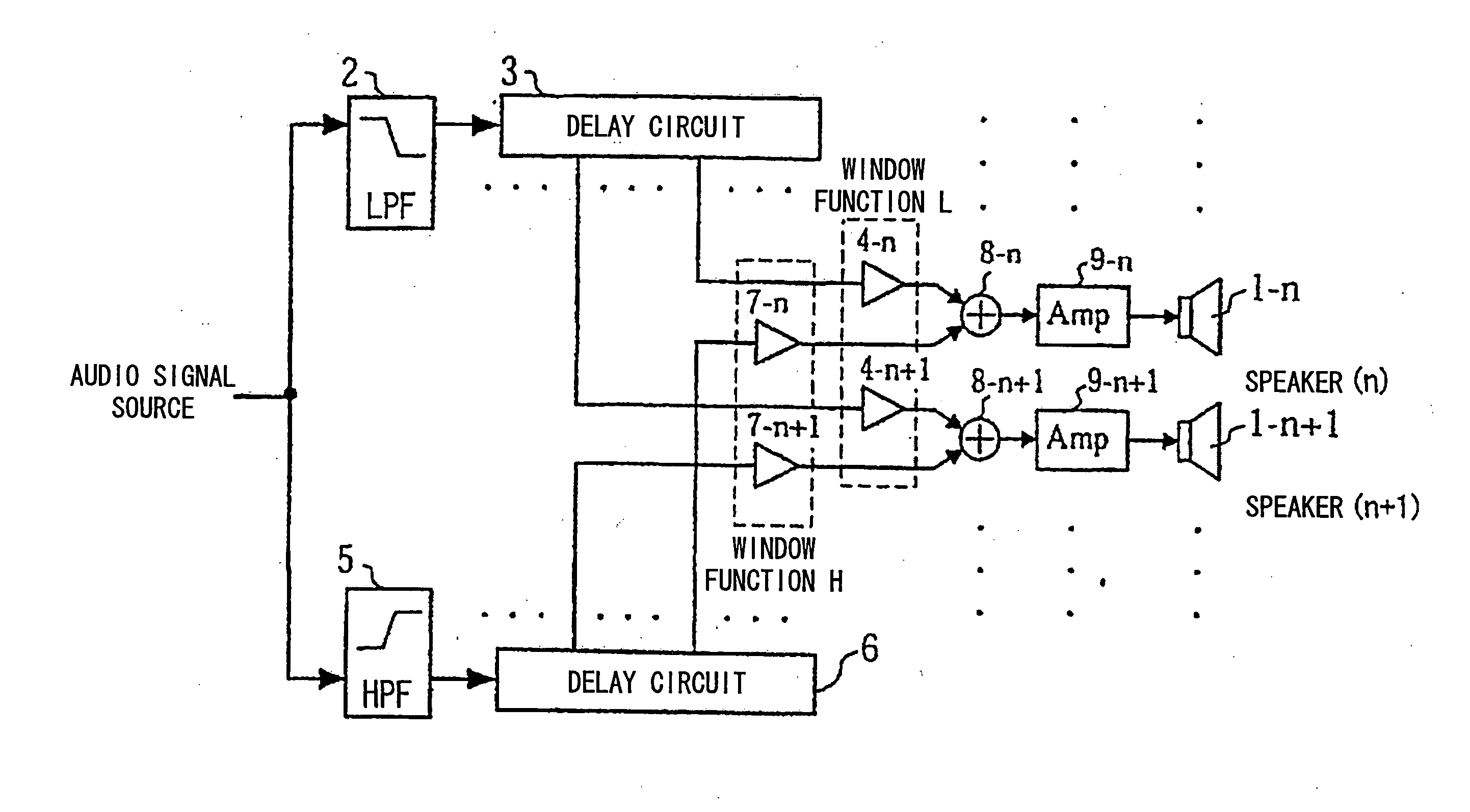
Figure 1 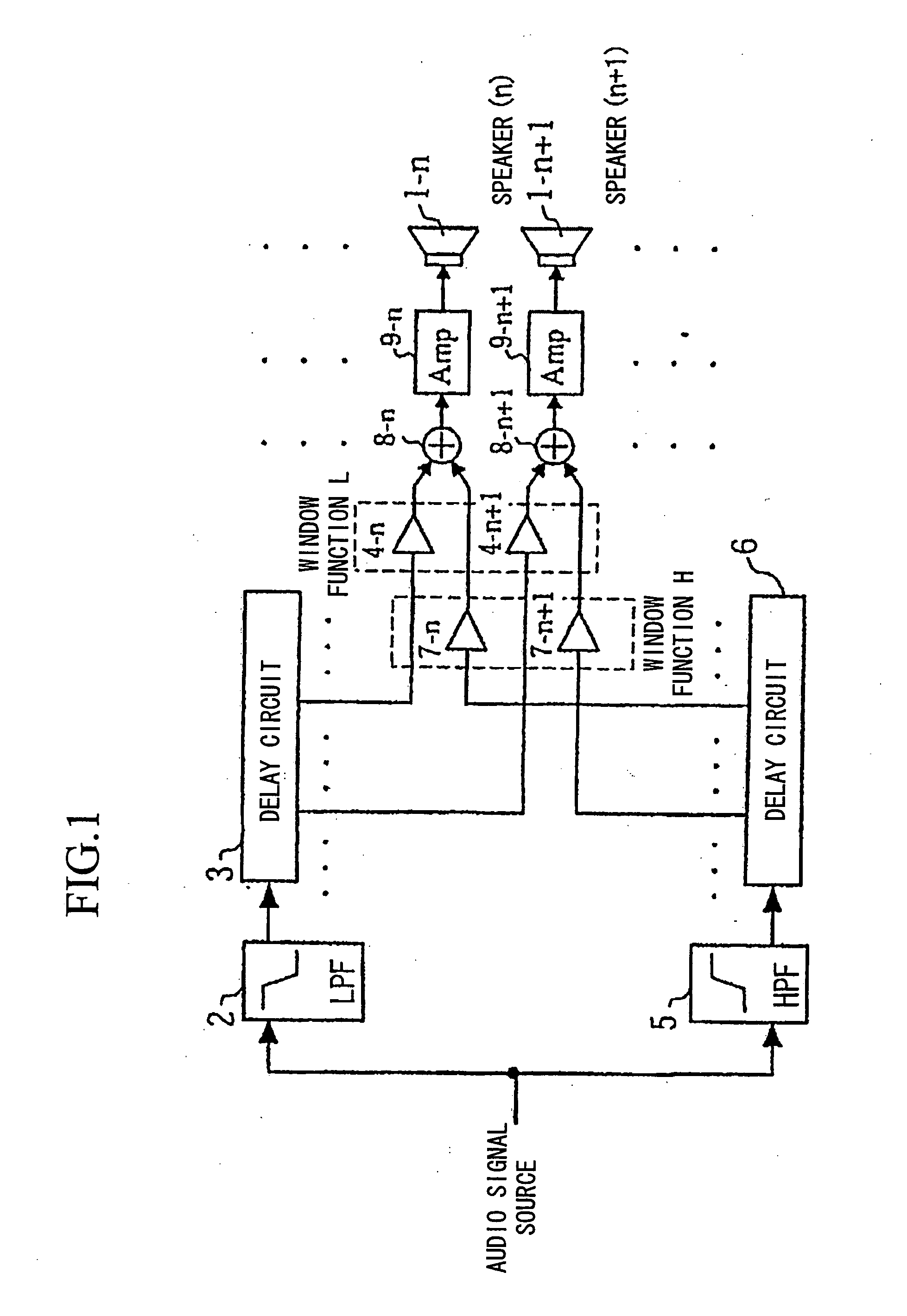
Figure 2 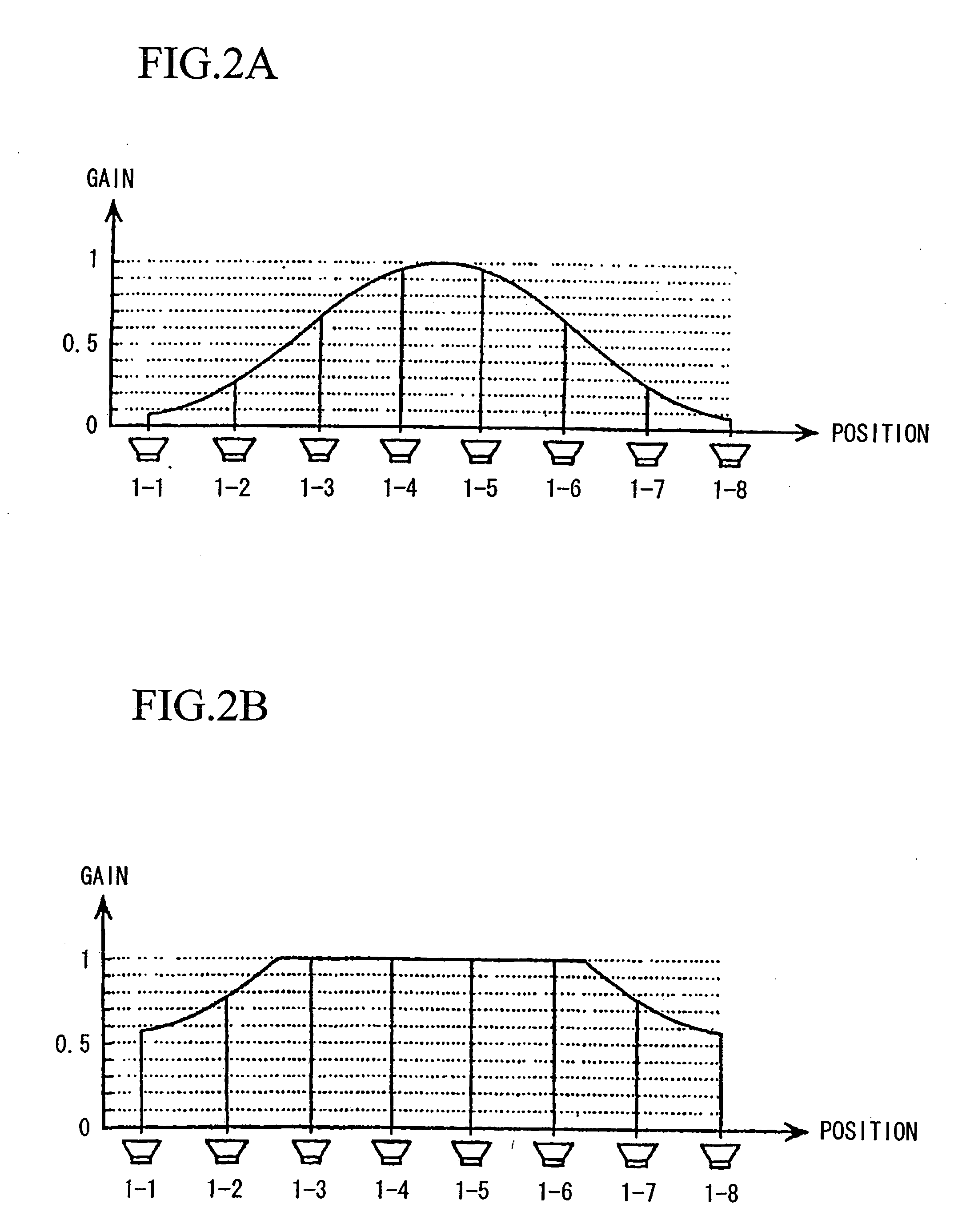
Figure 3
Abstract
Description
TECHNICAL FIELD
[0001] This invention relates to array speaker systems in which plural speaker units are arranged in an array. BACKGROUND ART
[0002] Conventionally, technologies for controlling audio signal beams (i.e., sound waves converted into beams having directivities) by use of array speakers, in which plural speaker units are regularly arranged, are known. For example, Japanese Unexamined Patent Application Publication No. H03-159500 and Japanese Unexamined Patent Application Publication No. S63-9300 disclose technologies regarding array speaker systems.
[0003] A control method for sound directivity in an array speaker will be described with reference to FIG. 7.
[0004] In FIG. 7, reference numerals sp-1 to sp-n designate speaker units that are linearly arranged with prescribed distances therebetween. In the case of generation of an audio signal beam emitted towards a focal point X, a circle Y whose radius matches a distance L from the focal point X is drawn, and delay times (...
Examples
first embodiment
[0052] The first embodiment is designed to use a Hamming window as the window function; of course, it is possible to use other window functions such as a Hanning window.
[0053] Realistically, it is difficult to perform sound directivity control in the low-frequency band whose frequency is several hundreds of hertz or less within the frequency bands of input audio signals due to the relationship between the size of the speaker and the wavelength. For this reason, it is preferable to perform gain adjustment realizing a good balance of sound pressure energy at a sweet spot by not subjecting signal components of the low-frequency band, which are separated from audio signals, to sound directivity control or by subjecting them to non-directivity.
[0054]FIG. 3 is a block diagram showing essential parts of a control circuit of an array speaker system in accordance with a second embodiment of this invention, wherein the low-frequency band whose frequency is several hundreds of hertz or less i...
second embodiment
[0056] As described above, the second embodiment is designed such that low-frequency components of signals whose frequencies are several hundreds of hertz or less and which are extracted by the LPF 12 are not subjected to delay processing for controlling sound directivities (i.e., directivities of audio signal beams) but are simply subjected to gain adjustment and are then supplied to the corresponding speaker units.
[0057] In the aforementioned second embodiment, it is possible to broaden sweet spots with a good balance of sound pressure energy in a wide range of frequencies ranging from low frequencies to high frequencies.
[0058] The aforementioned embodiments are described with respect to a one-dimensional array speaker in which plural speaker units are arrayed in a single line. Similarly, this invention can be applied to a two-dimensional array speaker in which plural speaker units are arrayed in a matrix. In this case, it is divided into one-dimensional arrays in terms of the ro...