
Tiered contention multiple access (TCMA): a method for priority-based shared channel access
a shared channel access and contention multiple technology, applied in the field of telecommunication methods, can solve the problems of preventing back-to-back re-transmission, protocol instability, and protocol also suffering from hidden terminal problems, so as to reduce the chance of collision and reduce delays
Patent Information
- Authority / Receiving Office
- US · United States
- Patent Type
- Applications(United States)
- Current Assignee / Owner
- Publication Date
- 2007-02-22
- Estimated Expiration
- Not applicable · inactive patent
Smart Images
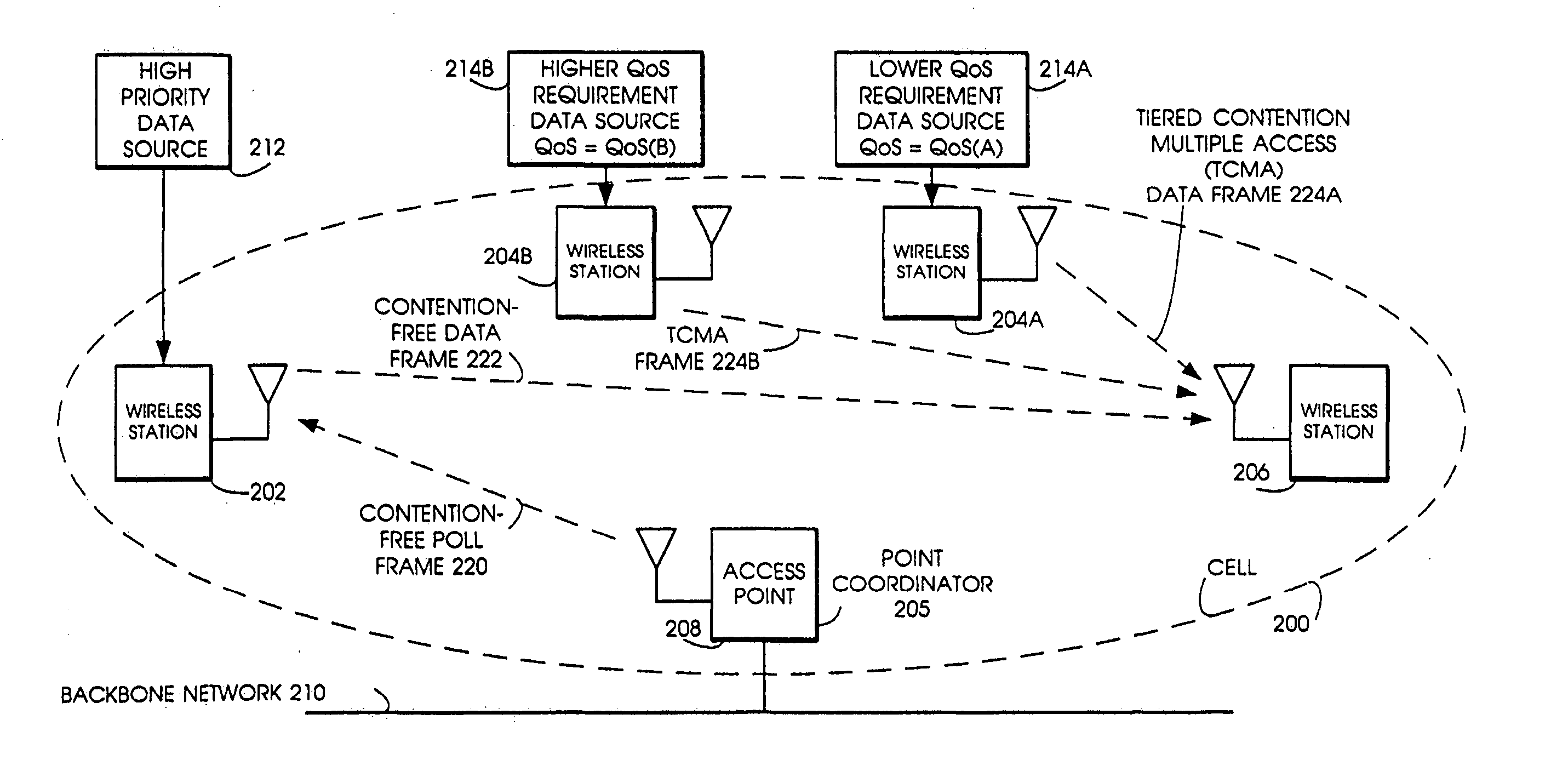
Figure 1 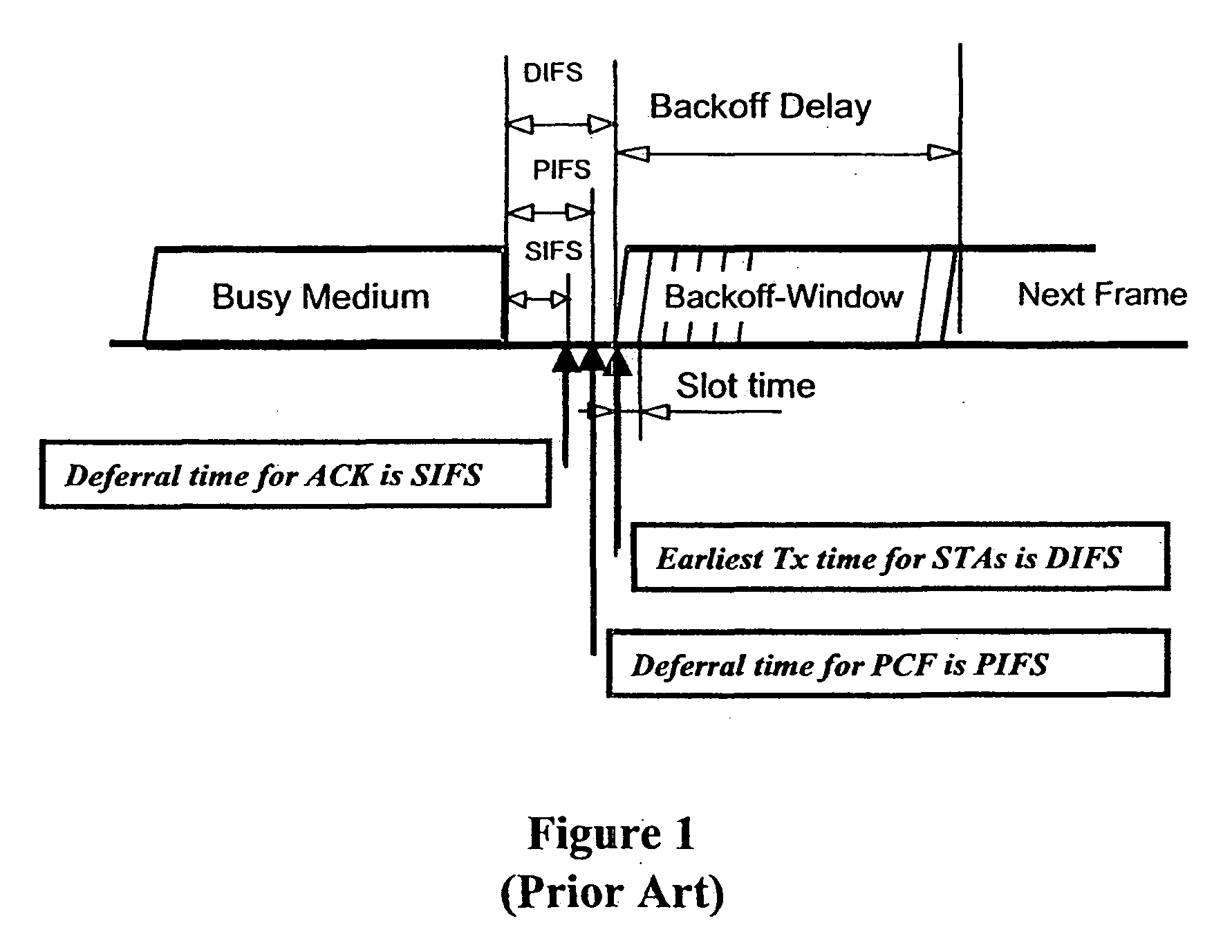
Figure 2 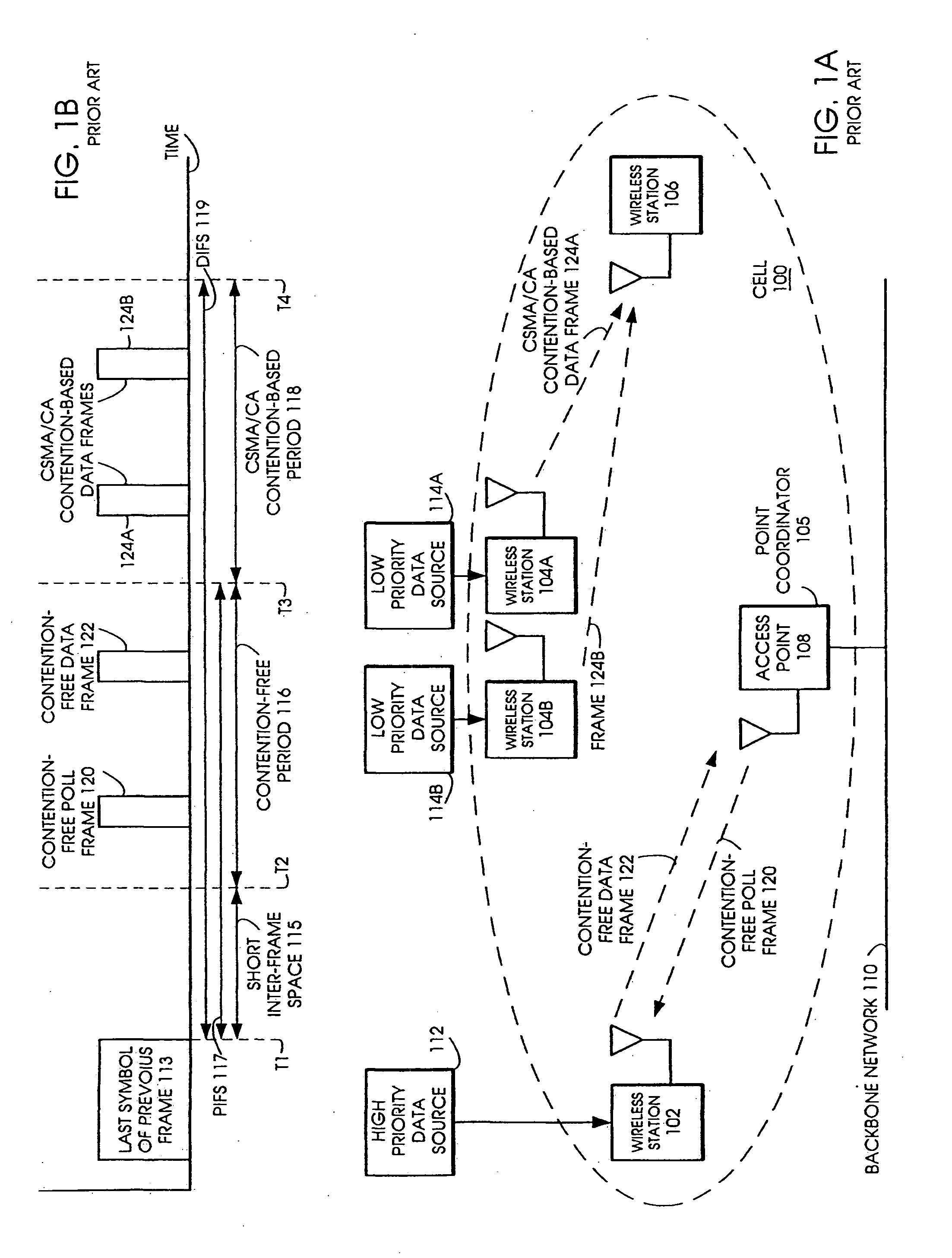
Figure 3
Abstract
Description
CROSS REFERENCE TO RELATED APPLICATIONS
[0001] This application is a continuation of copending U.S. patent application Ser. No. 09 / 985,257 filed on Nov. 2, 2001, entitled “TIERED CONTENTION MULTIPLE ACCESS (TCMA): A METHOD FOR PRIORITY-BASED SHARED CHANNEL ACCESS” (now allowed), which claims priority from U.S. Provisional Patent Application Nos. 60 / 245,186, filed Nov. 3, 2000; 60 / 249,254, filed Nov. 17, 2000; 60 / 254,544, filed Dec. 12, 2000; 60 / 256,337, filed Dec. 19, 2000; 60 / 257,983, filed Dec. 27, 2000; and 60 / 278,744, filed Mar. 27, 2001, all of which are incorporated herein by reference.FIELD OF THE INVENTION
[0002] The invention disclosed broadly relates to telecommunications methods and more particularly relates to Quality of Service (QoS) management in multiple access packet networks. BACKGROUND OF THE INVENTION
[0003] Wireless Local Area Networks (WLANs)
[0004] Wireless local area networks (WLANs) generally operate at peak speeds from 1 to 54 Mbps and have a typical range o...
Examples
example
[0244] The following example illustrates how the retrial backoff range can be adjusted to reflect traffic QoS characteristics. The rules for obtaining a new backoff range, (aLower[y],aUpper[y]), are the following: [0245] with each retrial, keep aLower[y] fixed, [0246] adjust aUpper[y] by increasing the contention window by a persistence factor pW[y] that depends on the class y, while [0247] imposing an upper bound CWmax[y]+1 on the contention window size, which is class dependent.
[0248] Consider now two classes, one receiving voice (VO) packets that require latency not exceeding 10 ms, and the other receiving video (VI) packets with a 100 ms maximum latency limit.
[0249] The following parameters are assigned to VO:
[0250] (The restriction to be no less than 1 is imposed on the lower bound of the backoff range in order to ensure backward compatibility with legacy stations.)