
Polymeric drug delivery system containing a multi-substituted aromatic moiety
Patent Information
- Authority / Receiving Office
- US · United States
- Current Assignee / Owner
- Publication Date
- 2009-01-15
- Estimated Expiration
- Not applicable · inactive patent
Smart Images
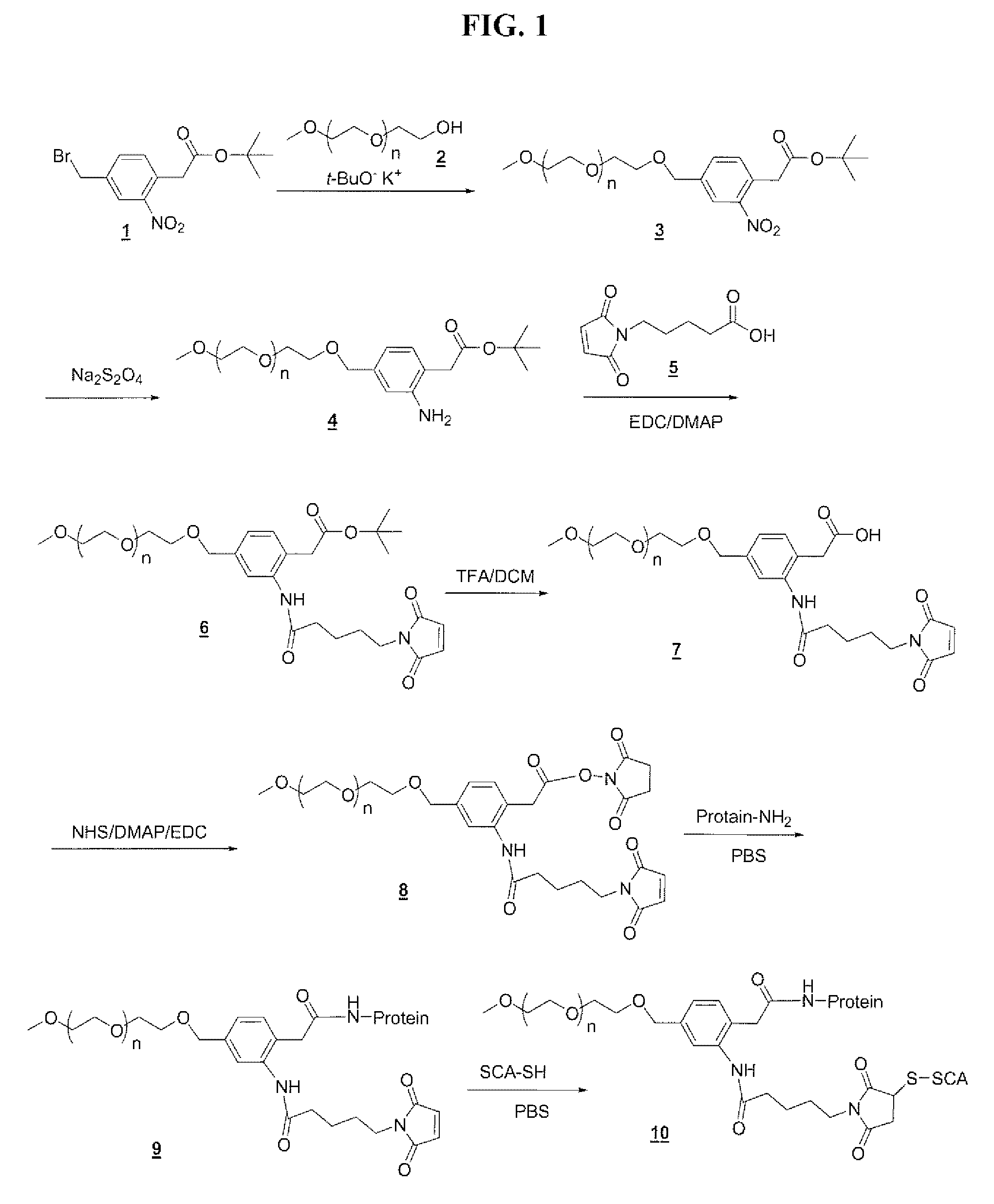
Figure 1 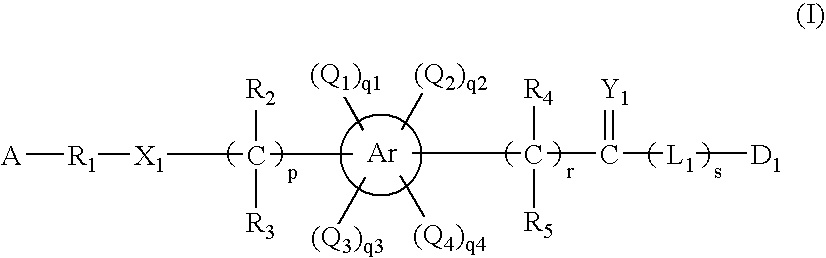
Figure 2 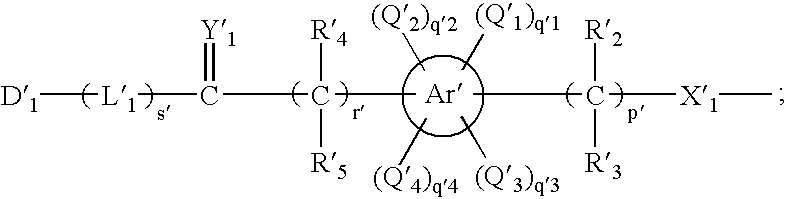
Figure 3
Abstract
Description
CROSS-REFERENCE TO RELATED APPLICATION
[0001] This application claims the benefit of priority from U.S. Provisional Patent Application Ser. No. 60 / 949,168 filed Jul. 11, 2007, the contents of which are incorporated herein by reference.FIELD OF THE INVENTION
[0002] The present invention relates to drug delivery systems. In particular, the invention relates to polymeric-based drug delivery system having a multi-substituted aromatic moiety. The aromatic moiety is conjugated to targeting groups and biologically active moieties such as therapeutic agents, enzymes, proteins and the like.BACKGROUND OF THE INVENTION
[0003] Over the years, numerous methods have been proposed for administering biologically-effective materials. Medicinal agents are quite often insoluble in aqueous fluid or rapidly degraded in vivo. For example, alkaloids are often difficult to be solubilized and proteins are often prematurely degraded upon administration into the body.
[0004] One of the attempts to solve the obstacles...
Examples
example 1
Compound 3
[0253]A solution of 5.0 g (1.0 mmole) of mPEG5K-OH (compound 2) in 130 ml of toluene is azeotroped for 2 hours, while removing 65 ml of toluene / water. This solution is cooled to 25° C., followed by addition of 2.0 ml (2.0 mmole) of 1.0 molar t-BuOK in t-butanol. This solution is stirred for 30 minutes at 25° C., followed by the addition of 30 ml of anhydrous DMF. To this reaction mixture is added dropwise, a solution of compound 1 (2.0 mmol) in anhydrous DMF. This solution is added at a rate of 10 ml per 20 min. During addition of the 4-(bromomethyl)-phenylacetic acid solution, while the pH of the reaction mixture is monitored. When the pH reaches ˜8.0, a 10 ml aliquot of 1.0 molar t-BuOK in t-butanol is added, total volume 7.0 ml over 40 minutes. The reaction mixture is then poured into 700 ml of ether, and the precipitate is collected by filtration and washed with ether. The solid is dissolved in 70 ml of 0.2N HCl solution, and extracted with methylene chloride. The com...
example 2
Compound 4
[0254]Compound 3 is suspended in a mixture of water and THF and is added Na2S2O4. The mixture is stirred overnight at room temperature. The mixture is concentrated in vacuo and the product is extracted with DCM twice. The organic layers are combined and dried over anhydrous Na2SO4, filtered, and concentrated to a minimum volume. Anhydrous ether is added to the residual solution to precipitate the product, which is collected by vacuum filtration and dried in the vacuum oven at 45° C. to give the product.
example 3
Compound 6
[0255]A solution of compound 4 (1.72 mmol), compound 5 (0.80 g, 6.9 mmol), DIEA (1.3 g, 10.3 mmol), and DMAP (50 mg, 0.4 mmol) in 75 ml of dry methylene chloride is cooled to 0° C. in an ice bath, followed by addition of EDC hydrochloride (1.66 g, 8.6 mmol). This mixture is allowed to warm to room temperature overnight. The solvent is partially removed by rotovap. The product is precipitated with ether, and collected and washed with ether to give the crude product, which is dried in the vacuum oven at 45° C. to give the product.