
Vehicle power controller
a technology for power controllers and vehicles, applied in the direction of motor/generator/converter stoppers, dynamo-electric converter control, capacitor propulsion, etc., can solve the problems of changing braking feeling, and achieve the reduction of regenerative braking force, increasing charging power to secondary batteries, and reducing regenerative braking force
Patent Information
- Authority / Receiving Office
- US · United States
- Patent Type
- Applications(United States)
- Current Assignee / Owner
- Publication Date
- 2009-07-02
Smart Images
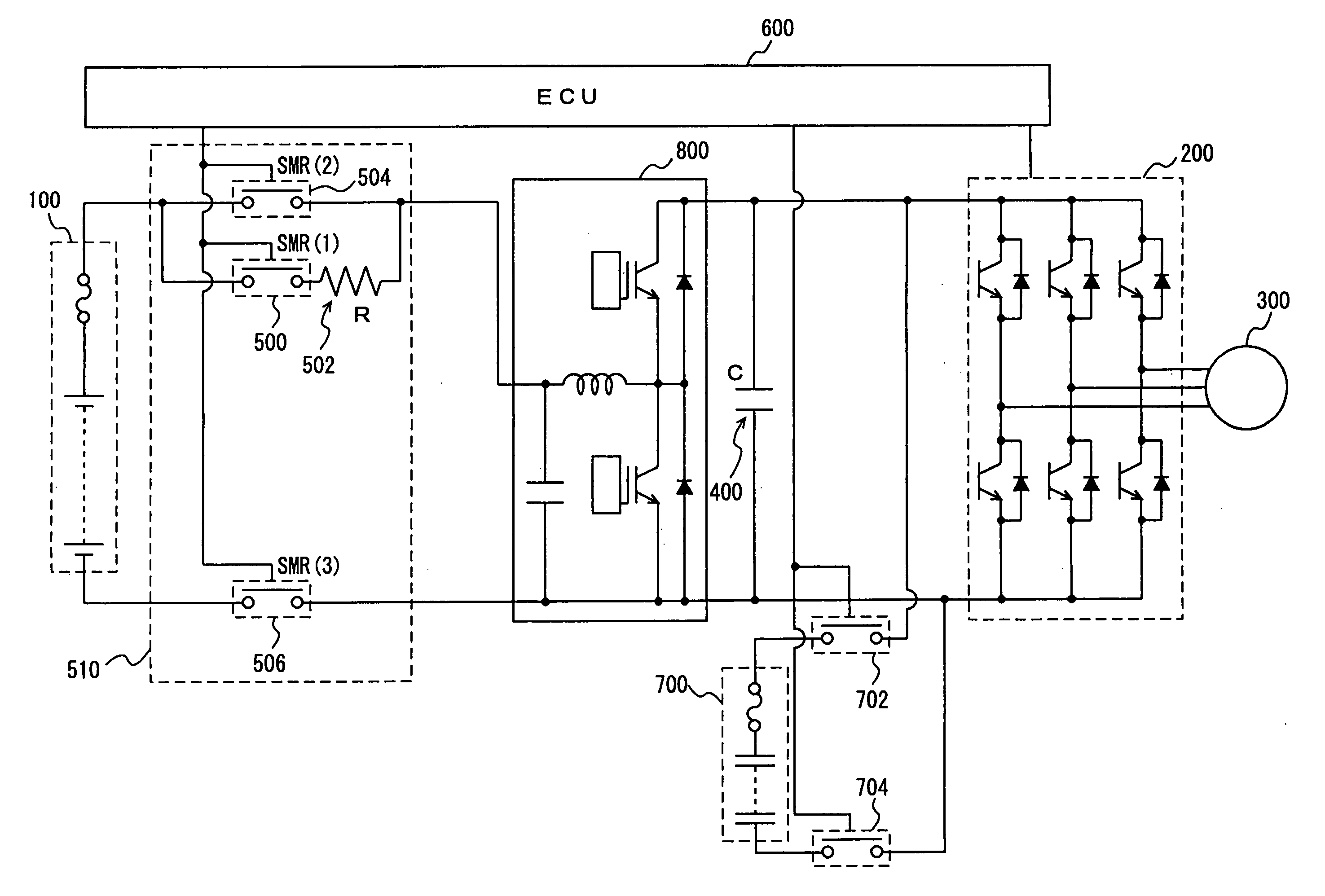
Figure 1 
Figure 2 
Figure 3
Abstract
Description
TECHNICAL FIELD
[0001] The present invention relates to power control of a vehicle including a rotating electric machine that generates regenerative power at the time of braking and, more specifically, to power control of a vehicle including a capacitor charged with the regenerative power.BACKGROUND ART
[0002] A vehicle mounting a power train referred to as a hybrid system, in which an engine (possibly a known mechanism such as a gasoline engine or a diesel engine) and a motor are combined, has been developed and commercially available. Further, a vehicle (electric vehicle, fuel cell electric vehicle) mounting a power train using only the motor as the running source and not mounting any engine, has also been developed. In such a vehicle, the motor functions as a generator at the time of braking of the vehicle to provide regenerative energy, and the regenerative energy charges an electric storage mechanism (a battery or a capacitor) for motor driving. Consequently, kinetic energy of the ...
Examples
Embodiment Construction
[0023]In the following, an embodiment of the present invention will be described with reference to the figures. In the following description, the same or corresponding portions are denoted by the same reference characters. Their names and functions are also the same. Therefore, detailed description thereof will not be repeated.
[0024]Referring to FIG. 1, the vehicle mounting the power controller in accordance with the embodiment of the present invention will be described. The vehicle includes: a battery 100; an inverter 200; a motor generator 300; a condenser 400; a system main relay 510 (SMR (1) 500, limiting resistor 502, SMR(2) 504, SMR(3) 506); and an ECU (Electronic Control Unit) 600. The power controller in accordance with the present embodiment is controlled by a program executed by ECU 600. In the present embodiment, the vehicle will be described as an electric vehicle that runs only by the driving force from motor generator 300. The vehicle on which power controller of the p...