
Parathyroid hormone variants and assays related to disease
a technology of parathyroid hormone and variants, applied in the field of parathyroid hormone variants and assays related to disease, can solve the problems of ambiguity in the exact molecular species under investigation, unsatisfactory characterization of clinical utility and/or confounding effects, and greater microheterogeneity of pth
Patent Information
- Authority / Receiving Office
- US · United States
- Patent Type
- Applications(United States)
- Current Assignee / Owner
- Publication Date
- 2013-08-22
- Estimated Expiration
- Not applicable · inactive patent
Smart Images
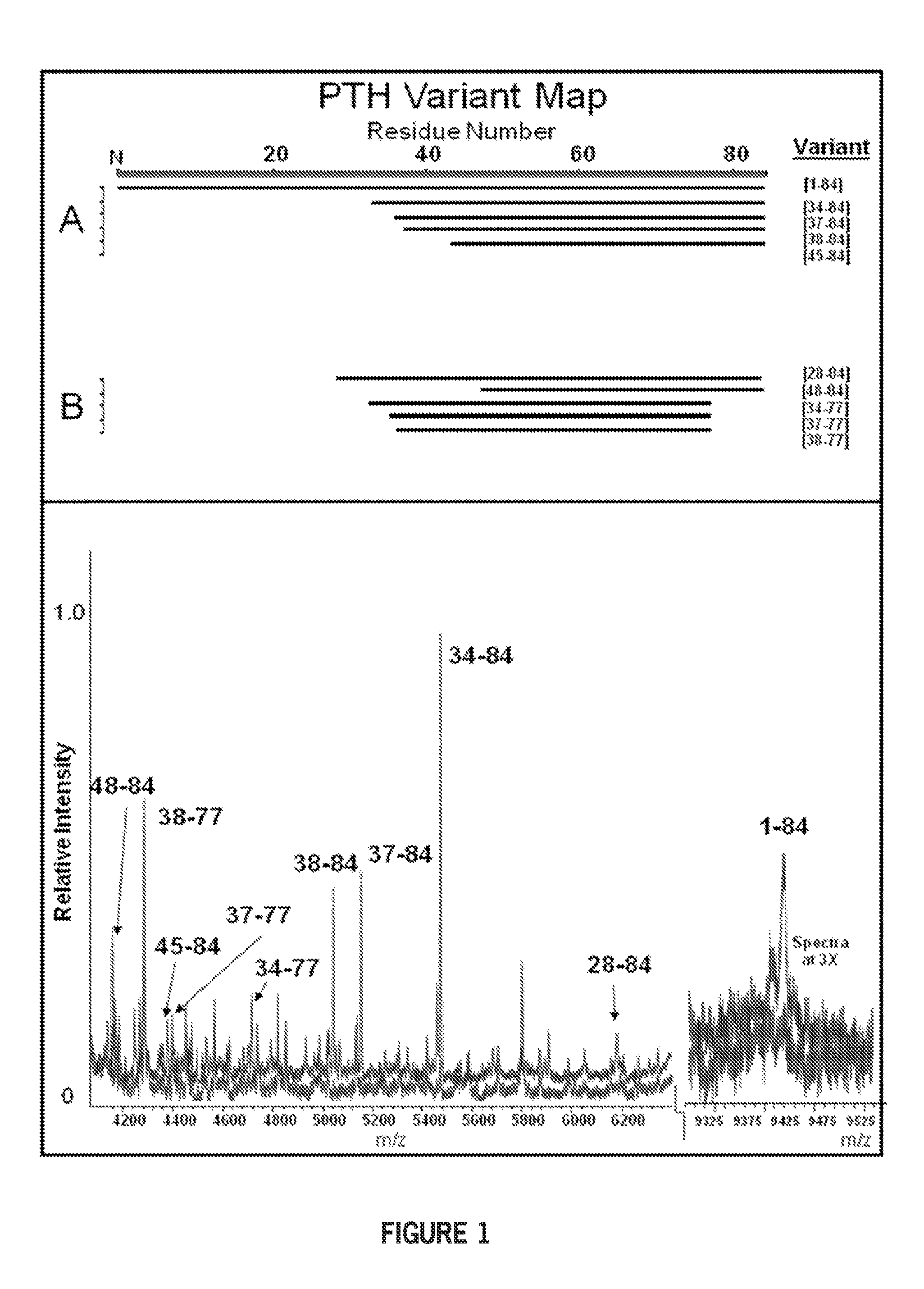
Figure 1 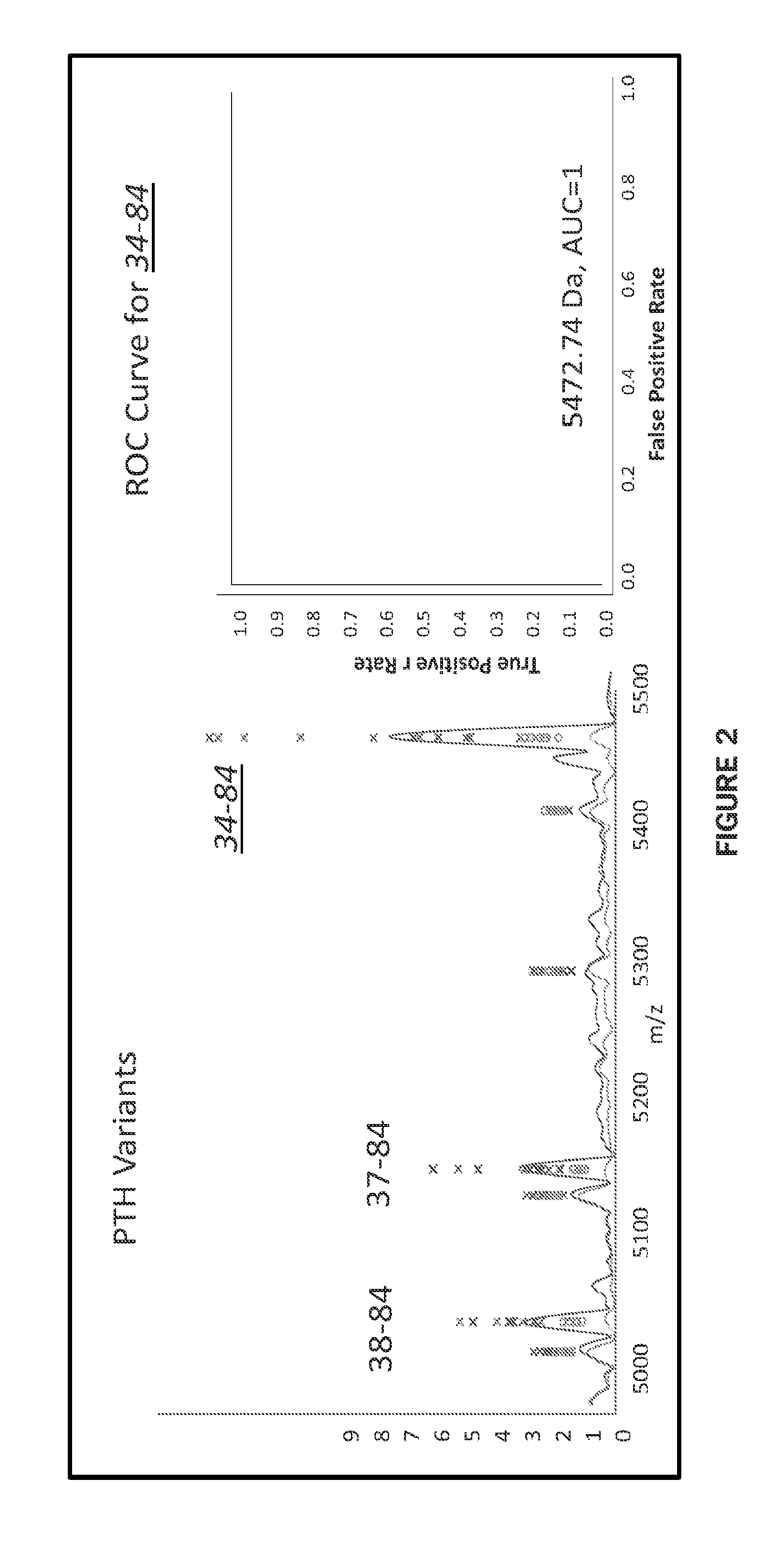
Figure 2 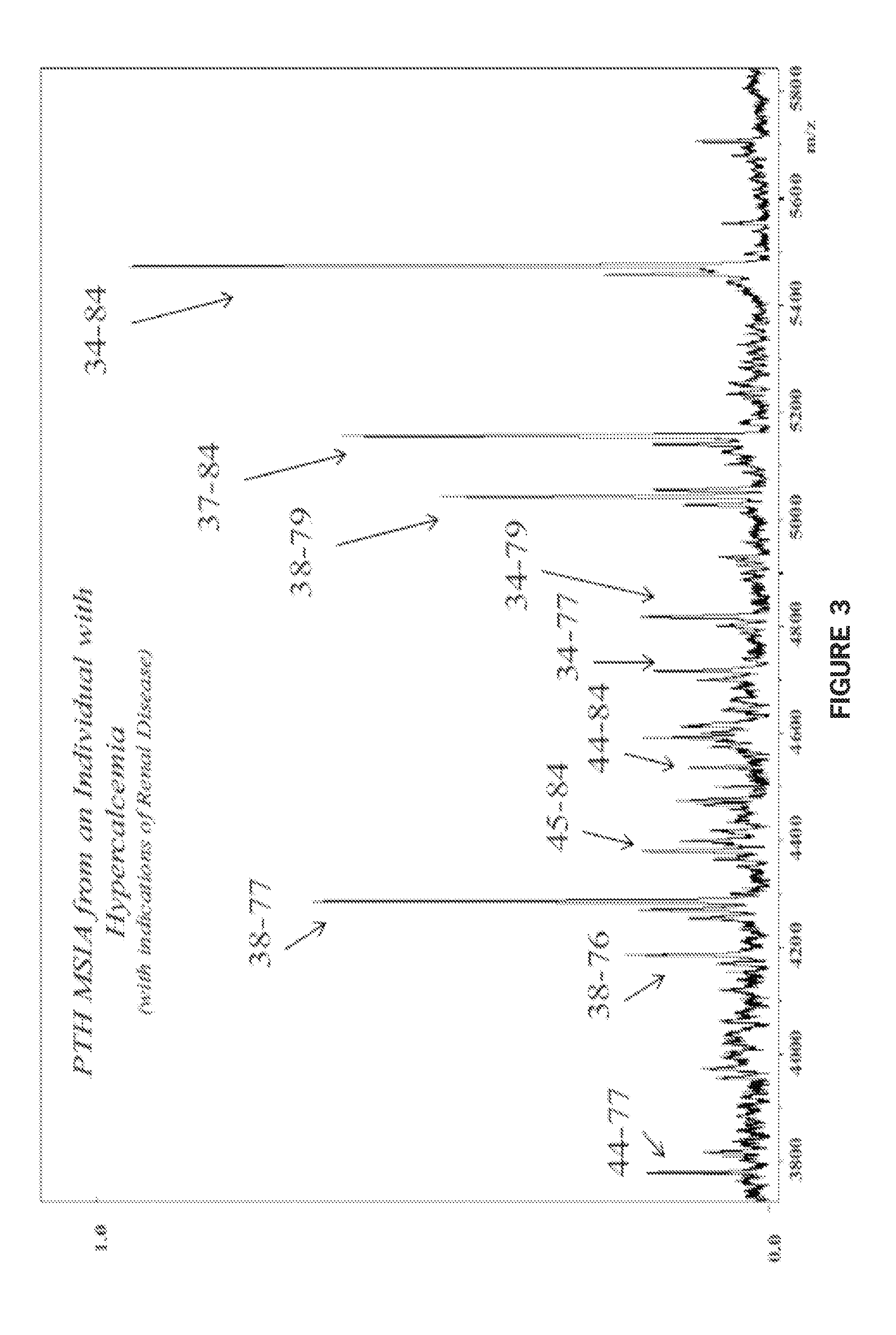
Figure 3
Abstract
Description
CROSS REFERNCE
[0001] This application claims priority to U.S. Provisional Application Ser. No. 61 / 406718 filed Oct. 26, 2010, which is incorporated herein by reference in its entirety.BACKGROUND
[0002] Parathyroid hormone (PTH) is produced in the parathyroid glands through the two-step conversion of pre-pro-PTH (115-amino acids) to pro-PTH (90-amino acids) to the 84-amino acid peptide (PTH1-84). The hormone is secreted into the circulatory system to produce basal (healthy) concentrations of ˜15-65 ng / L (1), and is assayed to assist in the diagnosis of hypo / hyperparathyroidism, hypercalcemia and in monitoring for renal osteodystrophy in patients with end-stage renal failure (1-3). Conventional PTH assays typically rely on two-antibody recognition systems coupled to a variety of detection modalities (e.g., enzymatic amplification, electrochemiluminescence and fluorescence) (4-6). Notably, the most specific assays are able to differentiate between different truncated forms of PTH, and are...
Examples
example 1
Materials and Methods
[0088]Approach: As a starting point for the development of the PTH MSIA, we surveyed the literature to define molecular variants that have already been identified. In addition to the well-characterized truncated variants (e.g., PTH1-84 and 7-84), four other molecular versions have been reported in the literature as present in human biofluids (primarily plasma or serum). Aligning these fragments to the sequence of PTH1-84 produced a variant map revealing forms stemming predominantly from N-terminal truncations (FIG. 1A). A conserved region (among several variants) was evident between residues 48-84. This region was suitable for immunoaffinity targeting in order to capture ragged N-terminal variants (e.g., PTH1-84 and PTH7-84). A full-scan MSIA (MALDI-TOF-MS) (18-23) captured these variants, and also presented the opportunity to discover other variants immunoreactive with the antibody (FIG. 1B). Reagents: Goat polyclonal Anti PTH39-84 antibody was purchased from I...
example 2
Results
[0091]Top-Down Analysis and Discovery of Novel Variants. The approach described herein couples targeting a common region of PTH using a polyclonal antibody (raised to the C-terminal end of the protein) with subsequent identification using mass spectrometry (either MALDI-TOF-MS or SRM). Using a top-down approach (MALDI-TOF-MS), novel truncated PTH variants were discovered in clinical samples (FIG. 1). FIG. 1, Bottom panel shows two MSIA (MALDI-TOF-MS) spectra representative of those obtained from plasma samples of 12 individuals suffering from renal failure and 12 healthy controls. Signals corresponding to the previously reported N-terminally truncated variants as well as additional signals aligning with other novel variants are indicated. Notably, a conserved cleavage site (residue 77) was observed in several of these new variants (FIG. 1B). With the exception of PTH7-84, the variants depicted in FIGS. 1A and B were detected in the majority of clinical samples, and not readil...
example 3
[0092]FIG. 3 presents a MALDI-TOF-MS spectrum from an individual known to have hypercalcemia (with indications of renal disease). The results confirm the PTH heterogeneity signature seen in Example 2, and demonstrate an additional variant that may be linked to hypercalcemia: PTH (44-77). As more disease states are scrutinized in more detail, it is expected that more unique PTH fragments will become evident and new disease-specific protein profiles will be established.
[0093]As demonstrated in the top-down analysis described above, a single, high-affinity polyclonal antibody was able to simultaneously extract numerous PTH variants and the selection of the epitope was directed by the desired assay target (ie intact and N-terminal variants). In the case presented here, our primary goal was to differentiate between intact PTH1-84 and N-terminal variant PTH7-84, while simultaneously identifying any additional N-terminal heterogeneity throughout the molecule. The results of these top-down ...