
Wt1 antigen peptide conjugate vaccine
a conjugate vaccine and antigen technology, applied in the field of cancer immunotherapy, can solve the problems of difficult control and prediction of the cleavage site by intracellular enzymes, difficult production and often difficult development of optimal formulations capable of efficiently inducing ctl. efficiently, to achieve the effect of efficiently converting the same to cancer antigen peptid
Patent Information
- Authority / Receiving Office
- US · United States
- Patent Type
- Applications(United States)
- Current Assignee / Owner
- Publication Date
- 2015-08-27
Smart Images
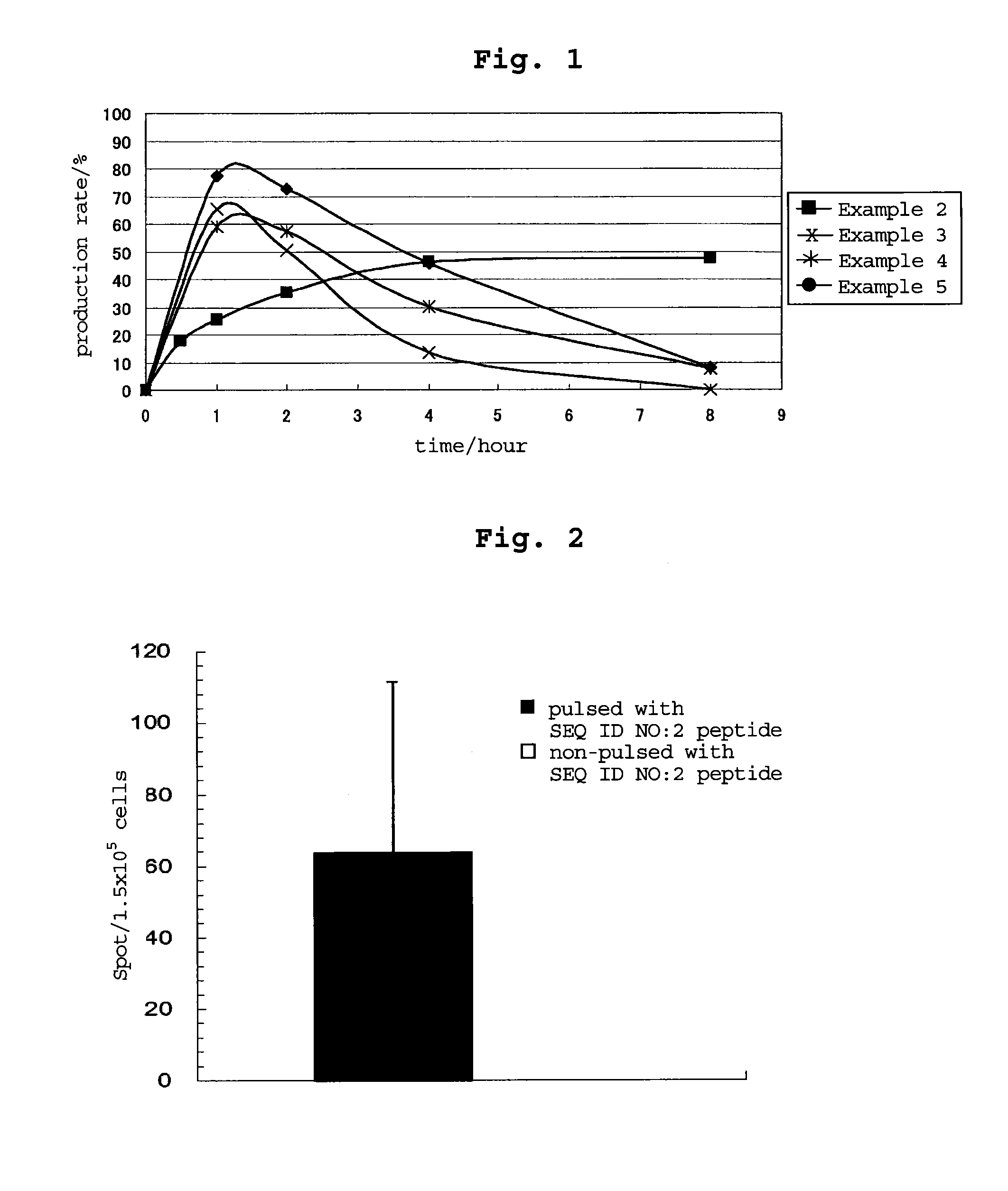
Figure 1 
Figure 2 
Figure 3
Abstract
Description
CROSS-REFERENCE TO RELATED APPLICATIONS
[0001] This is a divisional of and claims the benefits of priority to U.S. Ser. No. 14 / 549,091, filed Nov. 20, 2014, which is a continuation of International Application No. PCT / JP2014 / 059336, filed Mar. 28, 2014, which claims the benefits of priority to Japanese Application No. 2013-072173, filed Mar. 29, 2013 and Japanese Application No. 2013-158383, filed Jul. 31, 2013. The entire contents of all of the above applications are incorporated herein by reference.TECHNICAL FIELD OF THE INVENTION
[0002] 1. Technical Field
[0003] The present invention belongs to the field of cancer immunotherapy, and relates to a conjugate vaccine that can be subjected to trimming by peptidase ERAP1, is obtained by conjugating peptide precursors derived from WT1 antigen protein via a sulfur-sulfur covalent bond, and efficiently induces cytotoxic T cells.
[0004] 2. Background Art
[0005] For eradication of cancer cells in the body, cellular immunity, particularly cytotoxic T ...
Examples
example 1
[0169]Synthesis of the compound represented by the formula (5):
wherein the bond between C and C is a disulfide bond.
Step 1. Synthesis of H-Cys(Npys)-Arg-Met-Phe-Pro-Asn-Ala-Pro-Tyr-Leu-OH
(Synthesis of C(Npys)RMFPNAPYL)
[0170]Using Fmoc-Leu-Alko-resin (Alko is p-alkoxybenzylalcohol), 282 mg, (manufactured by Watanabe Chemical; 0.71 mmol / g, 0.2 mmol) as a starting material, the peptide chain was assembled by solid phase synthesis according to Fmoc / tBu method. Solid phase synthesis was performed using CS336X peptide synthesizer manufactured by CS Bio, and deprotection of Fmoc group was performed by treatment with a DMF solution of 20% piperidine for 5 min and for 20 min. Coupling of protected amino acid was performed by reaction with a DMF solution of 1.05 mmol of protected amino acid, 1 mmol HBTU and 2 mmol DIPEA for 1 hr. The obtained resin was washed with DMF and ether, and dried under reduced pressure to give Boc-Cys(Npys)-Arg(Pmc)-Met-Phe-Pro-Asn(Trt)-Ala-Pro-Tyr(tBu)-Leu-Alko-resi...
example 2
Synthesis of Peptide Consisting of the Following Amino Acid Sequence
[0189]
CRMFPNAPYL(SEQ ID NO: 13)
[0190]step 1. Using Fmoc-Leu-Alko-resin (Alko is p-alkoxybenzylalcohol) (338 mg, manufactured by Watanabe Chemical; 0.74 mmol / g, 0.25 mmol) as a starting material, and solid phase synthesis as in the method described in Example 1 was performed twice to give H-Cys(Trt)-Arg(Pmc)-Met-Phe-Pro-Asn(Trt)-Ala-Pro-Tyr(tBu)-Leu-Alko-resin (1.54 g). To this peptide resin was added a mixture of TFA / H2O / TIS=95 / 2.5 / 2.5 (15 ml), and the mixture was shaken at room temperature for 3 hr. The resin was filtered off, and the reaction mixture was concentrated under reduced pressure. The reaction mixture was ice-cooled and diethyl ether (50 ml) was added. The resulting precipitate was collected by filtration, washed with ether and dried under reduced pressure to give crude peptide (637 mg).
[0191]mass spectrometry: LC-ESI / MS m / z=1211.9 [M+1]+ (Calculated=1212.5)
[0192]step 2. The crude peptide (321 mg) obtain...
examples 3-5
[0200]By a method similar to that in Example 2, peptides consisting of the amino acid sequence of SEQ ID NO: 16, 18 or 17 were synthesized. Table 54 shows the synthesized amount and the results of mass spectrometry.
TABLE 54masssynthe-spectro-massaminose-sizedmetry:spectro-Ex.acidquenceamountLC-ESI / metry:No.sequenceNo.(mg)MS m / zCalculated3CALLPAVPSL1642 983.8 983.2[M + 1]+4CRVPGVAPTL18531012.71012.2[M + 1H]+5CSLGEQQYSV17311113.71113.2[M + 1]+