
Methods of making an elastomer composite reinforced with silica and products containing same
Patent Information
- Authority / Receiving Office
- US · United States
- Current Assignee / Owner
- Publication Date
- 2017-10-26
Smart Images
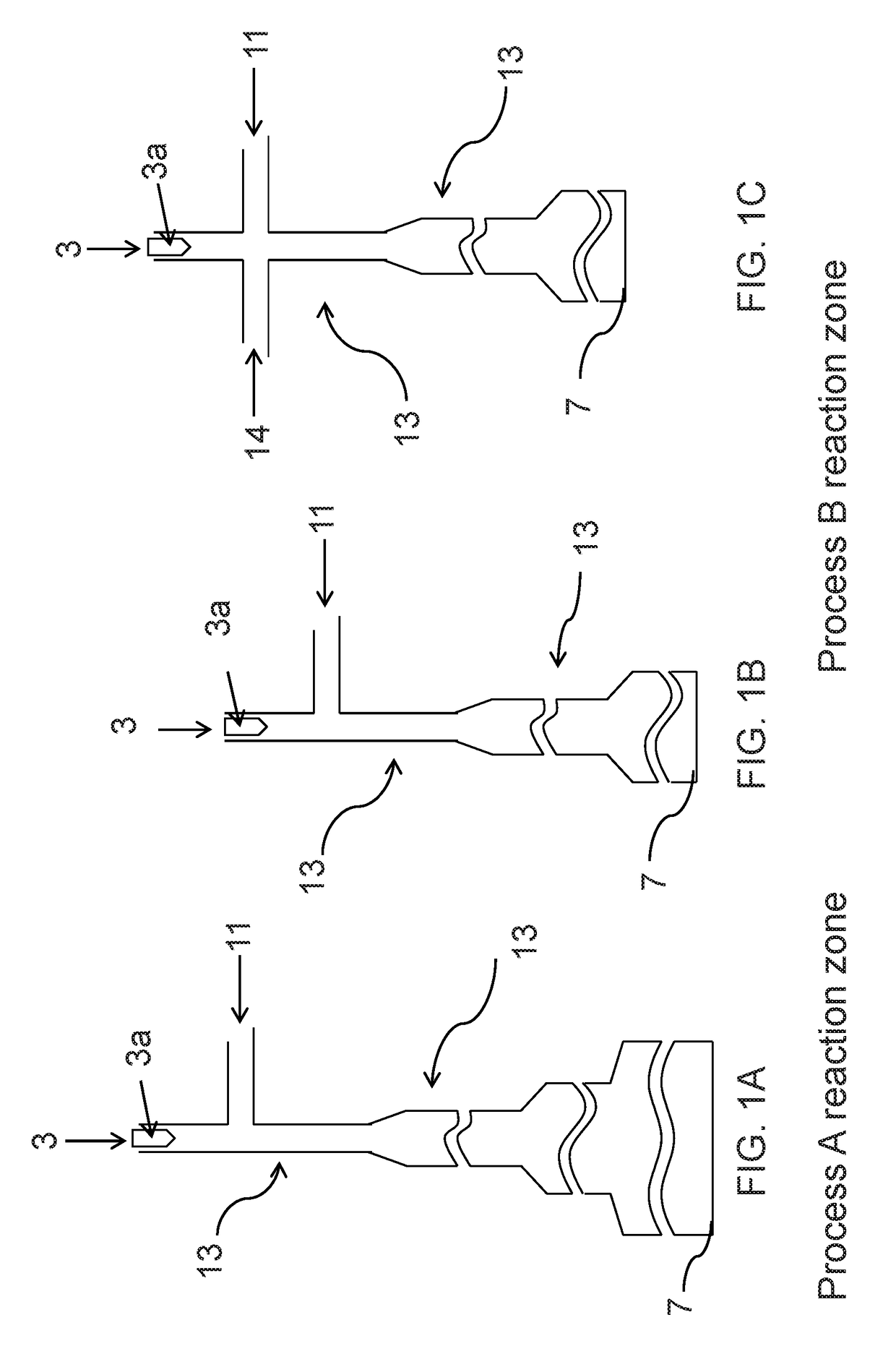
Figure 1 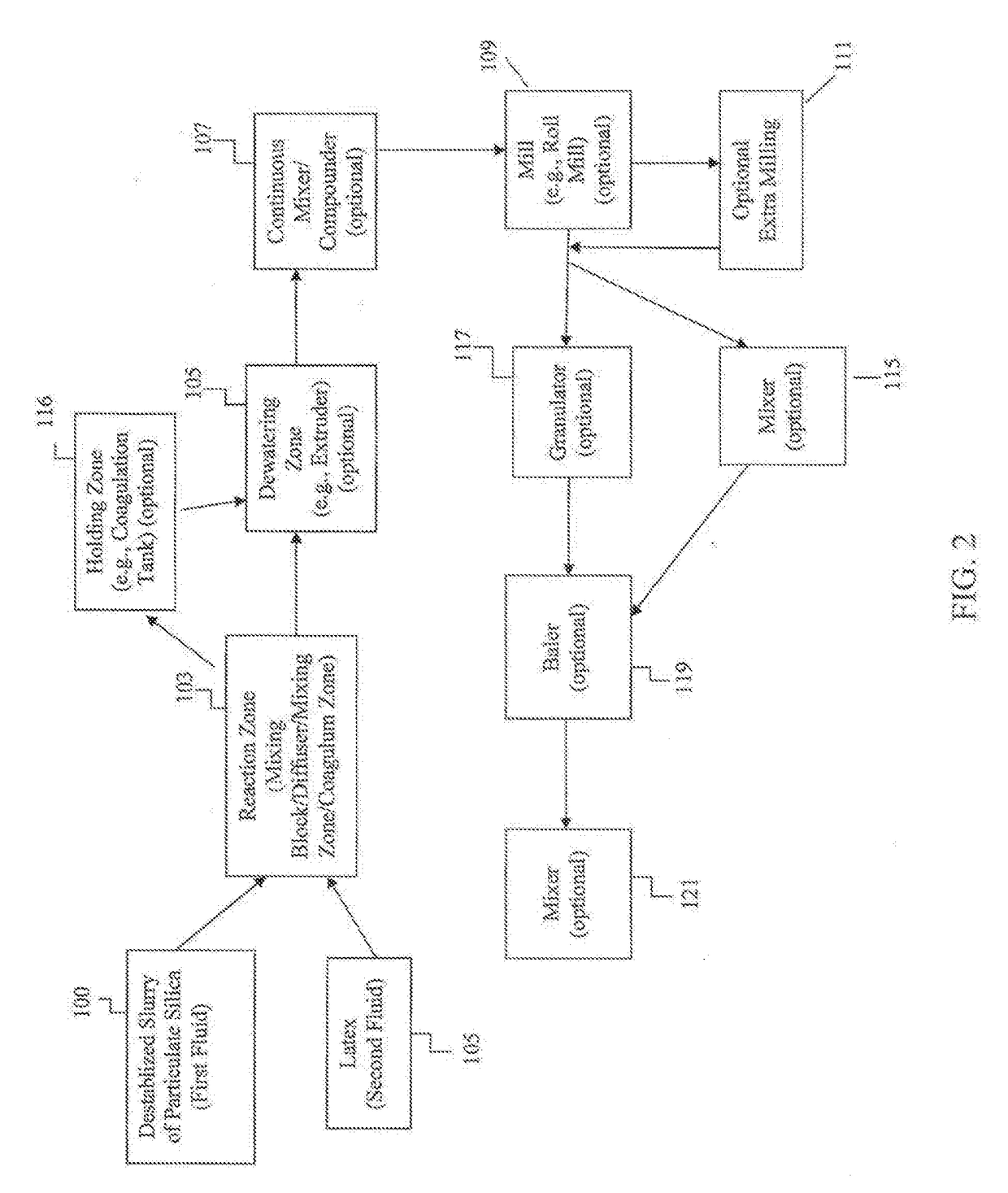
Figure 2 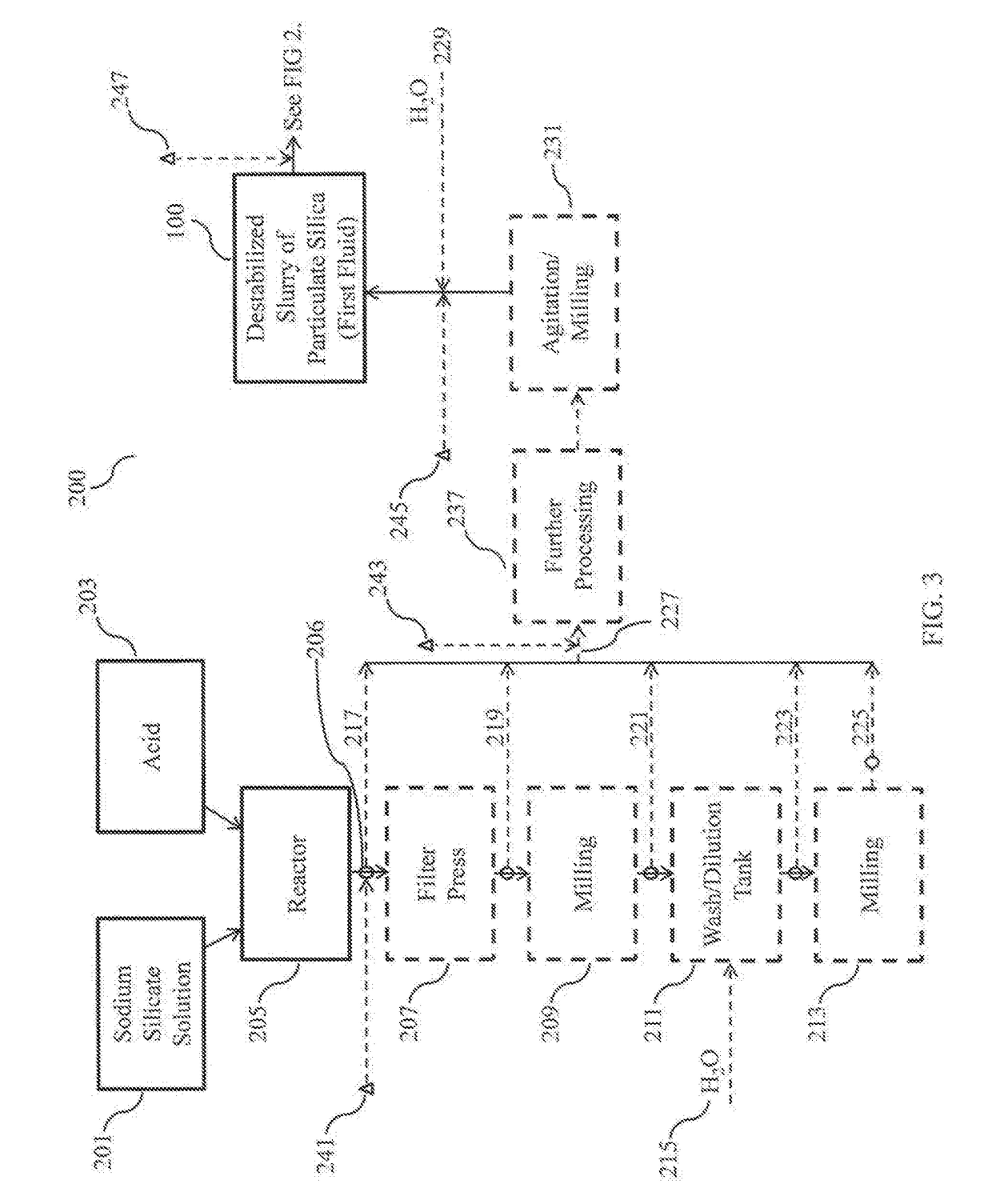
Figure 3
Abstract
Description
[0001] The present invention relates to methods of making silica elastomer composites. More particularly, the present invention relates to a silica reinforced elastomer composite formed by a wet masterbatch method.
[0002] Numerous products of commercial significance are formed of elastomeric compositions wherein particulate reinforcing material is dispersed in any of various synthetic elastomers, natural rubber or elastomer blends. Carbon black and silica, for example, are widely used as reinforcing agents in natural rubber and other elastomers. It is common to produce a masterbatch, that is, a premixture of reinforcing material, elastomer, and various optional additives, such as extender oil. Numerous products of commercial significance are formed of such elastomeric compositions. Such products include, for example, vehicle tires wherein different elastomeric compositions may be used for the tread portion, sidewalls, wire skim and carcass. Other products include, for example, engine m...
Examples
example 5
Silica Example 5
[0144]To prepare a silica sol containing approximately 2 wt % of silica, ion exchange resin (Lewatit Monoplus 108; Lanxess Deutschland GmbH, Leverkusen, Germany) is activated in a column by eluting it with H2SO4 until the pH of the eluent is below 2. Then it is neutralized by passing deionized water through the resin until the ion conductivity of the eluent is 5 μS / cm.
[0145]In a 2 L vessel equipped with stirrer and cooling unit, 1 L of wet ion exchange resin and 225 g of deionized water are cooled to 6° C. and stirred vigorously. Then 550 g of a sodium water glass solution with 4.875 wt % SiO2 are prepared by diluting a commercial sodium water glass solution (37 / 38 alkali silicate from Woellner GmbH, Ludwigshafen, Germany) with deionized water. This solution is added to the vessel via a peristaltic pump with an addition rate of 23 ml / min. Temperature is maintained below 12° C. When sodium water glass addition is completed, the mixture is stirred for 15 min at below 1...
example 1
[0178]A silica slurry with 27.8 wt % Zeosil® 1165 silica was prepared as described above in connection with the Slurry Zeta Potential test method. The slurry was then diluted using either deionized water or a supernatant obtained from ultracentrifugation of the 27.8 wt % slurry to make a series of silica slurries at various silica concentrations. The zeta potential of various silica slurries was measured to show the relationship between the concentration of the silica in the slurry and the zeta potential of the slurry. The zeta potential of the silica slurry, as shown in Table 1, appears to depend upon the silica concentration when the silica slurry is made using deionized water. However, as shown in Table 2, when slurry was diluted using the supernatant obtained from ultracentrifugation of the 27.8 wt % slurry, the zeta potential stays roughly the same at different silica concentrations.
TABLE 1Zeta potential of slurry of silica made using deionized water.Silica Concentration in slu...
example 2
[0180]The effect of adding salt or acid at various concentrations to silica slurries on the zeta potential of these slurries is set forth in Table 3. Slurries were prepared in deionized water by the Slurry Zeta Potential test method described above. Data summarized in Table 3 illustrate the dependence of zeta potential of silica slurries and destabilized silica slurries on the silica concentration, salt concentration, and acid concentration. Adding salt or acid to silica slurry reduces the magnitude of zeta potential, thus the stability of the silica slurry. As shown in Table 3, the zeta potential depends mostly on the concentration of salt or acid in the slurry or destabilized slurry, and not on silica concentration.
TABLE 3Zeta potential of slurry and destabilized of silica at various slurry concentrations,salt concentrations, and acid concentrations.Silica Con-centration[acetic[formicin Slurry [CaCl2]acid]acid]Zeta(wt %)(mM)(mM)(mM)(mV)pH22.0000−34.44.806.0000−45.0ND22.010.600−24....