
Mono-Nuclei Cationized Magnesium Salt, Preparation Method and Applications Thereof
Patent Information
- Authority / Receiving Office
- US · United States
- Current Assignee / Owner
- Publication Date
- 2018-11-01
Smart Images
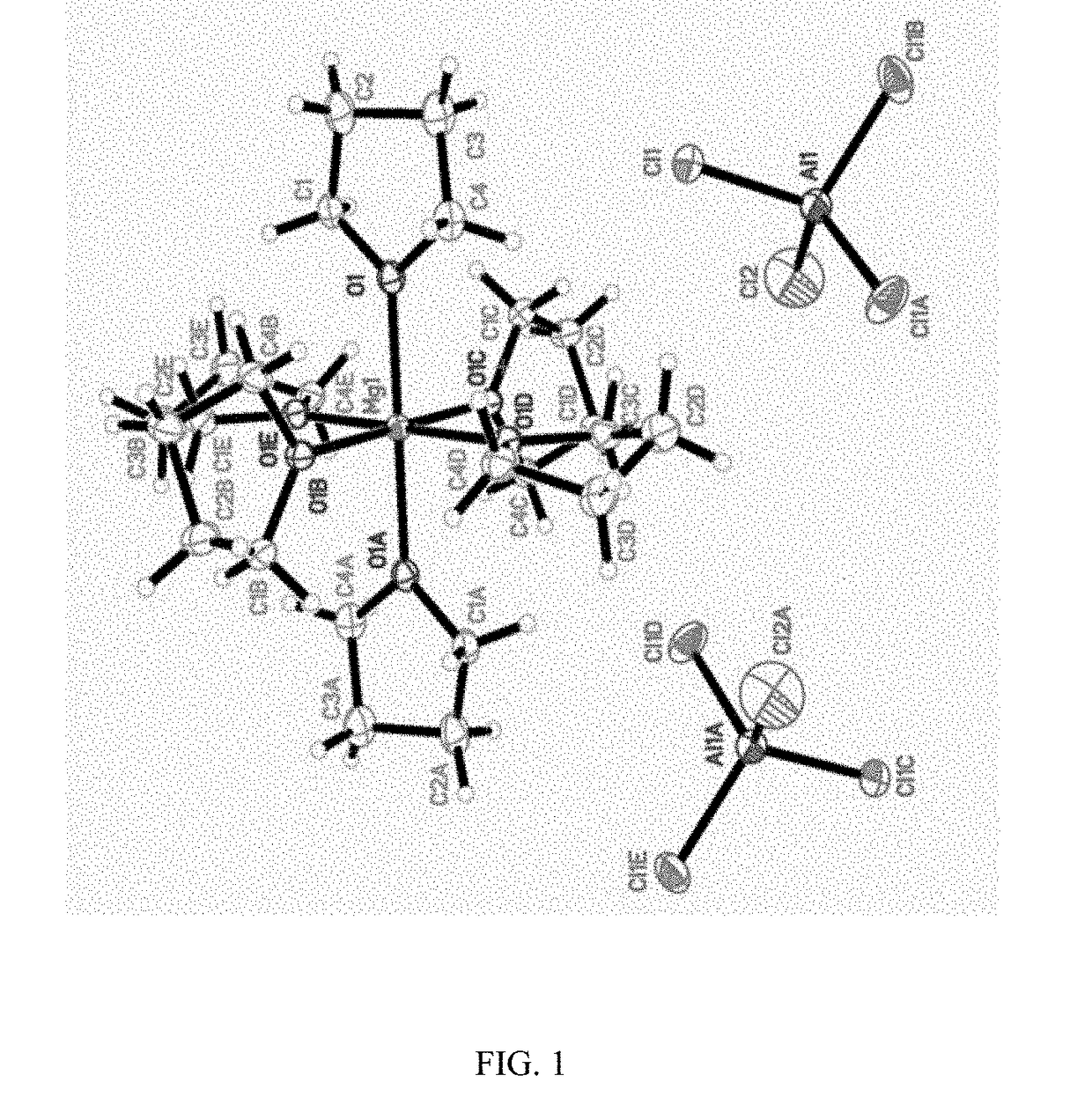
Figure 1 
Figure 2 
Figure 3
Abstract
Description
BACKGROUND OF THE INVENTIONTechnical Field
[0001] The invention relates to a mono-nuclei cationized magnesium salt, a preparation method and applications thereof, belonging to the field of electrochemical energy sources.Description of Related Art
[0002] To meet the requirements for efficient, clean, economical and safe energy systems of the 21st century, developing novel, environmentally-friendly, high-performance, large-scaled energy storage technologies and utilizing new energy sources efficiency have become an issue that draws attention from the whole world and are an irresistible trend of the future. A lithium-ion battery energy storage system as an efficient energy storage means draws more and more attentions from the energy departments and energy enterprises of all countries, and holds a dominant position in the current energy storage industrial field. However, global lithium resources are limited in reservation and not uniform in space distribution (lithium resources are mainly l...
Examples
embodiment 1
[0038] 56 mg of anhydrous magnesium chloride (MgCl2) and 158 mg of anhydrous aluminum chloride (AlCl3) react in 1 mL of ionic liquid, namely 1-methyl-(1-butyl) pyrrolidinium bis(trifluoromethanesulfonyl)imide (PYR14TFSI), at a temperature of 95° C. for 24 hours to obtain a light yellow solution; the obtained solution is cooled to room temperature and then added into 1 mL of THF; and 0.3M rechargeable magnesium electrolyte solution is obtained. The crystal structure represents that the electrolyte salt is [Mg(THF)6] [AlCl4]2, and the crystal structure can be seen in FIG. 1. The theoretical values according to the element analysis include C: 36.28, and H: 6.09; and the measured values include C: 36.27%, and N: 6.10%. Raman spectrum test results show that 350 cm−1 is the characteristic peak of the anions AlCl4−, and the Raman peak of other aluminum chloride anions is not seen.
embodiment 2
[0039] 56 mg of anhydrous magnesium chloride (MgCl2) and 158 mg of anhydrous aluminum chloride (AlCl3) react in 1 mL of triethylene glycol dimethyl ether (TEGDME) at a temperature of 30° C. for 24 hours to obtain a light yellow solution; the obtained solution is cooled to room temperature; and then, 0.6M rechargeable magnesium electrolyte solution is obtained. The crystal structure represents that the electrolyte salt is [Mg(TEGDME)2] [AlCl4]2. The theoretical values according to the element analysis include C: 22.87, and H: 4.48; and the measured values include C: 22.89%, and N: 4.47%. Raman spectrum test results show that 350 cm−1 is the characteristic peak of the anions AlCl4−, and the Raman peak of other aluminum chloride anions is not seen.
embodiment 3
[0040] 56 mg of anhydrous magnesium chloride (MgCl2) and 158 mg of anhydrous aluminum chloride (AlCl3) react in 1 mL of toluene at a temperature of 100° C. for 24 hours to obtain a light yellow solution; the obtained solution is cooled to room temperature; and then, 0.6M rechargeable magnesium electrolyte solution is obtained. The crystal structure represents that the electrolyte salt is [Mg(toluene)6] [AlCl4]2. The theoretical values according to the element analysis include C: 55.15, and H: 5.29; and the measured values include C: 55.10%, and H: 5.30%. Raman spectrum test results show that 350 cm−1 is the characteristic peak of the anions AlCl4−, and the Raman peak of other aluminum chloride anions is not seen.