
Systems, methods, and apparatuses for resuming dialog sessions via automated assistant
a technology of automatic assistant and dialog session, applied in the field of systems, methods and apparatuses for resuming dialog session via automated assistant, can solve the problems of incomplete conversation between the user and the automated assistant, and the inability of the automated assistant to open the music application, so as to reduce the rank associated with the conversation suggestion, the rank associated with the incomplete conversation can be increased, and the conversation can be resumed. the effect of computational resources
Patent Information
- Authority / Receiving Office
- US · United States
- Patent Type
- Applications(United States)
- Current Assignee / Owner
- Publication Date
- 2019-07-18
Smart Images
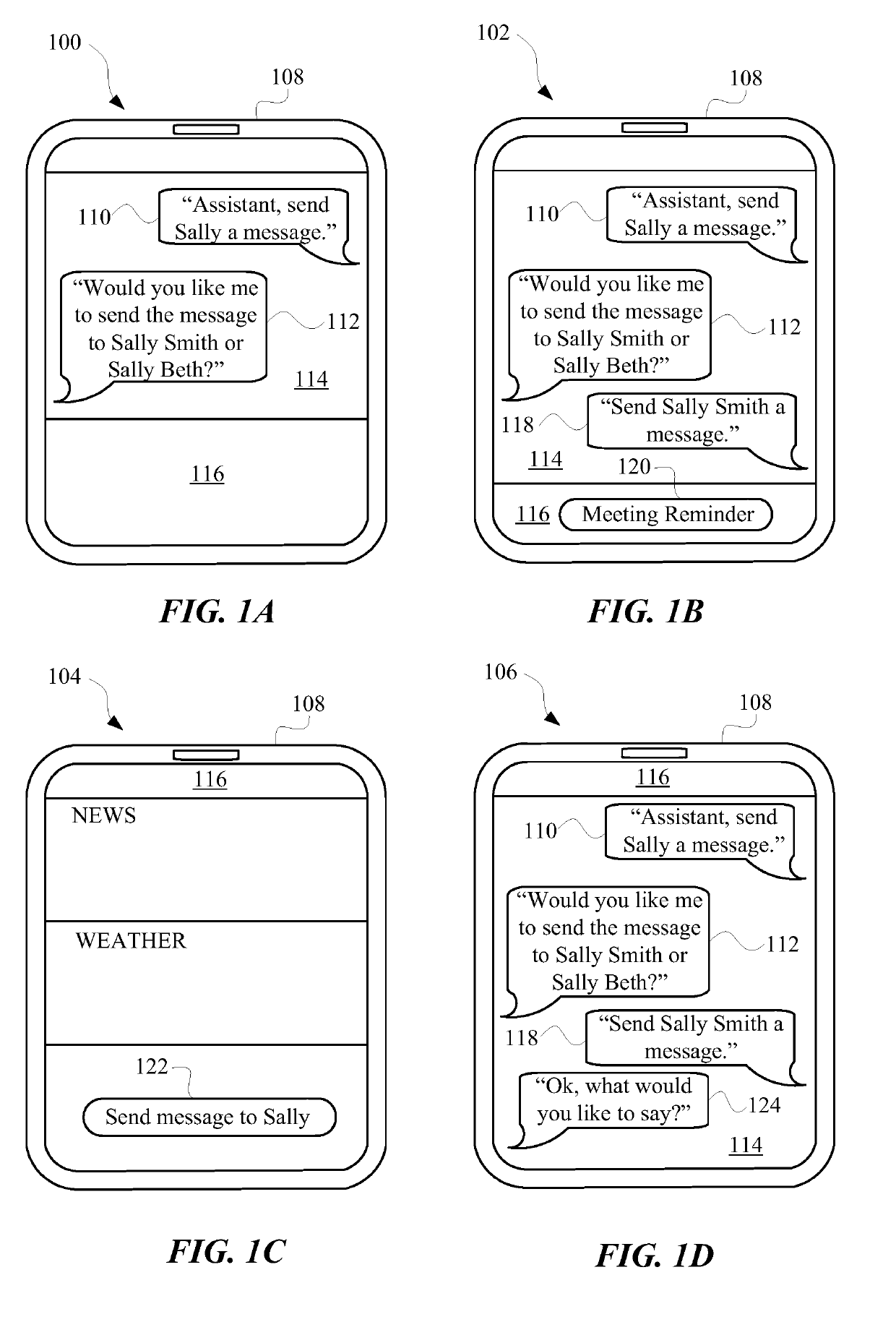
Figure 1 
Figure 2 
Figure 3
Abstract
Description
BACKGROUND
[0001] Automated assistants (also known as “personal assistant modules”, “mobile assistants”, or “chat bots”) may be interacted with by a user via a variety of computing devices, such as smart phones, tablet computers, wearable devices, automobile systems, standalone personal assistant devices, and so forth. The automated assistants receive input from the user (e.g., typed and / or spoken natural language input) and respond with responsive content (e.g., visual and / or audible natural language output). Unfortunately, while interacting with an automated assistant, a user may become distracted and not complete the interaction to the point of a task or action being completed by the automated assistant. As a result, the user may subsequently have to repeat inputs to the automated assistant in order to have the automated assistant complete the task or action. This can be a waste of computational resources and / or human time, given that the automated assistant would be reprocessing c...
Examples
Embodiment Construction
[0021]FIGS. 1A-1D illustrate diagrams of a client device 108 that can access an automated assistant capable of storing dialog sessions between a user and an automated assistant interface 114 in furtherance of a task to be completed via the automated assistant or client device 108. While client device 108 is depicted as a smart phone or tablet, this is not meant to be limiting. Client devices may take various other forms, such as standalone interactive speakers, wearable technologies (e.g., smart glasses), vehicle-based client devices (e.g., navigation systems, media control systems), so-called smart televisions, and so forth. In various implementations, various aspects of a dialog session (including its state), or any human-to-machine dialog, can be stored such that the interactions between the user and the automated assistant can be resumed at a later time in order that the initially solicited task can be completed.
[0022]Initially, in some implementations, the user can be viewing a...