
Golf ball
a golf ball and ball technology, applied in the field of golf balls, can solve the problems of deteriorating the resilience performance excessive spin generation affecting the impact feel of the golf ball, so as to suppress the back spin and side spin, reduce the weight, and reduce the impact. the effect of impa
Patent Information
- Authority / Receiving Office
- US · United States
- Patent Type
- Patents(United States)
- Current Assignee / Owner
- Publication Date
- 2011-10-25
- Estimated Expiration
- Not applicable · inactive patent
Smart Images
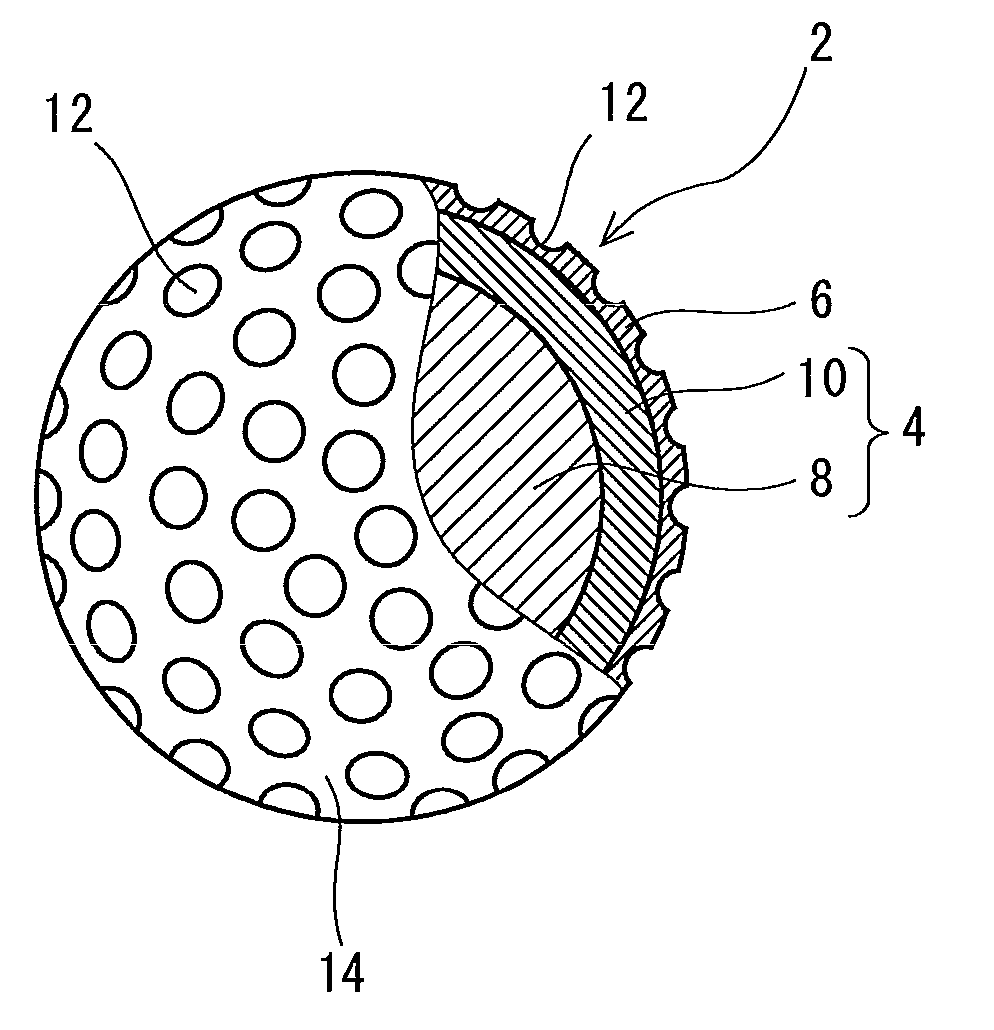
Figure 1 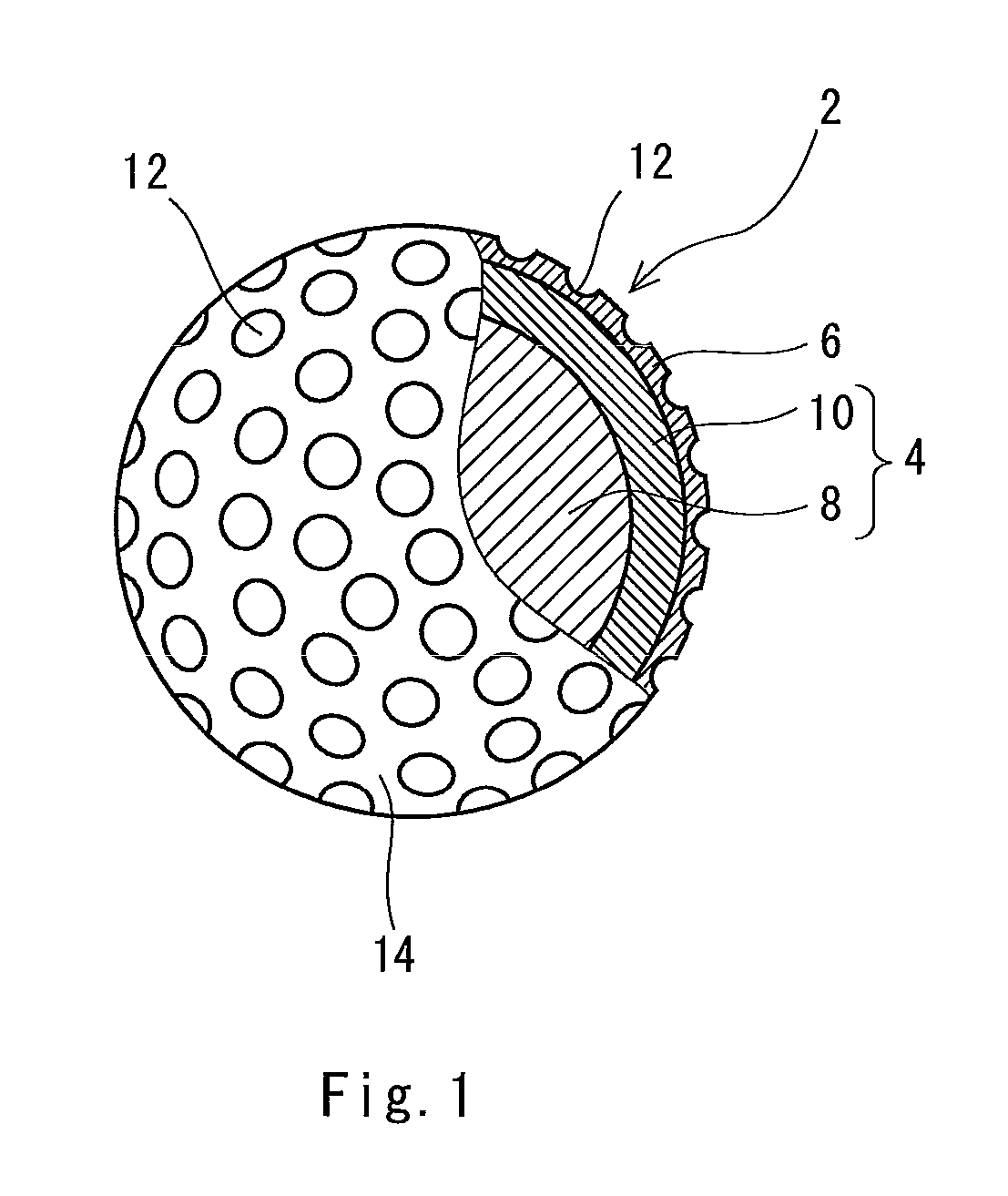
Figure 2
Abstract
Description
[0001] This application claims priority on Patent Application No. 2008-154893 filed in JAPAN on Jun. 13, 2008. The entire contents of this Japanese Patent Application are hereby incorporated by reference.BACKGROUND OF THE INVENTION
[0002] 1. Field of the Invention
[0003] The present invention relates to golf balls. More particularly, the present invention relates to multi-piece golf balls having a center, a mid layer and a cover.
[0004] 2. Description of the Related Art
[0005] Golf balls make a flight with accompanying back spin. Top concern to golf players for golf balls is their flight performances. The flight performance correlates with back spin rate. The flight with small spin rate results in an appropriate trajectory, whereby a great flight distance can be achieved. In light of the flight performance, golf balls which are less likely to be spun have been demanded.
[0006] Golf balls hit with an ideal swing are not accompanied by side spin. However, the side spin is inevitable according to...
Examples
example 1
[0075]A rubber composition (i) was obtained by kneading 100 parts by weight of high-cis polybutadiene (trade name “BR-730”, available from JSR Corporation), 28.0 parts by weight of zinc diacrylate, 10 parts by weight of zinc oxide, 12.7 parts by weight of barium sulfate, 0.5 parts by weight of diphenyl disulfide (Sumitomo Seika Chemicals Co., Ltd.) and 0.9 parts by weight of dicumyl peroxide (NOF Corporation). This rubber composition (i) was placed into a mold having upper and lower mold half each having a hemispherical cavity, and heated to obtain a center. This center had a diameter of 39.6 mm.
[0076]A resin composition (b) was obtained by kneading 35 parts by weight of an ionomer resin (the aforementioned “Surlyn® 8945”), 30 parts by weight of other ionomer resin (the aforementioned “Himilan AM7329”), 35 parts by weight of a styrene block-containing thermoplastic elastomer (the aforementioned “Rabalon® T3221C”) and 32 parts by weight of tungsten powder in a biaxial kneading extrud...