
Multi-armed catechol compound blends
a technology of catechol and compound, applied in the direction of surgical staples, prostheses, peptides, etc., can solve the problems of poor tissue adhesion characteristics, stiffness and brittleness in mechanical properties, etc., to inhibit or reduce the growth of biofilm (bacteria), control bleeding, and control bleeding
Patent Information
- Authority / Receiving Office
- US · United States
- Patent Type
- Patents(United States)
- Current Assignee / Owner
- Publication Date
- 2012-02-21
Smart Images
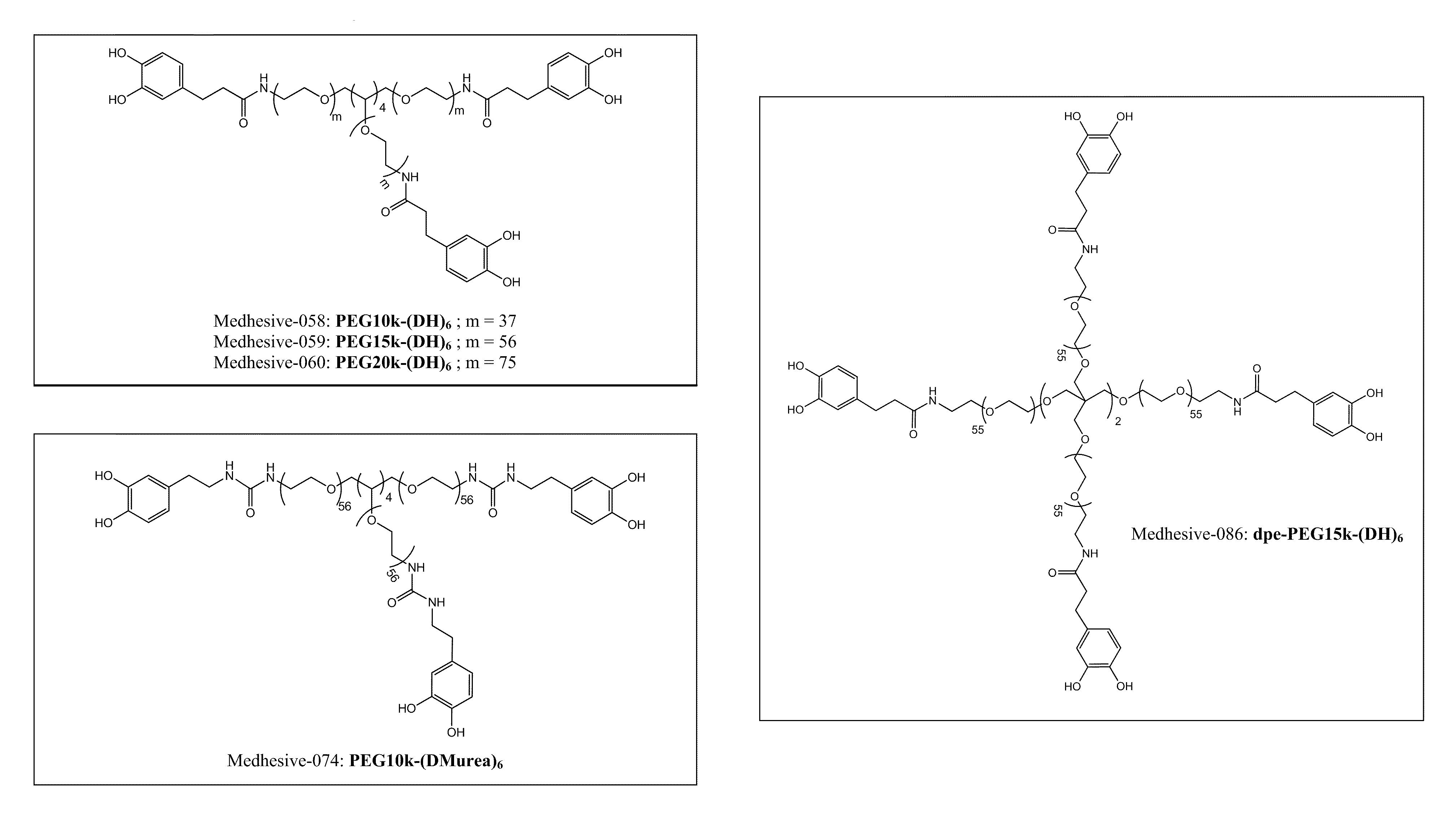
Figure 1 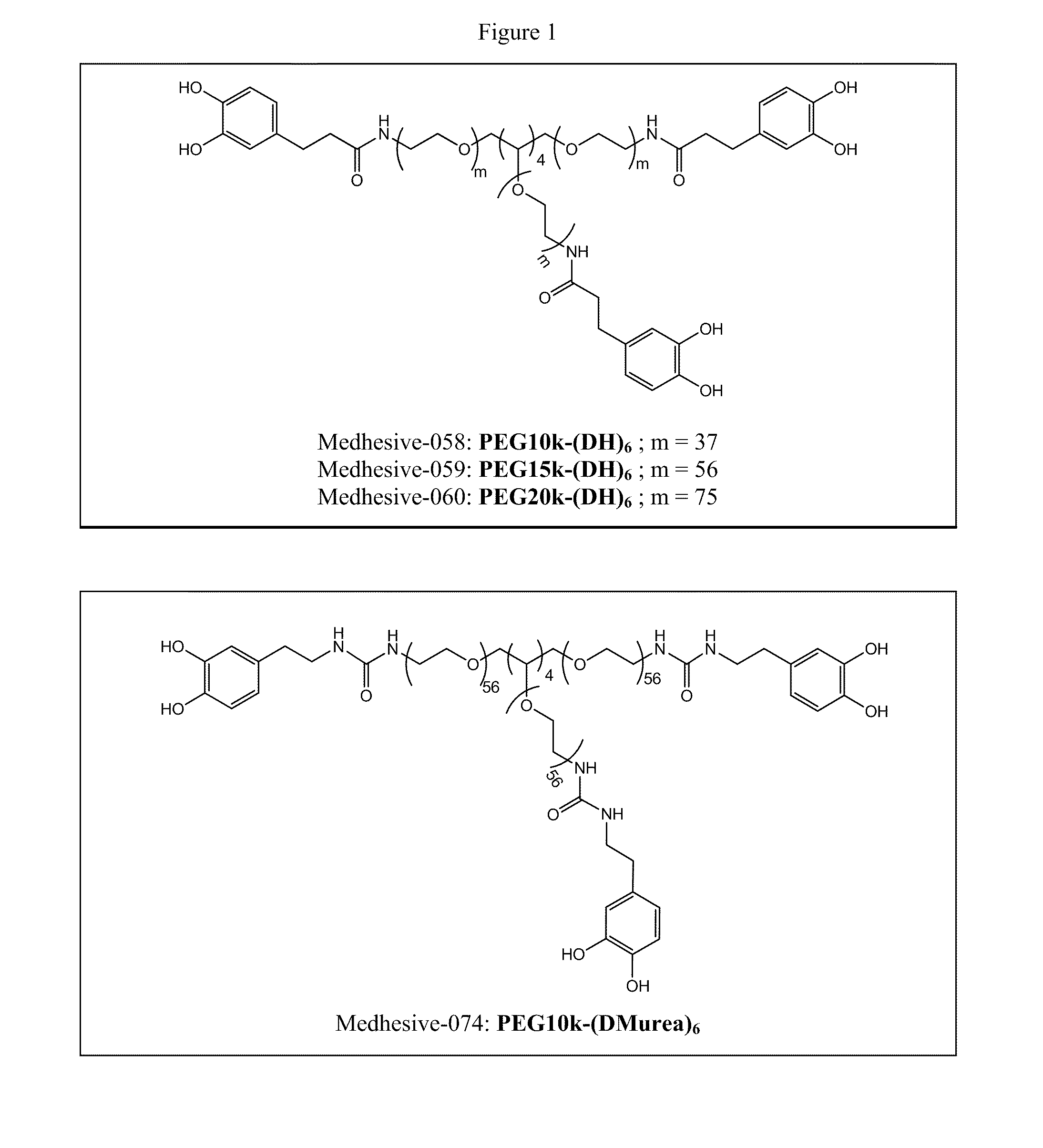
Figure 2 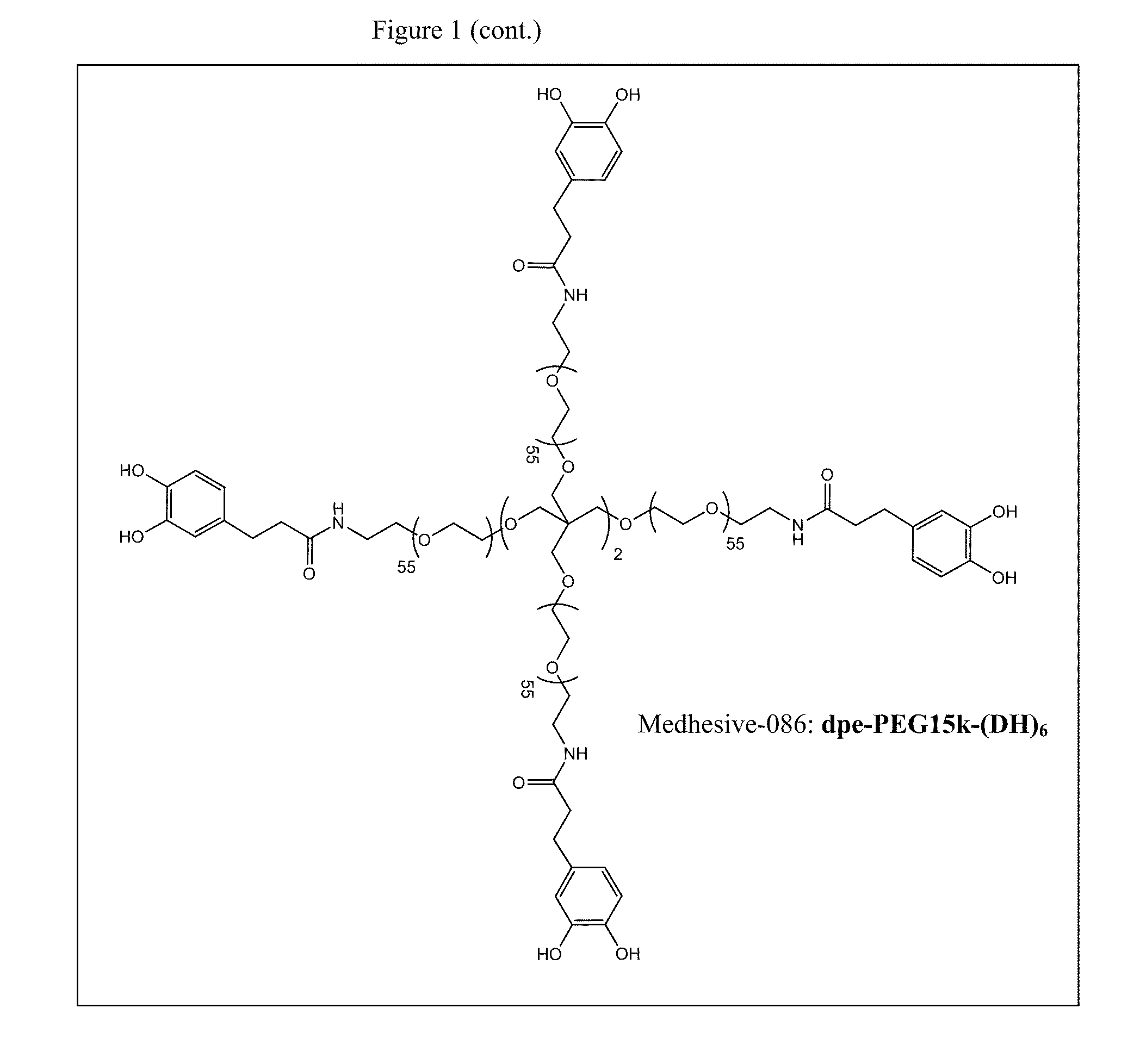
Figure 3
Abstract
Description
CROSS REFERENCE TO RELATED APPLICATIONS
[0001] This application claims priority to U.S. Provisional application 61 / 100,742, filed Sep. 28, 2008, entitled “Multi-Armed Catechol Compounds” and U.S. Provisional application 61 / 150,471, filed Feb. 6, 2009, entitled “Multi-Armed Catechol Compound Blends”, the contents of each are incorporated herein by reference for all purposes.REFERENCE TO FEDERAL FUNDING
[0002] 1H NMR was performed at National Magnetic Resonance Facility at Madison, which is supported by NIH (P41RR02301, P41GM66326, RR02781, RR08438), the NSF (DMB-8415048, OIA-9977486, BIR-9214394), the University of Wisconsin, and the USDA.FIELD OF THE INVENTION
[0003] The invention relates generally to new synthetic medical adhesives which exploit the key components of natural marine mussel adhesive proteins. The method exploits a biological strategy to modify surfaces that exhibit adhesive properties useful in a diverse array of medical applications. Specifically, the invention describes ...
Examples
examples
Synthesis of Medhesive-063 (PEG20k-(DH)8)
[0751]51 g of 8-Armed PEG-NH2 (20,000 MW; 21 mmol —NH2) was dissolved with 234 mL of chloroform and 116 mL of DMF. 6.0 g of DOHA (33 mmol), 4.4 g of HOBt (33 mmol), 12 g of HBTU (33 mmol), and 6.9 mL of triethylamine were added. The reaction mixture was stirred at room temperature for one hour and added to 2400 mL of diethyl ether. The precipitate was dissolved in 350 mL of 12 mM HCl and dialyzed (3,500 MWCO) with deionized H2O (acidified to pH 3.5 with concentrated HCl) for 24 hrs and lyophilized. Medhesive-058 PEG10k-(DH)6, Medhesive-059 PEG15k-(DH)6, and Medhesive-060 PEG20k-(DH)6 were created using similar procedures using corresponding starting material PEGs (6-armed PEG-NH2 10,000 MW, 6-armed PEG-NH2 15,000 MW, and 6-armed PEG-NH2 10,000 MW, respectively). Both 1H NMR and UV-vis were used to quantify the amount of PEG-bound catechol.
[0752]PEG20k-(DH)8 [Medhesive-063] L / N's 001479, 001490 and 002216. 1H NMR (400 MHz, D2O): δ 6.84-6.67 (m...