
Organic electroluminescent device and material for organic electroluminescent device
a technology of organic electroluminescence and organic el, which is applied in the direction of luminescnet screens, discharge tubes, organic chemistry, etc., can solve the problems of rapid deterioration in the performance of organic el devices and the inability to put organic el devices to practical use, and achieve excellent electron-accepting properties and electron mobility, excellent performance, and enhanced electron-accepting properties
Patent Information
- Authority / Receiving Office
- US · United States
- Patent Type
- Patents(United States)
- Current Assignee / Owner
- Publication Date
- 2012-09-18
Smart Images
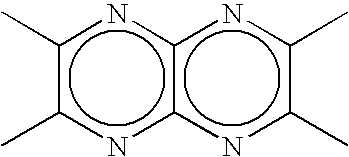
Figure 1 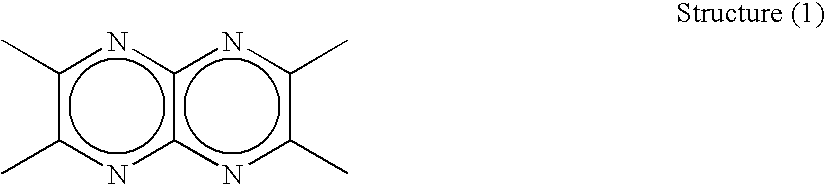
Figure 2 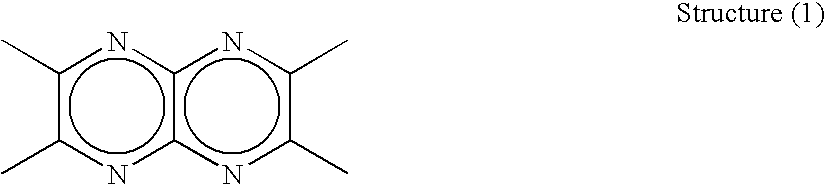
Figure 3
Abstract
Description
TECHNICAL FIELD
[0001] The present invention relates to a novel material for organic electroluminescence (EL) devices and an organic EL device comprising the material, and relates to an organic EL device having a low driving voltage, a long lifetime, and a small leakage current.BACKGROUND ART
[0002] The organic electroluminescence (EL) device using an organic material has been considered to be hopeful for use as a solid emitting type full color display device, which is cheap and has a large area and accordingly, there have widely been conducted a variety of investigations for the development of such devices. In general, the EL device comprises an emitting layer and a pair of electrodes sandwiching the emitting layer between them. The emission of light from the EL device is such a phenomenon that, when an electric field is applied between these electrodes, electrons are injected into the emitting layer from the side of the cathode, while holes are likewise injected into the layer from th...
Examples
example
Example 1
Synthesis of Compound (I)
[0215]3 g of 3,3′-diaminobenzidine (a) and 6.13 g of 5,6-dichloro-2,3-dicyanopyrazine (b) were reacted in 150 ml of acetonitrile under heat reflux for 10 hours. The reaction fluid was filtered at room temperature, and the resulting solid phase was washed with 100 ml of acetonitrile, 200 ml of water, and 50 ml of MeOH. The resulting solids were dried at 40° C. under reduced pressure for 4 hours to obtain 3.13 g of a crude product (c). The crude product (c) was subjected to the mass spectrometry (FDMS) and found to have m / e=466, so that the crude product (c) was identified as the intended product.
[0216]Further, 3 g of the crude product (c) and 3.21 g of DDQ (d) were reacted in 150 ml of THF at room temperature for 7 hours. The resulting reaction fluid was filtered, and the resulting solids were washed with 100 ml of THF and 30 ml of hexane. The resulting solid was dried at 40° C. under reduced pressure for 4 hours to obtain 2.77 g of a compound
[0217]T...
example 2
Synthesis of Compound (A-1)
[0220]10 g of acenaphthenequinone (e) and 8.8 g of 5,6-diamino-2,3-dicyanopyrazine (f) were reacted in 250 ml of pyridine under heat reflux for 18 hours. The reaction fluid was filtered at room temperature, and the resulting solid phase was washed with THF, and then further with acetonitrile. The resulting solids were dried at 60° C. under reduced pressure for 8 hours to obtain 11 g of a compound (A-1). The compound (A-1) was subjected to the mass spectrometry (FDMS) and found to have m / e=306, so that the compound (A-1) was identified as the intended product. The product was purified by the sublimation purification. The reduction potential of the purified compound was measured in the same manner as that for Example 1, and thereby found to be −0.48 V (vs Fc+ / Fc).
[0221]
example 3
Synthesis of Compound (3)
[0222]5 g of 4-trifluoromethyl-1,2-phenylenediamine (g) and 6.21 g of 5,6-dichloro-2,3-dicyanopyrazine (b) were reacted in 200 ml of acetonitrile under heat reflux for 10 hours. The reaction fluid was filtered at room temperature, and the resulting filtrate was concentrated to obtain 8.2 g of a crude product (h). The crude product (h) was subjected to the mass spectrometry (GC-MS) and found to have m / e=302, so that the crude product (h) was identified as the intended product. Further 6 g of the crude product (h) and 4.48 g of DDQ (d) were reacted in 100 ml of THF at room temperature for 8 hours. 400 ml of hexane was added to the resulting reaction fluid, and then a precipitate was collected by filtration. The resulting solids were dried at 60° C. under reduced pressure to obtain 3.33 g of a compound (3).
[0223]The compound (3) was subjected to the mass spectrometry (GC-MS) and found to have m / e=300, so that the compound (3) was identified as the intended prod...