
Soft silicone materials for ophthalmic applications
a technology of ophthalmic applications and silicone materials, applied in the field of polymer silicon materials, can solve the problems of damage to the corneal endothelium, adversely affecting the optical quality of the implant, and the foldable iols were not without drawbacks, and achieve high glass transition temperature and high glass transition temperature. , the effect of high glass transition temperatur
Patent Information
- Authority / Receiving Office
- US · United States
- Patent Type
- Patents(United States)
- Current Assignee / Owner
- Publication Date
- 2013-09-10
Smart Images
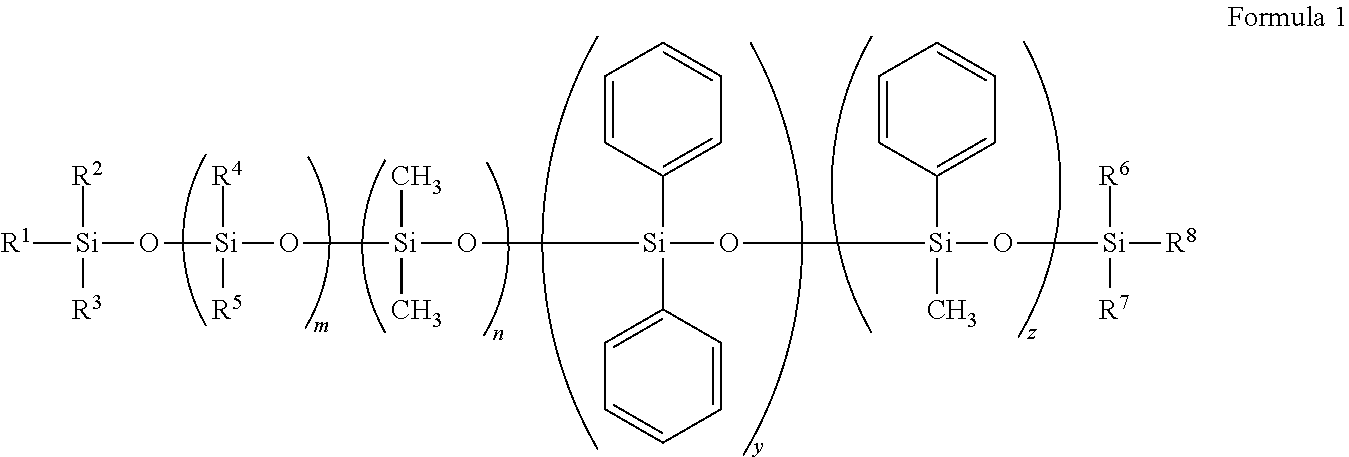
Figure 1 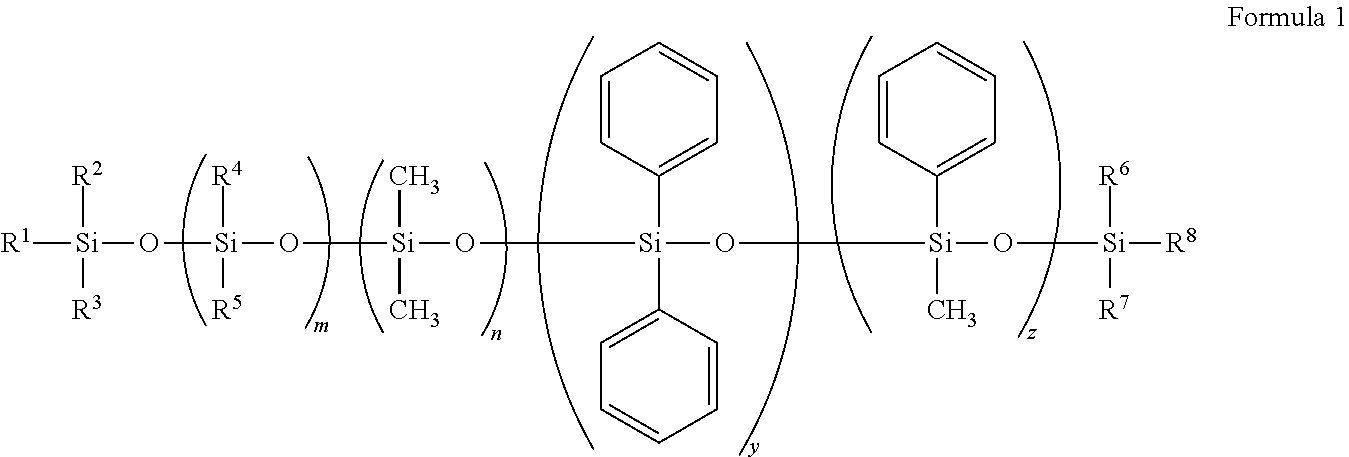
Figure 2 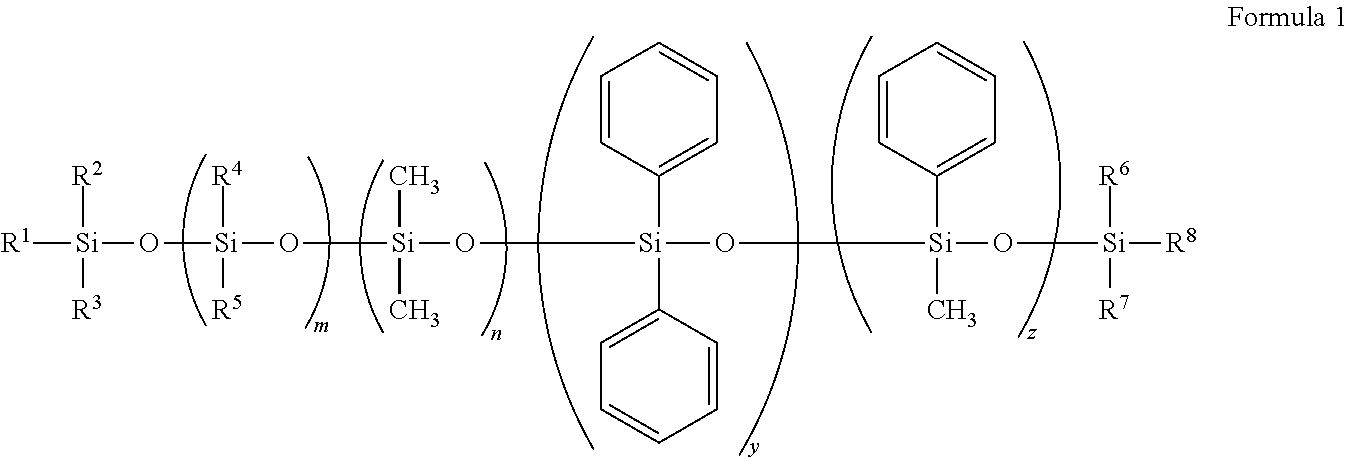
Figure 3
Abstract
Description
CROSS REFERENCE TO RELATED APPLICATIONS
[0001] This application is a continuation-in-part of application Ser. No. 11 / 963,351 filed Dec. 21, 2007.FIELD OF THE INVENTION
[0002] The present invention relates to polymeric silicon materials useful in forming optical materials including, but not limited to, lenses. Methods are also described for forming and shaping lenses.BACKGROUND OF THE INVENTION
[0003] The use of polymeric materials for medical devices is an area where vast improvements in polymeric materials have evolved and are still evolving. Physical properties of these polymers can be fine tuned for use in different environments or to behave in a predictable manner. For example, polymers for use in fabricating intraocular lenses (IOLs), need adaptation allowing for smaller incisions during implantation as well as attain a lower level of leachable content in the polymeric material itself.
[0004] Subsequently, IOLs were designed for smaller incisions through the use of elastomeric composit...
Examples
example 1
Preparation of Polymers
[0101]A. Synthesis of a Hexavinyl Terminated Silicone Fluid without Pendent Vinyl Groups.
[0102]In a method for making this polymer (polymer B38), 103.48 grams of octaphenylcyclotetrasiloxane was placed in a preheated 1000 mL reaction kettle at 105° C. (±10° C.). The mechanical stirrer was turned on and the system was purged with nitrogen for at least 30 minutes. Next, 691.78 grams of octamethylcyclotetrasiloxane and 5.15 grams of hexavinyl dislioxane were added together to the reaction kettle. Then, 3.17 grams of tetramethylammonium siloxanolate was added to the reaction kettle. Stirring continued for at least 68 hours at 105° C. (±10° C.). The temperature of the kettle was then raised to 150° C. (±20° C.) for at least 5 hours. After cooling, the silicone fluid was filtered through a 0.2 micron filter.
[0103]B. Synthesis of a Hexavinyl Terminated Silicone Fluid with Pendent Vinyl Groups.
[0104]In a method for making this polymer (polymer B37), 129.35 grams of oc...
example 2
Preparation of Disc 1
[0111]In a vessel, 0.045 grams of platinum-cyclovinylmethylsiloxane complex, was added to 15 grams of the B38 0.25% UVAM silicone fluid. The mixture was well mixed by high speed centrifugation at least twice for 30 seconds. The resulting formed “Part A” of the silicone fluid. The final catalyst concentration of three otherwise identical silicone fluids was, by weight, about 0.1%, to about 0.5%. In a separate vessel, “Part B” of the silicone fluid was prepared by mixing 0.4038 grams of 25-30% methylhydrosiloxane-dimethylsiloxane copolymer, trimethylsiloxane terminated (HMS-301 from Gelest) with 5 grams of the B38 0.25% UVAM silicone fluid prepared above. Five grams of Part A and 5 grams of Part B were mixed in a vessel with a theoretical HN ratio=1.0.
[0112]The resulting silicone mixture was poured into a Teflon® mold and the mold was placed in an oven at 140° C. for 10 minutes. Moduli of these discs (before and after extraction) were measured using a Q800 DMA (TA...
example 3
Preparation of Disc 2
[0113]In a vessel, 0.045 grams of platinum-cyclovinylmethylsiloxane complex, was added to 15 grams of the B38 0.25% UVAM silicone fluid. The mixture was well mixed by high speed centrifugation at least twice for 30 seconds. In a separate vessel, “Part B” of the silicone fluid was prepared by mixing 0.0908 grams of phenyltris(dimethylsiloxy)silane and 5 grams of B38 0.25% UVAM silicone fluid. Five grams of Part A and 5 grams of Part B were mixed in a vessel with a theoretical HN ratio=0.5.
[0114]The resulting silicone mixture was poured into a Teflon® mold and the mold was placed in an oven at 140° C. for 10 minutes. Moduli of these discs (before and after extraction) were measured using a Q800 DMA (TA Instruments). Diameter and thickness of the sample was measured using a calibrator. After loading the sample on the holder, the temperature of the system was raised to 35° C. and held at equilibrium for 5 minutes before testing. Ramp force was applied to the disk at...