
Urea and thiourea derivatives
a technology which is applied in the field of urea and thiourea derivatives, can solve the problems that the niacin and tryptophan which constitute alternative precursors in many normal cell types cannot be utilized in tumour cells, at least not in a sufficient degree for cell survival
Patent Information
- Authority / Receiving Office
- US · United States
- Patent Type
- Patents(United States)
- Current Assignee / Owner
- Publication Date
- 2014-10-28
- Estimated Expiration
- Not applicable · inactive patent
Smart Images
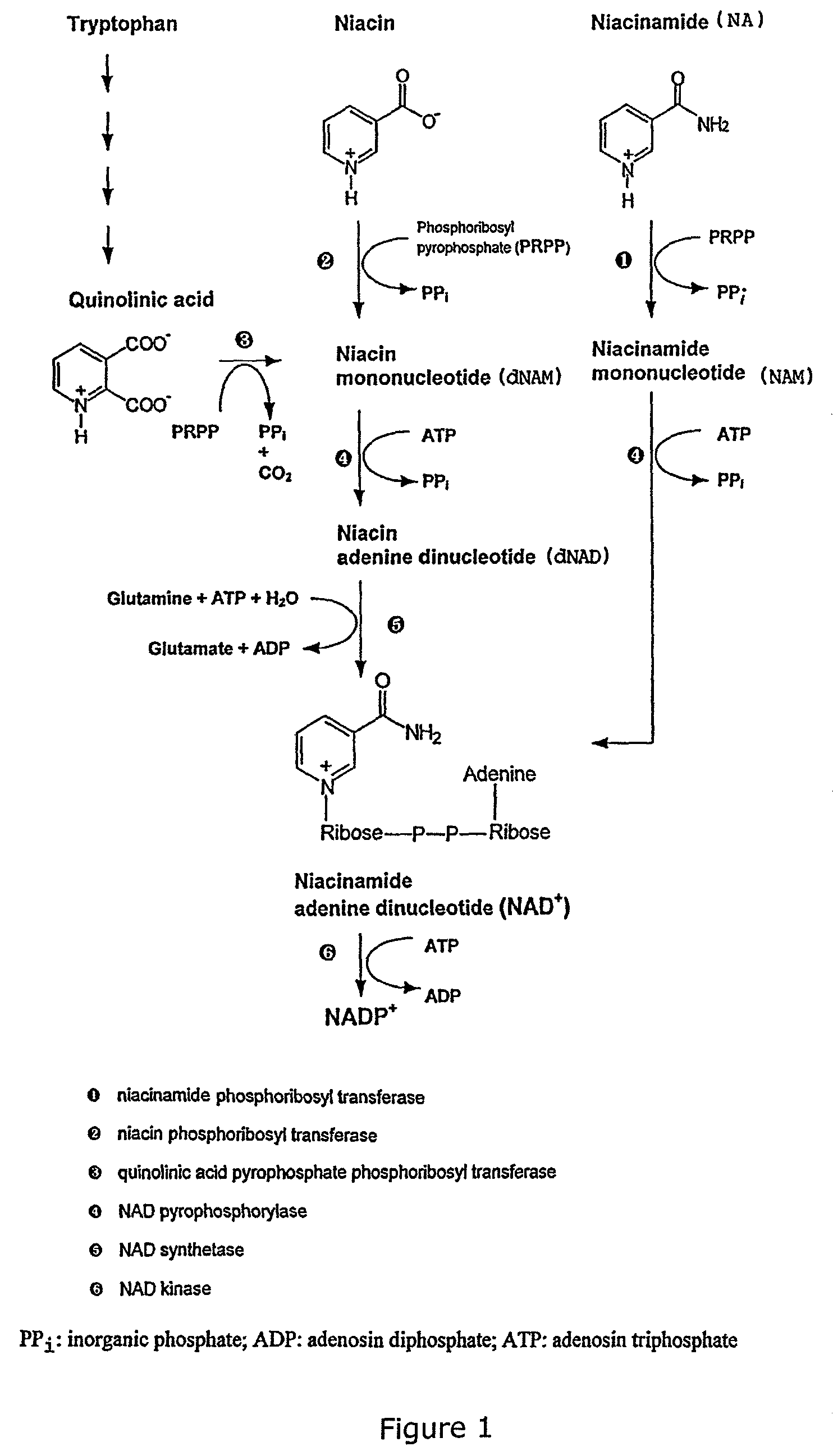
Figure 1 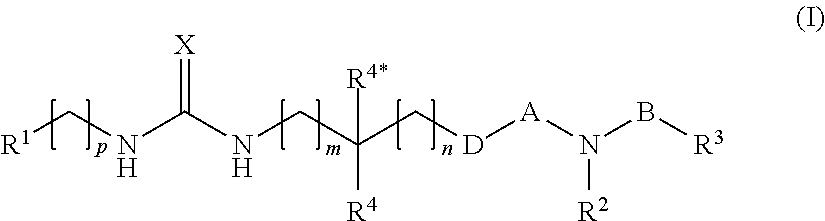
Figure 2 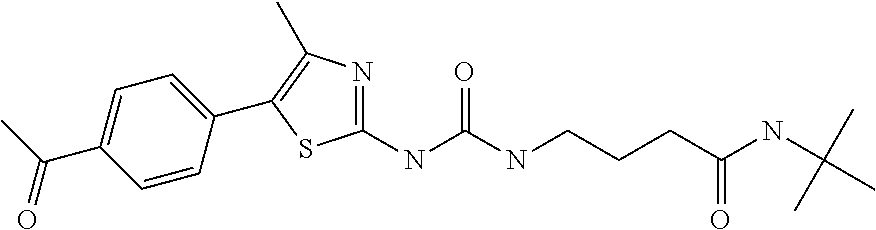
Figure 3
Abstract
Description
CROSS REFERENCE TO PRIOR APPLICATIONS
[0001] This application is a U.S. National Phase application under 35 U.S.C. §371 of International Application No. PCT / EP2009 / 061200, filed on Aug. 31, 2009 and claims benefit of priority to U.S. Provisional Patent Application No. 61 / 092,838, filed on Aug. 29, 2008. The International Application was published in English on Mar. 4, 2010 as WO 2010 / 023307 A1 under PCT Article 21(2). All of these applications are herein incorporated by reference.FIELD OF THE INVENTION
[0002] This invention relates to urea and thiourea derivatives, which are useful for the inhibiting of the enzyme nicotinamide phosphoribosyltransferase (NAMPRT), and to medical use of such derivatives.BACKGROUND OF THE INVENTION
[0003] Inhibition of the enzyme nicotinamide phosphoribosyltransferase (NAMPRT) results in the inhibition of NF-kB, the inhibition of NF-kB being a result of the lowering of cellular concentrations of nicotinamide adenine dinucleotide (NAD) (Beauparlant et al. (200...
Examples
embodiments
[0084]In one primary embodiment, X is selected from ═O and ═S.
[0085]In one embodiment hereof, X is ═O and B is —O—. Within one important variant of this embodiment A is —S(═O)2—. Within another important variant of this embodiment, A is —C(═O)—.
[0086]In another embodiment X is ═S and B is —O—. Within one important variant of this embodiment A is —S(═O)2—. Within another important variant of this embodiment, A is —C(═O)—.
[0087]In another embodiment, X is selected from ═O and ═S and B is a single bond. Within one important variant of this embodiment A is —S(═O)2—. Within another important variant of this embodiment, A is —C(═O)—.
[0088]In another embodiment, B is selected from —(CH2)3-6— and —O—(CF12)2-5—, preferably from —(CH2)3-4— and —O—(CH2)1-3—. Within this embodiment, X is preferably selected from ═O and ═S.
[0089]In the above embodiments, D is preferably selected from a single bond, —O—, and —NR9. More particular, D is a single bond.
[0090]With respect to R1, this substituent is p...
example 1
N-(cyclohexylmethoxy)-6-(3-pyridin-4-ylureido)hexane-1-sulfonamide (Compound 1001)
[0228]
[0229]General procedure 1. Starting materials: 4-aminopyridine and 6-amino-N-(cyclohexylmethoxy)hexane-1-sulfonamide (see, e.g., WO 2009 / 086835).
[0230]1H-NMR (CD3OD): δ 8.28 (m, 2H), 7.46 (m, 2H), 3.75 (d, 2H), 3.22 (m, 4H), 1.9-1.15 (m, 17 H), 0.99 (m, 2H).
example 2
N-Cyclohexyl-N-(2-morpholinoethoxy)-7-(3-pyridin-4-ylureido)heptanamide (Compound 1002)
[0231]
[0232]General procedure 1. Starting materials: 4-aminopyridine and 7-amino-N-cyclohexyl-N-(2-morpholinoethoxy)heptanamide (see, e.g., WO 2009 / 086835).
[0233]MS [M+H]+=476.3, [M−H]−=574.3.3, [M−H+HCOOH]−=520.5.