
Lightning protection structure of blade for wind power generation
a technology of blade protection and wind power generation, which is applied in the installation of lighting conductors, machines/engines, mechanical equipment, etc., can solve the problems of increasing the damage of the lightning receptor around the lightning receptor and the lightning itself, and the damage of the lightning receptor may not be restrained, so as to improve the function of arresting lightning, improve the effect of aerodynamic characteristics and reliably attach the lightning receptor to the blad
Patent Information
- Authority / Receiving Office
- US · United States
- Patent Type
- Patents(United States)
- Current Assignee / Owner
- Publication Date
- 2015-10-27
Smart Images
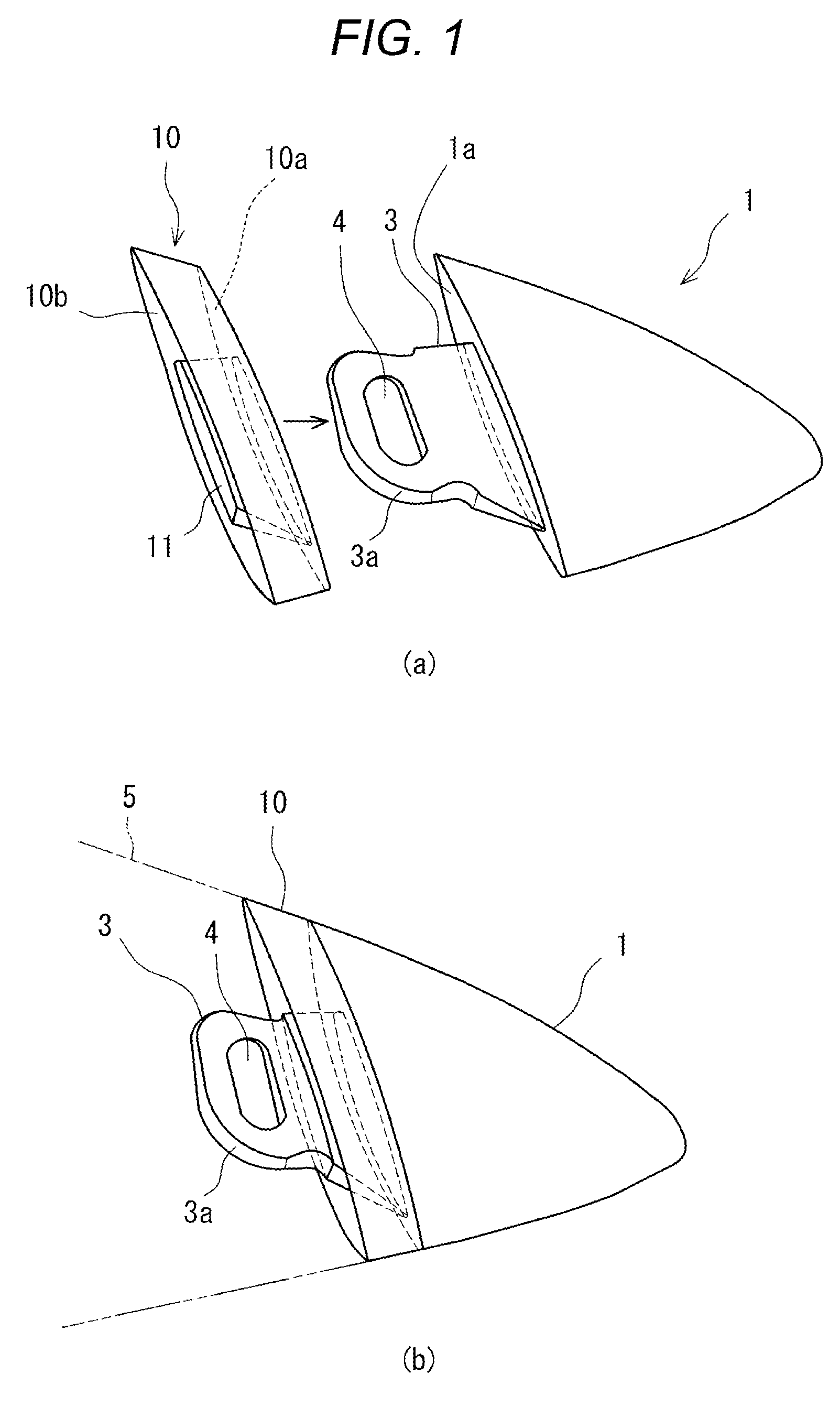
Figure 1 
Figure 2 
Figure 3
Abstract
Description
TECHNICAL FIELD
[0001] The present invention relates to a lightning protection of a blade for wind power generation to prevent damage of the blade which is utilized for the wind power generation.BACKGROUND ART
[0002] Blades for wind power generation currently used is mainly made of glass fiber reinforced plastics (GFRP), and the blade itself is an insulator and has no electrical conductivity. Accordingly, in an era when a small wind power generator was used, it was considered that the blade was not struck by lightning. However, as the wind power generator grows in size, damage of the blade struck by the lightning is increased. Accordingly, a method of attaching a member (e.g., lightning receptor) made of metal to the blade and connecting a lead line (e.g., down conductor) to the metallic member so as to lead the lightning to the ground has been generalized (for example, refer to Background-Art section of Patent Literature 1).
[0003] Various shapes or types of the lightning receptors have ...
Examples
embodiment 1
[0054]Next, the lightning protection structure including the lightning receptor 1 made of aluminum and the ceramic member 10 according to the embodiment of the present invention illustrated in FIG. 1 and a lightning protection structure including a lightning receptor 20, with no ceramic member is interposed, according to the related art illustrated in FIG. 6 were attached to an FRP material imitated as a blade. Then, those lightning protection structures were subjected to 2-D electric field analysis using simulation to predict a position struck by the lightning.
[0055]Incidentally, in the analysis, an analysis software MARC2007R1 (a product manufactured by MSC Software Corporation) was utilized, and a point charge was placed at a distance of 1 m from the tip end portion of the blade. Letting a position immediately above the tip end portion of the blade to be 0°, point charges were placed at positions of ±30°, ±60°, and ±90°, and positions of 200 mm and 500 mm lowered immediately belo...