

Autoclave Temperature Load Mapping: Optimization Techniques
SEP 12, 20259 MIN READ
Generate Your Research Report Instantly with AI Agent
PatSnap Eureka helps you evaluate technical feasibility & market potential.
Autoclave Temperature Mapping Background and Objectives
Autoclave temperature mapping has evolved significantly over the past four decades, transitioning from rudimentary manual monitoring systems to sophisticated digital solutions with real-time analytics capabilities. This technological progression has been driven by increasingly stringent regulatory requirements in pharmaceutical, medical device, and aerospace industries, where precise temperature control during sterilization and curing processes is critical for product quality and safety.
The fundamental principle of autoclave temperature mapping involves the strategic placement of temperature sensors throughout the chamber to identify thermal gradients, cold spots, and heat distribution patterns. Early mapping techniques relied on limited sensor arrays and post-process data analysis, which often resulted in delayed identification of process deviations and quality issues.
Current technological trends in this field include the integration of wireless sensor networks, cloud-based data storage and analysis, machine learning algorithms for predictive maintenance, and digital twin modeling for virtual process optimization. These advancements have significantly improved the accuracy, reliability, and efficiency of temperature mapping processes while reducing operational costs and validation timeframes.
The primary objective of optimizing autoclave temperature load mapping is to develop methodologies that ensure uniform temperature distribution throughout the chamber regardless of load configuration, cycle parameters, or environmental conditions. This optimization aims to minimize temperature variations within specified tolerance ranges, typically ±1°C in pharmaceutical applications and ±3°C in aerospace composite curing processes.
Secondary objectives include reducing cycle times without compromising quality, minimizing energy consumption through more efficient heating and cooling patterns, extending equipment lifespan through optimized operational parameters, and developing standardized validation protocols that comply with international regulations such as FDA 21 CFR Part 11, EU GMP Annex 15, and ISO 17665.
The technical evolution in this field has been characterized by a shift from reactive to proactive approaches, where potential temperature distribution issues are identified and addressed before they impact product quality. This paradigm shift has been facilitated by advances in computational fluid dynamics (CFD) modeling, which allows for the simulation of steam flow patterns and heat transfer mechanisms within the autoclave chamber under various loading conditions.
As industries continue to demand higher precision, greater efficiency, and enhanced documentation capabilities, the development of next-generation temperature mapping technologies remains a critical focus area for research and development efforts in thermal processing applications.
The fundamental principle of autoclave temperature mapping involves the strategic placement of temperature sensors throughout the chamber to identify thermal gradients, cold spots, and heat distribution patterns. Early mapping techniques relied on limited sensor arrays and post-process data analysis, which often resulted in delayed identification of process deviations and quality issues.
Current technological trends in this field include the integration of wireless sensor networks, cloud-based data storage and analysis, machine learning algorithms for predictive maintenance, and digital twin modeling for virtual process optimization. These advancements have significantly improved the accuracy, reliability, and efficiency of temperature mapping processes while reducing operational costs and validation timeframes.
The primary objective of optimizing autoclave temperature load mapping is to develop methodologies that ensure uniform temperature distribution throughout the chamber regardless of load configuration, cycle parameters, or environmental conditions. This optimization aims to minimize temperature variations within specified tolerance ranges, typically ±1°C in pharmaceutical applications and ±3°C in aerospace composite curing processes.
Secondary objectives include reducing cycle times without compromising quality, minimizing energy consumption through more efficient heating and cooling patterns, extending equipment lifespan through optimized operational parameters, and developing standardized validation protocols that comply with international regulations such as FDA 21 CFR Part 11, EU GMP Annex 15, and ISO 17665.
The technical evolution in this field has been characterized by a shift from reactive to proactive approaches, where potential temperature distribution issues are identified and addressed before they impact product quality. This paradigm shift has been facilitated by advances in computational fluid dynamics (CFD) modeling, which allows for the simulation of steam flow patterns and heat transfer mechanisms within the autoclave chamber under various loading conditions.
As industries continue to demand higher precision, greater efficiency, and enhanced documentation capabilities, the development of next-generation temperature mapping technologies remains a critical focus area for research and development efforts in thermal processing applications.
Market Demand Analysis for Optimized Autoclave Processes
The global autoclave market is experiencing significant growth, driven by increasing demand for sterilization and composite curing processes across multiple industries. The market was valued at approximately $1.9 billion in 2022 and is projected to reach $2.7 billion by 2028, growing at a CAGR of 6.2%. This growth is particularly pronounced in aerospace, healthcare, and advanced materials manufacturing sectors where precise temperature control is critical.
In the aerospace industry, the push for lightweight composite materials has intensified the need for optimized autoclave processes. Major aircraft manufacturers are seeking temperature mapping solutions that can reduce cycle times by 15-20% while maintaining or improving part quality. This demand is driven by production backlogs and the need to increase manufacturing efficiency for next-generation aircraft components.
The healthcare sector represents another significant market segment, with hospitals and medical device manufacturers requiring increasingly precise sterilization processes. The COVID-19 pandemic has accelerated this trend, with a 35% increase in demand for advanced autoclave systems that can provide validated temperature mapping and documentation for regulatory compliance.
Pharmaceutical manufacturing presents a substantial growth opportunity, with stringent regulatory requirements driving investment in temperature mapping technologies. The FDA and EMA have strengthened validation requirements, creating a market for solutions that can demonstrate uniform temperature distribution and process repeatability. This segment is expected to grow at 7.8% annually through 2027.
Geographically, North America and Europe currently dominate the market for advanced autoclave optimization technologies, accounting for approximately 65% of global demand. However, Asia-Pacific regions, particularly China and India, are showing the fastest growth rates at 9.3% annually as manufacturing capabilities expand and quality standards increase.
Customer pain points consistently identified in market research include energy consumption, process validation time, and temperature uniformity challenges. Surveys indicate that 78% of industrial autoclave users consider energy efficiency a critical factor in purchasing decisions, while 82% cite temperature uniformity as essential for quality outcomes.
The market is increasingly demanding integrated digital solutions that combine temperature mapping with predictive analytics and process optimization. This trend is reflected in a 40% year-over-year increase in adoption of IoT-enabled autoclave monitoring systems that provide real-time temperature mapping data and optimization recommendations.
In the aerospace industry, the push for lightweight composite materials has intensified the need for optimized autoclave processes. Major aircraft manufacturers are seeking temperature mapping solutions that can reduce cycle times by 15-20% while maintaining or improving part quality. This demand is driven by production backlogs and the need to increase manufacturing efficiency for next-generation aircraft components.
The healthcare sector represents another significant market segment, with hospitals and medical device manufacturers requiring increasingly precise sterilization processes. The COVID-19 pandemic has accelerated this trend, with a 35% increase in demand for advanced autoclave systems that can provide validated temperature mapping and documentation for regulatory compliance.
Pharmaceutical manufacturing presents a substantial growth opportunity, with stringent regulatory requirements driving investment in temperature mapping technologies. The FDA and EMA have strengthened validation requirements, creating a market for solutions that can demonstrate uniform temperature distribution and process repeatability. This segment is expected to grow at 7.8% annually through 2027.
Geographically, North America and Europe currently dominate the market for advanced autoclave optimization technologies, accounting for approximately 65% of global demand. However, Asia-Pacific regions, particularly China and India, are showing the fastest growth rates at 9.3% annually as manufacturing capabilities expand and quality standards increase.
Customer pain points consistently identified in market research include energy consumption, process validation time, and temperature uniformity challenges. Surveys indicate that 78% of industrial autoclave users consider energy efficiency a critical factor in purchasing decisions, while 82% cite temperature uniformity as essential for quality outcomes.
The market is increasingly demanding integrated digital solutions that combine temperature mapping with predictive analytics and process optimization. This trend is reflected in a 40% year-over-year increase in adoption of IoT-enabled autoclave monitoring systems that provide real-time temperature mapping data and optimization recommendations.
Current Challenges in Autoclave Temperature Distribution
Despite significant advancements in autoclave technology, achieving uniform temperature distribution throughout the chamber remains one of the most persistent challenges in industrial applications. Current autoclave systems struggle with thermal gradients that can vary by as much as 5-10°C between different locations within the chamber, particularly in large-scale industrial autoclaves used for composite curing and sterilization processes. These temperature inconsistencies directly impact product quality, process reliability, and energy efficiency.
The primary physical constraint stems from heat transfer limitations inherent to the autoclave design. Conventional forced convection systems often create "hot spots" and "cold spots" due to uneven airflow patterns. This is especially problematic in densely loaded autoclaves where airflow obstruction occurs between products or components, creating stagnant zones with inadequate heat transfer. Recent studies have documented that up to 30% of the autoclave volume may experience suboptimal temperature conditions during standard processing cycles.
Sensor placement and monitoring systems present another significant challenge. Traditional temperature mapping relies on a limited number of fixed thermocouples that cannot capture the complete thermal profile throughout the chamber. The industry standard of using 10-15 sensors for large industrial autoclaves provides insufficient spatial resolution to detect localized temperature anomalies, particularly in complex geometries or densely packed loads.
Control system limitations further exacerbate temperature distribution issues. Most current autoclave controllers employ simplified PID algorithms that cannot adequately compensate for the complex, non-linear thermal behavior within the chamber. These systems typically respond to average temperature readings rather than addressing specific zones requiring targeted heating or cooling, resulting in overcompensation and temperature oscillations that can exceed specification limits.
Energy efficiency concerns also complicate temperature distribution management. The industry faces increasing pressure to reduce energy consumption while maintaining process performance. Current approaches often rely on brute-force heating methods that consume excessive energy without resolving distribution issues. Studies indicate that up to 40% of energy input may be wasted due to inefficient heating strategies and poor thermal management.
Material loading configurations represent another critical challenge. The arrangement, density, and thermal properties of processed materials significantly impact temperature distribution. Current practices often lack standardized loading protocols, resulting in inconsistent thermal performance between batches. This variability makes it difficult to establish reliable temperature mapping models that can predict thermal behavior across different load configurations.
The primary physical constraint stems from heat transfer limitations inherent to the autoclave design. Conventional forced convection systems often create "hot spots" and "cold spots" due to uneven airflow patterns. This is especially problematic in densely loaded autoclaves where airflow obstruction occurs between products or components, creating stagnant zones with inadequate heat transfer. Recent studies have documented that up to 30% of the autoclave volume may experience suboptimal temperature conditions during standard processing cycles.
Sensor placement and monitoring systems present another significant challenge. Traditional temperature mapping relies on a limited number of fixed thermocouples that cannot capture the complete thermal profile throughout the chamber. The industry standard of using 10-15 sensors for large industrial autoclaves provides insufficient spatial resolution to detect localized temperature anomalies, particularly in complex geometries or densely packed loads.
Control system limitations further exacerbate temperature distribution issues. Most current autoclave controllers employ simplified PID algorithms that cannot adequately compensate for the complex, non-linear thermal behavior within the chamber. These systems typically respond to average temperature readings rather than addressing specific zones requiring targeted heating or cooling, resulting in overcompensation and temperature oscillations that can exceed specification limits.
Energy efficiency concerns also complicate temperature distribution management. The industry faces increasing pressure to reduce energy consumption while maintaining process performance. Current approaches often rely on brute-force heating methods that consume excessive energy without resolving distribution issues. Studies indicate that up to 40% of energy input may be wasted due to inefficient heating strategies and poor thermal management.
Material loading configurations represent another critical challenge. The arrangement, density, and thermal properties of processed materials significantly impact temperature distribution. Current practices often lack standardized loading protocols, resulting in inconsistent thermal performance between batches. This variability makes it difficult to establish reliable temperature mapping models that can predict thermal behavior across different load configurations.
Current Temperature Load Mapping Methodologies and Standards
01 Temperature distribution monitoring systems in autoclaves
Systems designed to monitor and map temperature distribution within autoclaves during sterilization cycles. These systems typically include multiple temperature sensors placed at strategic locations throughout the autoclave chamber to identify cold spots and ensure uniform heat distribution. The data collected helps validate that all areas within the load reach the required sterilization temperature, which is critical for ensuring effective sterilization of medical devices and pharmaceutical products.- Temperature distribution monitoring systems in autoclaves: Advanced monitoring systems are used to track temperature distribution within autoclaves during sterilization cycles. These systems employ multiple temperature sensors strategically placed throughout the chamber to create detailed temperature maps. Real-time data collection allows for identification of cold spots or uneven heating patterns, ensuring that all items in the load receive adequate sterilization temperatures. These monitoring systems often include software for data analysis and visualization of temperature gradients across the autoclave chamber.
- Load mapping techniques for validation of sterilization processes: Load mapping involves placing temperature sensors at critical locations within the autoclave load to verify that sterilization parameters are met throughout the entire chamber. This technique is essential for validating sterilization processes in pharmaceutical, medical device, and food industries. The mapping process identifies the slowest-to-heat locations within different load configurations, ensuring that even the most challenging areas reach the required temperature for the specified time. Validation protocols typically require multiple mapping runs with various load patterns to establish consistent performance.
- Innovative sensor placement strategies for temperature mapping: Strategic placement of temperature sensors is critical for accurate mapping of temperature distribution in autoclaves. Sensors are positioned at geometric center points, corners, near doors, and adjacent to cooling systems where temperature variations are most likely to occur. Some systems use wireless or flexible sensors that can be placed directly within product packaging or containers to measure actual product temperatures rather than just ambient chamber temperatures. Advanced mapping approaches may include 3D modeling of heat transfer to optimize sensor placement for different load configurations.
- Automated temperature distribution analysis and reporting systems: Modern autoclave temperature mapping systems incorporate automated analysis tools that process temperature data to generate comprehensive reports on sterilization cycle performance. These systems can automatically identify temperature deviations, calculate F0 values (sterilization equivalence), and determine if acceptance criteria are met. Real-time alerts notify operators of potential issues during the sterilization process. Advanced software platforms provide visualization tools such as heat maps, 3D temperature profiles, and trend analysis to simplify interpretation of complex temperature distribution data.
- Load configuration optimization based on temperature distribution data: Temperature mapping data is used to optimize load configurations within autoclaves to improve sterilization efficiency and consistency. Analysis of temperature distribution patterns helps determine ideal spacing between items, orientation of containers, and maximum load densities. Some systems incorporate computational fluid dynamics to model steam or heat flow around different load arrangements. This approach allows for development of standardized loading patterns that ensure uniform temperature distribution while maximizing autoclave capacity and minimizing cycle times.
02 Load mapping techniques for autoclave validation
Methodologies for mapping temperature distribution across different load configurations in autoclaves. These techniques involve placing temperature sensors throughout the load to verify that sterilization parameters are met at all points. The mapping process identifies the slowest-to-heat locations and ensures that even the most challenging areas reach the required temperature for the specified time. This validation is essential for regulatory compliance and quality assurance in medical and pharmaceutical manufacturing.Expand Specific Solutions03 Real-time temperature monitoring and data acquisition systems
Advanced systems that provide real-time monitoring of temperature distribution during autoclave cycles. These systems collect and analyze temperature data from multiple points simultaneously, allowing for immediate detection of temperature anomalies. The technology typically includes data loggers, wireless sensors, and software interfaces that generate comprehensive reports on temperature uniformity. Real-time monitoring enables operators to make adjustments during the sterilization process if necessary.Expand Specific Solutions04 Temperature sensor placement optimization for autoclave validation
Methods for determining optimal placement of temperature sensors within autoclave loads to accurately capture temperature distribution. These approaches use mathematical models and empirical testing to identify critical monitoring points that represent worst-case scenarios. Proper sensor placement ensures that the coldest spots in the load are monitored, providing confidence that if these locations reach sterilization temperature, the entire load has been properly sterilized.Expand Specific Solutions05 Automated temperature mapping systems with analytical capabilities
Integrated systems that not only map temperature distribution but also provide analytical capabilities to interpret the data. These systems automatically process temperature data from multiple sensors, generate visual heat maps, calculate statistical parameters, and identify potential issues. The analytical tools help in understanding temperature gradients within the autoclave chamber and can suggest improvements to load configuration or cycle parameters to achieve more uniform temperature distribution.Expand Specific Solutions
Leading Manufacturers and Research Institutions in Autoclave Industry
Autoclave temperature load mapping optimization is currently in a growth phase, with the market expanding due to increasing demand for precision in thermal processing across aerospace, healthcare, and manufacturing sectors. The global market size for autoclave technology is estimated at $2.5-3 billion, growing at 5-7% annually. Technologically, the field is moderately mature but evolving rapidly with digital integration. Leading companies demonstrate varying maturity levels: Boeing, GE, and Airbus represent advanced implementation with proprietary systems; Siemens Energy and Kawasaki Heavy Industries offer comprehensive commercial solutions; while specialized firms like Aerothermal Technology Group and SFA Engineering provide niche expertise in thermal mapping optimization. Academic institutions including Carnegie Mellon and Zhejiang University contribute significant research advancing computational modeling techniques.
The Boeing Co.
Technical Solution: Boeing has developed advanced autoclave temperature load mapping systems for aerospace composite manufacturing. Their approach integrates multiple thermal sensors strategically positioned throughout the autoclave chamber to create comprehensive thermal profiles. Boeing's system employs predictive modeling algorithms that anticipate temperature variations based on part geometry and material properties, allowing for real-time adjustments during cure cycles. The company has implemented machine learning techniques to analyze historical cure data, enabling optimization of temperature ramp rates and dwell times for specific composite layups. Boeing's solution includes proprietary software that generates 3D thermal maps of the autoclave environment, identifying potential cold or hot spots before production begins, significantly reducing trial-and-error in manufacturing processes.
Strengths: Exceptional integration with aerospace-grade composite manufacturing processes; sophisticated predictive modeling capabilities; extensive historical data for machine learning optimization. Weaknesses: System complexity requires significant technical expertise; high implementation costs; primarily optimized for aerospace applications rather than broader industrial uses.
General Electric Company
Technical Solution: GE has developed a comprehensive autoclave temperature load mapping system as part of their Industrial Internet of Things (IIoT) platform. Their solution employs a network of high-precision temperature sensors combined with advanced analytics to create detailed thermal profiles throughout the autoclave chamber. GE's system utilizes proprietary algorithms that analyze historical temperature data alongside current readings to predict and prevent thermal anomalies during the curing process. The company has implemented edge computing capabilities that process temperature data in real-time, allowing for immediate adjustments to heating elements and air circulation systems. GE's platform integrates with their Predix industrial analytics software, enabling manufacturers to optimize autoclave cycles based on specific part geometries and material requirements, resulting in reported energy savings of up to 15% and cycle time reductions of approximately 20% for certain applications.
Strengths: Seamless integration with broader industrial IoT ecosystem; powerful predictive analytics capabilities; applicable across multiple industries beyond aerospace. Weaknesses: Requires significant investment in compatible GE infrastructure; optimization benefits vary significantly depending on specific applications; complex implementation process.
Critical Technical Innovations in Temperature Sensor Placement
Autoclave
PatentInactiveJP2012110810A
Innovation
- The autoclave design incorporates a gas flow path with a bypass channel and auxiliary heating means, including airflow guide nozzles and heating elements, to ensure uniform heat distribution and curing rates by compensating for heat loss in the upper stage.


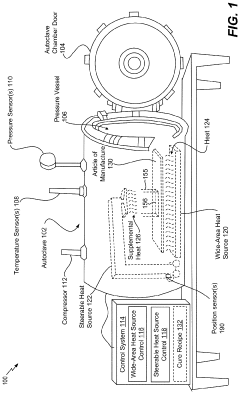
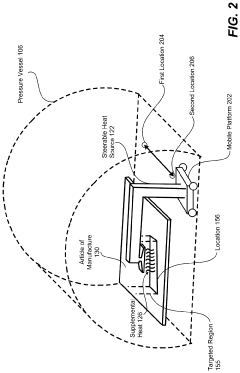
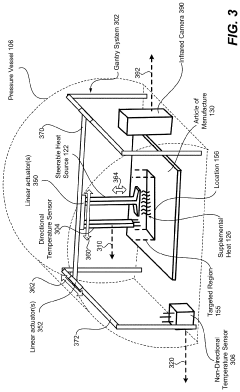
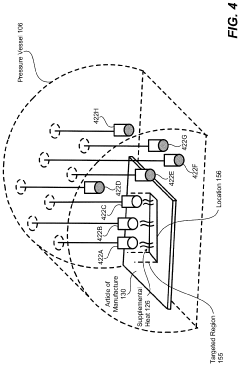
Steerable heat source
PatentActiveUS20200307035A1
Innovation
- A steerable heat source is integrated within the autoclave, coupled with a control system that directs supplemental heat to targeted regions using temperature sensors and a compressor to regulate pressure, ensuring precise temperature control and uniform heating.
Regulatory Compliance and Validation Requirements
Regulatory compliance for autoclave temperature load mapping is governed by several international standards and guidelines that manufacturers must adhere to. The FDA's 21 CFR Part 211 for pharmaceutical manufacturing and ISO 17665 for sterilization of health care products establish the foundational requirements for validation protocols. These regulations mandate comprehensive documentation of temperature distribution within autoclaves to ensure sterilization efficacy.
The validation requirements typically follow a three-phase approach: Installation Qualification (IQ), Operational Qualification (OQ), and Performance Qualification (PQ). During IQ, all autoclave components must be verified against design specifications. OQ requires demonstration that the autoclave operates within established parameters across its operational range. PQ involves challenging the system under worst-case scenarios to confirm consistent sterilization performance.
Temperature mapping validation protocols must include specific acceptance criteria, typically requiring that all measured points within the chamber reach the minimum sterilization temperature. The commonly accepted standard for steam sterilization is 121°C for a minimum of 15 minutes, with temperature variations not exceeding ±1°C during the sterilization phase.
Documentation requirements are particularly stringent, necessitating detailed records of sensor calibration, placement rationale, and raw data collection. Regulatory bodies expect to see statistical analysis of temperature distribution, including identification of cold spots and calculation of F0 values (sterilization equivalence) for biological validation.
Risk-based approaches to validation have gained regulatory acceptance in recent years, allowing manufacturers to focus resources on critical areas identified through formal risk assessment. This approach must be scientifically justified and thoroughly documented to satisfy regulatory scrutiny.
Revalidation schedules must be established based on equipment changes, maintenance activities, or significant process modifications. Most regulatory frameworks require periodic revalidation, typically annually, even without changes to ensure continued compliance and system performance.
International harmonization efforts through organizations like PDA (Parenteral Drug Association) and ISPE (International Society for Pharmaceutical Engineering) have produced technical reports that serve as industry standards for temperature mapping methodologies, helping manufacturers meet global compliance requirements while optimizing validation resources.
The validation requirements typically follow a three-phase approach: Installation Qualification (IQ), Operational Qualification (OQ), and Performance Qualification (PQ). During IQ, all autoclave components must be verified against design specifications. OQ requires demonstration that the autoclave operates within established parameters across its operational range. PQ involves challenging the system under worst-case scenarios to confirm consistent sterilization performance.
Temperature mapping validation protocols must include specific acceptance criteria, typically requiring that all measured points within the chamber reach the minimum sterilization temperature. The commonly accepted standard for steam sterilization is 121°C for a minimum of 15 minutes, with temperature variations not exceeding ±1°C during the sterilization phase.
Documentation requirements are particularly stringent, necessitating detailed records of sensor calibration, placement rationale, and raw data collection. Regulatory bodies expect to see statistical analysis of temperature distribution, including identification of cold spots and calculation of F0 values (sterilization equivalence) for biological validation.
Risk-based approaches to validation have gained regulatory acceptance in recent years, allowing manufacturers to focus resources on critical areas identified through formal risk assessment. This approach must be scientifically justified and thoroughly documented to satisfy regulatory scrutiny.
Revalidation schedules must be established based on equipment changes, maintenance activities, or significant process modifications. Most regulatory frameworks require periodic revalidation, typically annually, even without changes to ensure continued compliance and system performance.
International harmonization efforts through organizations like PDA (Parenteral Drug Association) and ISPE (International Society for Pharmaceutical Engineering) have produced technical reports that serve as industry standards for temperature mapping methodologies, helping manufacturers meet global compliance requirements while optimizing validation resources.
Energy Efficiency and Sustainability Considerations
Energy efficiency and sustainability have become critical considerations in autoclave temperature load mapping optimization. Modern industrial autoclaves consume significant amounts of energy, with thermal processes accounting for approximately 60-70% of total energy consumption in many manufacturing facilities. The environmental impact of these energy-intensive operations has prompted industries to seek more sustainable approaches to autoclave operations.
Recent advancements in thermal insulation materials have demonstrated potential energy savings of 15-25% in autoclave operations. These materials, including aerogel-based composites and advanced ceramic fiber blankets, provide superior thermal resistance while maintaining operational integrity under high-pressure conditions. Implementation of these materials in autoclave design has shown reduced heat loss and more uniform temperature distribution, contributing to both energy efficiency and process quality.
Heat recovery systems represent another significant opportunity for sustainability improvements. Waste heat recapture technologies can redirect thermal energy from completed autoclave cycles to preheat incoming loads or supplement facility heating requirements. Case studies from aerospace manufacturing facilities indicate that integrated heat recovery systems can reduce overall energy consumption by 20-30% while decreasing carbon emissions proportionally.
Digital twin modeling has emerged as a powerful tool for energy optimization in autoclave operations. These virtual replicas enable engineers to simulate various operational parameters and identify optimal energy-efficient processing conditions without disrupting production. Advanced algorithms can predict energy consumption patterns and recommend adjustments to minimize resource utilization while maintaining product quality standards.
Water consumption represents another sustainability concern in autoclave operations. Closed-loop cooling systems and water recycling technologies have demonstrated water usage reductions of up to 40% compared to traditional open systems. These approaches not only conserve water resources but also reduce the energy required for water treatment and distribution.
Carbon footprint reduction strategies specifically tailored for autoclave operations include transitioning to renewable energy sources, implementing demand-response systems to align energy-intensive processes with periods of renewable energy availability, and developing carbon offset programs. Several manufacturing facilities have successfully implemented hybrid energy systems that integrate solar thermal collectors with traditional heating methods, reducing fossil fuel dependency by 25-35% for autoclave operations.
Return on investment analyses indicate that most energy efficiency improvements in autoclave operations achieve payback periods of 2-4 years, making them financially attractive while supporting corporate sustainability goals and regulatory compliance requirements. As environmental regulations become increasingly stringent worldwide, proactive adoption of these sustainable practices positions organizations advantageously for future operational continuity.
Recent advancements in thermal insulation materials have demonstrated potential energy savings of 15-25% in autoclave operations. These materials, including aerogel-based composites and advanced ceramic fiber blankets, provide superior thermal resistance while maintaining operational integrity under high-pressure conditions. Implementation of these materials in autoclave design has shown reduced heat loss and more uniform temperature distribution, contributing to both energy efficiency and process quality.
Heat recovery systems represent another significant opportunity for sustainability improvements. Waste heat recapture technologies can redirect thermal energy from completed autoclave cycles to preheat incoming loads or supplement facility heating requirements. Case studies from aerospace manufacturing facilities indicate that integrated heat recovery systems can reduce overall energy consumption by 20-30% while decreasing carbon emissions proportionally.
Digital twin modeling has emerged as a powerful tool for energy optimization in autoclave operations. These virtual replicas enable engineers to simulate various operational parameters and identify optimal energy-efficient processing conditions without disrupting production. Advanced algorithms can predict energy consumption patterns and recommend adjustments to minimize resource utilization while maintaining product quality standards.
Water consumption represents another sustainability concern in autoclave operations. Closed-loop cooling systems and water recycling technologies have demonstrated water usage reductions of up to 40% compared to traditional open systems. These approaches not only conserve water resources but also reduce the energy required for water treatment and distribution.
Carbon footprint reduction strategies specifically tailored for autoclave operations include transitioning to renewable energy sources, implementing demand-response systems to align energy-intensive processes with periods of renewable energy availability, and developing carbon offset programs. Several manufacturing facilities have successfully implemented hybrid energy systems that integrate solar thermal collectors with traditional heating methods, reducing fossil fuel dependency by 25-35% for autoclave operations.
Return on investment analyses indicate that most energy efficiency improvements in autoclave operations achieve payback periods of 2-4 years, making them financially attractive while supporting corporate sustainability goals and regulatory compliance requirements. As environmental regulations become increasingly stringent worldwide, proactive adoption of these sustainable practices positions organizations advantageously for future operational continuity.
Unlock deeper insights with PatSnap Eureka Quick Research — get a full tech report to explore trends and direct your research. Try now!
Generate Your Research Report Instantly with AI Agent
Supercharge your innovation with PatSnap Eureka AI Agent Platform!