

CSAC Performance Under Shock And Vibration: Test Methods
AUG 29, 20259 MIN READ
Generate Your Research Report Instantly with AI Agent
PatSnap Eureka helps you evaluate technical feasibility & market potential.
CSAC Technology Background and Objectives
Chip-Scale Atomic Clocks (CSACs) represent a significant advancement in precision timing technology, miniaturizing atomic clock capabilities into remarkably compact form factors. The development of CSACs began in the early 2000s, primarily driven by DARPA's initiative to create ultra-small, low-power atomic frequency references. These devices leverage the quantum properties of atoms, typically cesium or rubidium, to achieve exceptional timing stability that far exceeds traditional quartz oscillators.
The evolution of CSAC technology has been characterized by progressive improvements in size reduction, power efficiency, and performance reliability. Early prototypes demonstrated the feasibility of miniaturizing atomic clock technology but faced significant challenges in maintaining performance under variable environmental conditions. Over the past decade, substantial progress has been made in addressing these limitations, with contemporary CSACs achieving remarkable stability while consuming only milliwatts of power.
Understanding CSAC performance under mechanical stress conditions represents a critical frontier in this technology's development. As these devices find increasing applications in mobile platforms, aerospace systems, and defense equipment, their ability to maintain timing accuracy while experiencing shock and vibration becomes paramount. The historical trajectory shows that while frequency stability has improved significantly, environmental resilience remains an ongoing challenge.
The primary technical objective in CSAC shock and vibration testing is to develop standardized methodologies that accurately characterize performance degradation under mechanical stress. This includes quantifying frequency shifts, phase noise increases, and potential physical damage thresholds. Additionally, there is a need to establish correlations between specific mechanical stress profiles and their impacts on different CSAC architectures and designs.
Current technical goals focus on enhancing CSAC resilience to mechanical disturbances without compromising their fundamental advantages in size, weight, and power consumption. This involves innovations in internal damping mechanisms, structural reinforcements, and advanced packaging techniques that can isolate sensitive components from external forces.
The broader technological trajectory points toward CSACs that can maintain sub-ppb (parts per billion) frequency stability even when subjected to significant mechanical stress. This capability would enable deployment in increasingly demanding environments, from unmanned aerial vehicles experiencing turbulence to spacecraft during launch sequences. The development of robust test methods represents a critical enabler for this evolution, providing standardized frameworks to evaluate and compare performance across different CSAC implementations.
The evolution of CSAC technology has been characterized by progressive improvements in size reduction, power efficiency, and performance reliability. Early prototypes demonstrated the feasibility of miniaturizing atomic clock technology but faced significant challenges in maintaining performance under variable environmental conditions. Over the past decade, substantial progress has been made in addressing these limitations, with contemporary CSACs achieving remarkable stability while consuming only milliwatts of power.
Understanding CSAC performance under mechanical stress conditions represents a critical frontier in this technology's development. As these devices find increasing applications in mobile platforms, aerospace systems, and defense equipment, their ability to maintain timing accuracy while experiencing shock and vibration becomes paramount. The historical trajectory shows that while frequency stability has improved significantly, environmental resilience remains an ongoing challenge.
The primary technical objective in CSAC shock and vibration testing is to develop standardized methodologies that accurately characterize performance degradation under mechanical stress. This includes quantifying frequency shifts, phase noise increases, and potential physical damage thresholds. Additionally, there is a need to establish correlations between specific mechanical stress profiles and their impacts on different CSAC architectures and designs.
Current technical goals focus on enhancing CSAC resilience to mechanical disturbances without compromising their fundamental advantages in size, weight, and power consumption. This involves innovations in internal damping mechanisms, structural reinforcements, and advanced packaging techniques that can isolate sensitive components from external forces.
The broader technological trajectory points toward CSACs that can maintain sub-ppb (parts per billion) frequency stability even when subjected to significant mechanical stress. This capability would enable deployment in increasingly demanding environments, from unmanned aerial vehicles experiencing turbulence to spacecraft during launch sequences. The development of robust test methods represents a critical enabler for this evolution, providing standardized frameworks to evaluate and compare performance across different CSAC implementations.
Market Requirements for Ruggedized Atomic Clocks
The market for ruggedized atomic clocks is primarily driven by defense and aerospace applications where precise timing must be maintained under extreme environmental conditions. Military systems, including tactical communication networks, radar systems, and electronic warfare equipment, require atomic clocks that can withstand significant physical stress while maintaining accuracy. The growing deployment of autonomous vehicles and unmanned systems in battlefield environments has further increased demand for timing components that can operate reliably under shock and vibration.
Commercial space applications represent another significant market segment, with satellite constellations for communications and navigation requiring atomic clocks that can survive launch conditions and operate reliably in orbit. The emerging low Earth orbit (LEO) satellite market, with companies deploying thousands of satellites, has dramatically expanded the potential market for ruggedized timing solutions.
Critical infrastructure protection has also emerged as a key market driver. Telecommunications networks, power grids, and financial systems increasingly rely on precise timing for synchronization, creating demand for atomic clocks that can maintain performance during seismic events or other physical disturbances. The vulnerability of GPS-based timing to jamming and spoofing has further accelerated interest in local timing solutions with enhanced physical robustness.
Market requirements for ruggedized CSACs (Chip-Scale Atomic Clocks) specifically emphasize performance stability during and after exposure to mechanical stress. End users typically require devices that can withstand operational shock levels of 100g to 1000g depending on the application, with minimal frequency deviation during the event and rapid recovery afterward. For vibration tolerance, requirements commonly specify performance across frequency ranges from 10Hz to 2000Hz with acceleration levels up to 20g RMS.
Size, weight, and power consumption remain critical market considerations alongside ruggedization. Defense and aerospace customers particularly value miniaturized solutions that maintain performance under stress without significant increases in form factor or power requirements. The ideal market solution combines the compact advantages of CSAC technology with enhanced physical robustness.
Certification standards represent another key market requirement, with MIL-STD-810 compliance being essential for defense applications. Commercial space customers increasingly specify compliance with NASA GEVS (General Environmental Verification Specification) or equivalent standards. The market increasingly demands not just compliance with these standards but comprehensive test data demonstrating performance during and after exposure to specified environmental conditions.
Commercial space applications represent another significant market segment, with satellite constellations for communications and navigation requiring atomic clocks that can survive launch conditions and operate reliably in orbit. The emerging low Earth orbit (LEO) satellite market, with companies deploying thousands of satellites, has dramatically expanded the potential market for ruggedized timing solutions.
Critical infrastructure protection has also emerged as a key market driver. Telecommunications networks, power grids, and financial systems increasingly rely on precise timing for synchronization, creating demand for atomic clocks that can maintain performance during seismic events or other physical disturbances. The vulnerability of GPS-based timing to jamming and spoofing has further accelerated interest in local timing solutions with enhanced physical robustness.
Market requirements for ruggedized CSACs (Chip-Scale Atomic Clocks) specifically emphasize performance stability during and after exposure to mechanical stress. End users typically require devices that can withstand operational shock levels of 100g to 1000g depending on the application, with minimal frequency deviation during the event and rapid recovery afterward. For vibration tolerance, requirements commonly specify performance across frequency ranges from 10Hz to 2000Hz with acceleration levels up to 20g RMS.
Size, weight, and power consumption remain critical market considerations alongside ruggedization. Defense and aerospace customers particularly value miniaturized solutions that maintain performance under stress without significant increases in form factor or power requirements. The ideal market solution combines the compact advantages of CSAC technology with enhanced physical robustness.
Certification standards represent another key market requirement, with MIL-STD-810 compliance being essential for defense applications. Commercial space customers increasingly specify compliance with NASA GEVS (General Environmental Verification Specification) or equivalent standards. The market increasingly demands not just compliance with these standards but comprehensive test data demonstrating performance during and after exposure to specified environmental conditions.
Current CSAC Resilience Challenges
Despite significant advancements in Chip-Scale Atomic Clock (CSAC) technology, current CSAC systems face substantial resilience challenges when exposed to mechanical stressors. The primary vulnerability lies in the sensitivity of atomic physics packages to external mechanical forces, which can significantly degrade frequency stability and accuracy. When subjected to shock events exceeding 500g or vibration environments above 20g RMS, many commercial CSACs exhibit frequency shifts of 10^-10 or greater, far exceeding the acceptable limits for mission-critical applications in defense, aerospace, and telecommunications sectors.
The miniaturization that makes CSACs attractive simultaneously creates inherent structural vulnerabilities. The vapor cells, typically measuring only a few cubic millimeters, contain precise optical pathways that can become misaligned under mechanical stress. Current designs struggle to maintain the critical optical alignment between the laser, vapor cell, and photodetector components during high-g events, resulting in temporary or permanent performance degradation.
Thermal management presents another significant challenge. Mechanical stressors often induce thermal transients within the physics package, disrupting the delicate temperature control systems that maintain optimal atomic resonance conditions. These thermal fluctuations can persist long after the mechanical event has ceased, creating extended recovery periods during which the CSAC provides unreliable timing signals.
The electronic control systems in current CSACs also demonstrate vulnerability to mechanical stress. The phase-locked loops and digital control algorithms that maintain frequency stability can experience cycle slips or complete loss of lock during shock events. Re-acquisition times following such disturbances can range from seconds to minutes, creating unacceptable timing gaps for many applications.
Material fatigue represents a long-term resilience concern. Repeated exposure to vibration environments, even within specified operational parameters, leads to progressive degradation of mechanical mounting structures, solder joints, and internal components. This cumulative damage manifests as declining performance over time, with many current CSACs showing significant drift in baseline performance after accumulated exposure to mechanical stress.
Current testing methodologies further complicate the assessment of CSAC resilience. The industry lacks standardized test protocols specifically designed for miniature atomic clocks, with many manufacturers adapting protocols from larger timing systems or general electronics testing. This inconsistency makes comparative evaluation difficult and creates uncertainty regarding real-world performance expectations in mechanically challenging environments.
The miniaturization that makes CSACs attractive simultaneously creates inherent structural vulnerabilities. The vapor cells, typically measuring only a few cubic millimeters, contain precise optical pathways that can become misaligned under mechanical stress. Current designs struggle to maintain the critical optical alignment between the laser, vapor cell, and photodetector components during high-g events, resulting in temporary or permanent performance degradation.
Thermal management presents another significant challenge. Mechanical stressors often induce thermal transients within the physics package, disrupting the delicate temperature control systems that maintain optimal atomic resonance conditions. These thermal fluctuations can persist long after the mechanical event has ceased, creating extended recovery periods during which the CSAC provides unreliable timing signals.
The electronic control systems in current CSACs also demonstrate vulnerability to mechanical stress. The phase-locked loops and digital control algorithms that maintain frequency stability can experience cycle slips or complete loss of lock during shock events. Re-acquisition times following such disturbances can range from seconds to minutes, creating unacceptable timing gaps for many applications.
Material fatigue represents a long-term resilience concern. Repeated exposure to vibration environments, even within specified operational parameters, leads to progressive degradation of mechanical mounting structures, solder joints, and internal components. This cumulative damage manifests as declining performance over time, with many current CSACs showing significant drift in baseline performance after accumulated exposure to mechanical stress.
Current testing methodologies further complicate the assessment of CSAC resilience. The industry lacks standardized test protocols specifically designed for miniature atomic clocks, with many manufacturers adapting protocols from larger timing systems or general electronics testing. This inconsistency makes comparative evaluation difficult and creates uncertainty regarding real-world performance expectations in mechanically challenging environments.
Existing CSAC Shock and Vibration Test Protocols
01 Shock and vibration resistant CSAC designs
Chip-Scale Atomic Clocks can be designed with specific structural features to enhance resistance to shock and vibration. These designs include specialized mounting systems, vibration isolation mechanisms, and reinforced components that protect the sensitive atomic resonance chamber. Such designs maintain frequency stability and accuracy even when the device is subjected to mechanical stresses, making them suitable for mobile and aerospace applications where vibration is common.- Shock and vibration resistant CSAC designs: Various structural designs have been developed to enhance the resistance of chip-scale atomic clocks to shock and vibration. These designs include specialized mounting systems, vibration isolation mechanisms, and robust packaging techniques that protect the sensitive internal components. The improved structural integrity helps maintain clock performance and accuracy even when subjected to harsh environmental conditions including mechanical shocks and continuous vibrations.
- Compensation mechanisms for environmental disturbances: Advanced compensation mechanisms have been implemented in CSACs to counteract the effects of shock and vibration. These systems include feedback loops, digital signal processing algorithms, and adaptive control mechanisms that detect environmental disturbances and make real-time adjustments to maintain frequency stability. By actively compensating for mechanical perturbations, these technologies significantly improve clock performance in dynamic environments.
- Performance testing methodologies under extreme conditions: Specialized testing methodologies have been developed to evaluate CSAC performance under various shock and vibration conditions. These include standardized testing protocols, simulation environments, and measurement techniques that quantify frequency stability, phase noise, and other critical parameters during and after exposure to mechanical stress. The testing approaches help validate clock reliability for applications in aerospace, military, and other demanding environments.
- Miniaturized stabilization technologies: Innovative miniaturized stabilization technologies have been integrated into CSACs to mitigate the effects of shock and vibration. These include micro-electromechanical systems (MEMS), nano-scale damping structures, and advanced materials with superior vibration absorption properties. The miniaturized nature of these technologies allows them to be incorporated into the compact form factor of chip-scale atomic clocks while providing significant improvements in stability under mechanical stress.
- Thermal management systems for mechanical stability: Thermal management systems have been developed to enhance CSAC stability under shock and vibration conditions. These systems control temperature fluctuations that can be induced by mechanical stress, maintaining optimal operating conditions for the atomic resonance cell. By integrating precise temperature control mechanisms with mechanical isolation features, these technologies ensure that thermal variations do not compound the effects of shock and vibration on clock performance.
02 Testing methodologies for CSAC performance evaluation
Various testing methodologies have been developed to evaluate CSAC performance under shock and vibration conditions. These include standardized vibration profiles, shock impact tests, and long-term stability measurements during continuous vibration. The testing protocols help quantify how environmental stresses affect frequency stability, power consumption, and overall reliability of the atomic clock, enabling manufacturers to certify devices for specific operational environments.Expand Specific Solutions03 Compensation mechanisms for vibration effects
Advanced CSACs incorporate electronic and algorithmic compensation mechanisms to counteract the effects of shock and vibration. These systems detect mechanical disturbances and apply real-time corrections to maintain timing accuracy. Some designs use accelerometers or other motion sensors to provide feedback for the compensation algorithms, while others implement predictive models to anticipate and mitigate frequency shifts caused by mechanical stress.Expand Specific Solutions04 Packaging innovations for environmental protection
Specialized packaging solutions have been developed to shield CSACs from environmental stresses including shock and vibration. These include hermetically sealed enclosures, cushioning materials with specific damping properties, and multi-layer protection systems. Some designs incorporate micro-electromechanical systems (MEMS) packaging techniques to provide additional isolation from mechanical disturbances while maintaining the compact form factor that defines chip-scale devices.Expand Specific Solutions05 Application-specific CSAC modifications for high-stress environments
CSACs can be modified for specific applications that involve extreme shock and vibration conditions. These modifications include reinforced internal components, alternative atomic vapor cell designs, and specialized operating modes that prioritize stability during mechanical stress. Military and aerospace applications often require CSACs with enhanced ruggedness, leading to designs that sacrifice some size or power advantages in exchange for superior performance under harsh conditions.Expand Specific Solutions
Leading CSAC Manufacturers and Research Institutions
The CSAC (Chip Scale Atomic Clock) performance under shock and vibration testing market is currently in a growth phase, with increasing demand driven by military, aerospace, and telecommunications applications requiring precise timing in harsh environments. The global market size for atomic clocks is projected to reach approximately $500 million by 2025, with CSACs representing a significant segment. Technology maturity varies across competitors, with companies like Honeywell International Technologies and Raytheon Co. leading in military-grade shock resistance development, while Microsemi (now part of Microchip) dominates commercial applications. Research institutions such as MIT and Guangdong University of Technology are advancing fundamental testing methodologies, while Keysight Technologies and Teledyne Scientific & Imaging are developing sophisticated measurement equipment specifically for CSAC performance evaluation under extreme conditions.
Honeywell International Technologies Ltd.
Technical Solution: Honeywell has developed comprehensive test methodologies for evaluating Chip-Scale Atomic Clock (CSAC) performance under shock and vibration conditions. Their approach includes multi-axis vibration testing using specialized fixtures that isolate the CSAC while monitoring frequency stability in real-time. They employ advanced accelerometers and high-precision measurement equipment to capture micro-scale frequency shifts during environmental stress testing. Honeywell's test protocol includes sinusoidal vibration sweeps (10-2000 Hz), random vibration profiles simulating various operational environments, and mechanical shock testing up to 100g. Their methodology incorporates Allan deviation measurements before, during, and after exposure to quantify both immediate performance degradation and long-term stability effects. Honeywell has also developed proprietary vibration isolation mounting solutions that can be validated through these test procedures to ensure CSAC reliability in defense and aerospace applications.
Strengths: Extensive experience in aerospace and defense applications provides deep understanding of harsh environment requirements. Their comprehensive test methodology covers multiple vibration profiles relevant to real-world scenarios. Weaknesses: Their proprietary test equipment may limit standardization across the industry, and their solutions may be optimized primarily for military applications rather than broader commercial uses.
Raytheon Co.
Technical Solution: Raytheon has pioneered advanced test methods for CSAC performance under extreme shock and vibration conditions, particularly for military applications. Their approach integrates MIL-STD-810G test procedures with customized protocols specifically designed for atomic clock technology. Raytheon's test methodology includes three-dimensional shock response spectrum analysis to identify resonant frequencies that might affect CSAC performance. They utilize high-speed data acquisition systems capable of microsecond sampling to capture transient frequency shifts during shock events up to 500g. Their vibration testing incorporates both sinusoidal and random profiles across 5-5000 Hz frequency ranges with acceleration levels up to 20g RMS. Raytheon has developed specialized test fixtures that allow simultaneous monitoring of multiple performance parameters including frequency stability, power consumption, and thermal response during environmental stress testing. Their methodology also includes combined environment testing where vibration is applied simultaneously with temperature cycling to simulate real-world operational conditions.
Strengths: Extensive military-grade testing capabilities with access to specialized equipment for extreme conditions. Their comprehensive approach addresses both immediate and long-term effects of mechanical stress on atomic clock performance. Weaknesses: Their solutions may be overengineered and cost-prohibitive for commercial applications, and their test methodologies may be classified or restricted due to defense applications.
Critical Test Parameters and Performance Metrics
Molecular clock
PatentActiveUS20190235445A1
Innovation
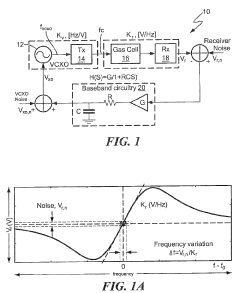
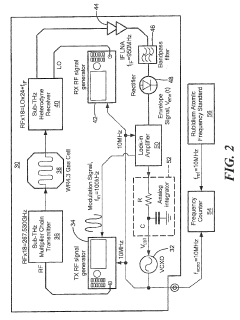
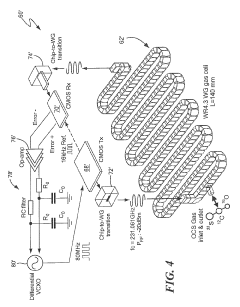
- A molecular clock utilizing rotational-state transitions of gaseous polar molecules in the sub-THz region, integrated with CMOS technology, providing a compact, low-power, and robust frequency reference with enhanced stability and instant start-up capabilities.

Chip-scale atomic clock (CSAC) and method for making same
PatentWO2006036268A2
Innovation
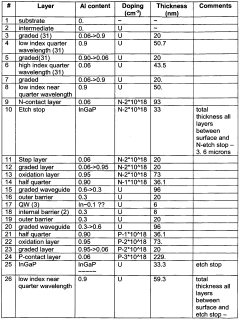
- A portable, at least partially evacuated housing with a cell having internal dimensions less than 1 millimeter, containing metal atomic vapor, an electrical to optical energy converter, an optical energy intensity detector, and conductive windings to stabilize the magnetic field, enabling efficient signal detection and stabilization.
Military and Aerospace Standards Compliance
Compliance with military and aerospace standards is critical for CSAC (Chip-Scale Atomic Clock) deployment in defense and space applications. The MIL-STD-810 series, particularly MIL-STD-810G Method 516.6 for shock and Method 514.6 for vibration, provides comprehensive test protocols that CSACs must satisfy. These standards define specific shock profiles including functional shock (20g, 11ms), crash safety shock (40g, 11ms), and high-intensity shock (75-100g) scenarios that simulate battlefield conditions.
For aerospace applications, DO-160G Environmental Conditions and Test Procedures for Airborne Equipment establishes rigorous requirements for avionics equipment. Sections 7 (Operational Shocks) and 8 (Vibration) are particularly relevant for CSAC testing, with requirements varying based on aircraft type and installation location. Space applications follow NASA-STD-7001A (Payload Vibroacoustic Test Criteria) and GSFC-STD-7000 (General Environmental Verification Standard), which mandate random vibration testing up to 2000 Hz and shock response spectrum analysis.
The Joint Service Specification Guide (JSSG-2005) provides additional requirements for aircraft avionics systems, while MIL-STD-1540D addresses test requirements for launch, upper-stage, and space vehicles. For naval applications, MIL-S-901D covers high-impact shock testing for shipboard materials, requiring medium weight shock testing for precision timing devices like CSACs.
Test compliance documentation must include detailed test plans, procedures, and reports with clear pass/fail criteria. Manufacturers typically provide Military Conformance Test Reports (MCTRs) that document compliance with these standards. Many CSAC manufacturers now offer MIL-STD-qualified versions that have undergone Environmental Stress Screening (ESS) and can provide documented evidence of compliance.
Recent trends show increasing harmonization between military and commercial standards, with some CSAC manufacturers pursuing dual qualification to both MIL-STD-810 and commercial standards like IEC 60068. This approach broadens market applicability while ensuring robust performance in demanding military environments. The Defense Standardization Program Office (DSPO) continues to update these standards to address emerging technologies like CSACs, with the latest revisions incorporating specific guidance for atomic frequency standards.
For aerospace applications, DO-160G Environmental Conditions and Test Procedures for Airborne Equipment establishes rigorous requirements for avionics equipment. Sections 7 (Operational Shocks) and 8 (Vibration) are particularly relevant for CSAC testing, with requirements varying based on aircraft type and installation location. Space applications follow NASA-STD-7001A (Payload Vibroacoustic Test Criteria) and GSFC-STD-7000 (General Environmental Verification Standard), which mandate random vibration testing up to 2000 Hz and shock response spectrum analysis.
The Joint Service Specification Guide (JSSG-2005) provides additional requirements for aircraft avionics systems, while MIL-STD-1540D addresses test requirements for launch, upper-stage, and space vehicles. For naval applications, MIL-S-901D covers high-impact shock testing for shipboard materials, requiring medium weight shock testing for precision timing devices like CSACs.
Test compliance documentation must include detailed test plans, procedures, and reports with clear pass/fail criteria. Manufacturers typically provide Military Conformance Test Reports (MCTRs) that document compliance with these standards. Many CSAC manufacturers now offer MIL-STD-qualified versions that have undergone Environmental Stress Screening (ESS) and can provide documented evidence of compliance.
Recent trends show increasing harmonization between military and commercial standards, with some CSAC manufacturers pursuing dual qualification to both MIL-STD-810 and commercial standards like IEC 60068. This approach broadens market applicability while ensuring robust performance in demanding military environments. The Defense Standardization Program Office (DSPO) continues to update these standards to address emerging technologies like CSACs, with the latest revisions incorporating specific guidance for atomic frequency standards.
Environmental Qualification Test Matrix
The Environmental Qualification Test Matrix for CSAC (Chip-Scale Atomic Clock) performance evaluation under shock and vibration conditions provides a comprehensive framework for systematic testing across multiple environmental parameters. This matrix categorizes test procedures into mechanical, thermal, electromagnetic, and combined environmental tests, establishing clear pass/fail criteria for each test scenario.
The mechanical testing section includes sinusoidal vibration tests at frequencies ranging from 10Hz to 2000Hz with acceleration levels from 0.5g to 20g, random vibration profiles simulating various operational environments (ground vehicles, aircraft, spacecraft), and mechanical shock tests with half-sine pulses of 20g to 100g amplitude and 6ms to 11ms duration. These tests are conducted along three orthogonal axes to ensure comprehensive evaluation.
Thermal testing incorporates temperature cycling (-40°C to +85°C), thermal shock tests, and steady-state temperature tests at operational extremes. The matrix specifies dwell times at temperature extremes (typically 1-4 hours) and transition rates between temperature points (3-5°C per minute), allowing for thorough assessment of frequency stability under thermal stress.
Electromagnetic compatibility tests within the matrix include radiated susceptibility (80MHz to 18GHz), conducted susceptibility, and electromagnetic interference measurements. These tests ensure CSAC performance remains within specification when exposed to electromagnetic fields typical in deployment environments.
Combined environmental testing represents the most rigorous qualification approach, subjecting CSACs to simultaneous thermal cycling and vibration, temperature-humidity-vibration combinations, and thermal vacuum testing for space applications. These combined tests reveal potential interaction effects between environmental stressors that might not be apparent in isolated testing.
The matrix defines specific measurement parameters for each test condition, including frequency stability (Allan deviation at various integration times), power consumption variations, time to first fix, and phase noise characteristics. Performance thresholds are established for each parameter, with typical requirements specifying Allan deviation stability better than 1×10^-11 over one-hour integration times even under specified environmental stress.
Test durations are carefully prescribed, ranging from short-duration shock tests to extended reliability demonstrations lasting 1000+ hours, ensuring both immediate performance impacts and long-term reliability concerns are addressed. The qualification matrix also includes provisions for accelerated life testing to predict long-term performance in various deployment scenarios.
The mechanical testing section includes sinusoidal vibration tests at frequencies ranging from 10Hz to 2000Hz with acceleration levels from 0.5g to 20g, random vibration profiles simulating various operational environments (ground vehicles, aircraft, spacecraft), and mechanical shock tests with half-sine pulses of 20g to 100g amplitude and 6ms to 11ms duration. These tests are conducted along three orthogonal axes to ensure comprehensive evaluation.
Thermal testing incorporates temperature cycling (-40°C to +85°C), thermal shock tests, and steady-state temperature tests at operational extremes. The matrix specifies dwell times at temperature extremes (typically 1-4 hours) and transition rates between temperature points (3-5°C per minute), allowing for thorough assessment of frequency stability under thermal stress.
Electromagnetic compatibility tests within the matrix include radiated susceptibility (80MHz to 18GHz), conducted susceptibility, and electromagnetic interference measurements. These tests ensure CSAC performance remains within specification when exposed to electromagnetic fields typical in deployment environments.
Combined environmental testing represents the most rigorous qualification approach, subjecting CSACs to simultaneous thermal cycling and vibration, temperature-humidity-vibration combinations, and thermal vacuum testing for space applications. These combined tests reveal potential interaction effects between environmental stressors that might not be apparent in isolated testing.
The matrix defines specific measurement parameters for each test condition, including frequency stability (Allan deviation at various integration times), power consumption variations, time to first fix, and phase noise characteristics. Performance thresholds are established for each parameter, with typical requirements specifying Allan deviation stability better than 1×10^-11 over one-hour integration times even under specified environmental stress.
Test durations are carefully prescribed, ranging from short-duration shock tests to extended reliability demonstrations lasting 1000+ hours, ensuring both immediate performance impacts and long-term reliability concerns are addressed. The qualification matrix also includes provisions for accelerated life testing to predict long-term performance in various deployment scenarios.
Unlock deeper insights with PatSnap Eureka Quick Research — get a full tech report to explore trends and direct your research. Try now!
Generate Your Research Report Instantly with AI Agent
Supercharge your innovation with PatSnap Eureka AI Agent Platform!