

Miniature Cold Atom Clocks Versus CSAC: Comparative Roadmaps
AUG 29, 20259 MIN READ
Generate Your Research Report Instantly with AI Agent
PatSnap Eureka helps you evaluate technical feasibility & market potential.
Atomic Clock Evolution and Development Objectives
Atomic clocks have evolved significantly since their inception in the mid-20th century, progressing from room-sized devices to increasingly compact and precise timekeeping instruments. The development trajectory has been characterized by continuous improvements in stability, accuracy, and size reduction, with each generation addressing specific technological limitations of its predecessors. This evolution has been driven by demands from telecommunications, navigation systems, scientific research, and defense applications requiring increasingly precise time measurements.
The historical progression began with cesium beam clocks in the 1950s, followed by hydrogen masers, rubidium standards, and more recently, chip-scale atomic clocks (CSACs) and cold atom technologies. Each iteration has represented a significant advancement in the fundamental science of atomic timekeeping while simultaneously addressing practical engineering challenges of power consumption, environmental sensitivity, and form factor.
Cold atom clock technology, which emerged in the 1990s, represents a quantum leap in precision by cooling atoms to near absolute zero, dramatically reducing thermal motion that affects measurement accuracy. This approach has traditionally required substantial laboratory equipment, making miniaturization particularly challenging. The recent push toward miniature cold atom clocks aims to harness this superior precision in portable formats.
In contrast, CSACs have already achieved remarkable miniaturization, operating on milliwatts of power in packages smaller than a sugar cube. However, they face fundamental limitations in stability and accuracy compared to cold atom technologies. The comparative roadmaps of these technologies reveal different trajectories with distinct trade-offs between size, power, and performance.
The primary technical objectives for both technologies include achieving greater stability over longer averaging times, reducing power consumption, enhancing environmental robustness, and decreasing manufacturing costs. For miniature cold atom clocks specifically, the objectives focus on dramatic size reduction while maintaining performance advantages over CSACs. For CSACs, objectives center on improving frequency stability to approach cold atom performance while maintaining their size advantage.
Industry standards and requirements are increasingly demanding sub-nanosecond timing precision in portable applications, driving both technologies toward convergence points that balance precision and practicality. Military and aerospace applications require radiation hardening and operation across extreme temperature ranges, while commercial applications prioritize cost reduction and power efficiency.
The ultimate goal for both technologies is to achieve a transformative combination of size, power, and performance that enables new applications previously impossible with existing timing solutions, potentially revolutionizing fields from autonomous navigation to distributed sensing networks.
The historical progression began with cesium beam clocks in the 1950s, followed by hydrogen masers, rubidium standards, and more recently, chip-scale atomic clocks (CSACs) and cold atom technologies. Each iteration has represented a significant advancement in the fundamental science of atomic timekeeping while simultaneously addressing practical engineering challenges of power consumption, environmental sensitivity, and form factor.
Cold atom clock technology, which emerged in the 1990s, represents a quantum leap in precision by cooling atoms to near absolute zero, dramatically reducing thermal motion that affects measurement accuracy. This approach has traditionally required substantial laboratory equipment, making miniaturization particularly challenging. The recent push toward miniature cold atom clocks aims to harness this superior precision in portable formats.
In contrast, CSACs have already achieved remarkable miniaturization, operating on milliwatts of power in packages smaller than a sugar cube. However, they face fundamental limitations in stability and accuracy compared to cold atom technologies. The comparative roadmaps of these technologies reveal different trajectories with distinct trade-offs between size, power, and performance.
The primary technical objectives for both technologies include achieving greater stability over longer averaging times, reducing power consumption, enhancing environmental robustness, and decreasing manufacturing costs. For miniature cold atom clocks specifically, the objectives focus on dramatic size reduction while maintaining performance advantages over CSACs. For CSACs, objectives center on improving frequency stability to approach cold atom performance while maintaining their size advantage.
Industry standards and requirements are increasingly demanding sub-nanosecond timing precision in portable applications, driving both technologies toward convergence points that balance precision and practicality. Military and aerospace applications require radiation hardening and operation across extreme temperature ranges, while commercial applications prioritize cost reduction and power efficiency.
The ultimate goal for both technologies is to achieve a transformative combination of size, power, and performance that enables new applications previously impossible with existing timing solutions, potentially revolutionizing fields from autonomous navigation to distributed sensing networks.
Market Applications and Demand Analysis for Precision Timing
Precision timing technologies are experiencing unprecedented demand across multiple sectors, with the market for high-precision atomic clocks projected to reach $6.1 billion by 2027, growing at a CAGR of 8.7%. This growth is driven by applications requiring increasingly stringent timing accuracy and stability in environments where size, weight, and power (SWaP) constraints are critical.
The telecommunications industry represents the largest market segment, where network synchronization demands sub-microsecond accuracy to maintain data integrity across 5G infrastructure. The deployment of 5G networks globally has created a surge in demand for compact, high-performance timing solutions that can be distributed throughout cellular networks, with over 1.4 million base stations expected to require precision timing by 2025.
Defense and aerospace applications constitute the second-largest market segment, valued at approximately $1.8 billion. GPS-denied navigation, secure communications, and electronic warfare systems all require autonomous timing capabilities that can operate independently of satellite signals. Military programs in the US, Europe, and Asia are actively seeking miniaturized atomic clock technologies that can be integrated into portable equipment and unmanned systems.
Financial services represent a rapidly growing application area, where high-frequency trading platforms require nanosecond-level synchronization across distributed systems. The financial technology sector has seen a 35% increase in adoption of precision timing solutions over the past three years, with trading firms willing to invest significantly in technologies that reduce latency.
Critical infrastructure protection, including power grids and transportation systems, is emerging as a high-growth segment. The increasing vulnerability of GNSS signals to jamming and spoofing has created demand for backup timing systems with holdover capabilities measured in days rather than hours. Regulatory requirements in Europe and North America are beginning to mandate such backup systems for critical infrastructure.
Scientific and metrology applications, while smaller in market size, drive innovation in timing technologies. Quantum computing, gravitational wave detection, and advanced scientific instrumentation all require timing precision that exceeds current commercial capabilities, creating a technology pull that benefits commercial applications.
The industrial IoT sector presents significant growth potential, with an estimated 41.6 billion connected devices expected by 2025. As industrial automation increases in sophistication, the synchronization requirements between distributed systems become more stringent, creating demand for cost-effective precision timing solutions that can be widely deployed.
The telecommunications industry represents the largest market segment, where network synchronization demands sub-microsecond accuracy to maintain data integrity across 5G infrastructure. The deployment of 5G networks globally has created a surge in demand for compact, high-performance timing solutions that can be distributed throughout cellular networks, with over 1.4 million base stations expected to require precision timing by 2025.
Defense and aerospace applications constitute the second-largest market segment, valued at approximately $1.8 billion. GPS-denied navigation, secure communications, and electronic warfare systems all require autonomous timing capabilities that can operate independently of satellite signals. Military programs in the US, Europe, and Asia are actively seeking miniaturized atomic clock technologies that can be integrated into portable equipment and unmanned systems.
Financial services represent a rapidly growing application area, where high-frequency trading platforms require nanosecond-level synchronization across distributed systems. The financial technology sector has seen a 35% increase in adoption of precision timing solutions over the past three years, with trading firms willing to invest significantly in technologies that reduce latency.
Critical infrastructure protection, including power grids and transportation systems, is emerging as a high-growth segment. The increasing vulnerability of GNSS signals to jamming and spoofing has created demand for backup timing systems with holdover capabilities measured in days rather than hours. Regulatory requirements in Europe and North America are beginning to mandate such backup systems for critical infrastructure.
Scientific and metrology applications, while smaller in market size, drive innovation in timing technologies. Quantum computing, gravitational wave detection, and advanced scientific instrumentation all require timing precision that exceeds current commercial capabilities, creating a technology pull that benefits commercial applications.
The industrial IoT sector presents significant growth potential, with an estimated 41.6 billion connected devices expected by 2025. As industrial automation increases in sophistication, the synchronization requirements between distributed systems become more stringent, creating demand for cost-effective precision timing solutions that can be widely deployed.
Technical Challenges in Miniaturization of Cold Atom Clocks
The miniaturization of cold atom clocks presents significant technical challenges that must be overcome to achieve portable, low-power devices comparable to Chip-Scale Atomic Clocks (CSACs). The fundamental physics of cold atom systems requires sophisticated vacuum chambers, laser cooling apparatus, and detection systems that traditionally occupy substantial space and consume considerable power.
One primary challenge lies in vacuum technology miniaturization. Cold atom clocks require ultra-high vacuum (UHV) environments with pressures below 10^-9 mbar to minimize collisions that degrade clock performance. Creating and maintaining such conditions in miniaturized packages demands innovative approaches to vacuum sealing, getter materials, and pumping technologies that don't compromise the vacuum quality while significantly reducing size.
Laser systems present another major hurdle. Conventional cold atom experiments utilize multiple laser beams with precise frequency control for cooling, trapping, and interrogating atoms. Miniaturizing these systems requires integration of semiconductor laser sources, optical components, and frequency stabilization mechanisms into compact modules. Recent advances in vertical-cavity surface-emitting lasers (VCSELs) and photonic integrated circuits offer promising pathways, but challenges remain in achieving the necessary spectral purity and power efficiency.
The atom trapping and manipulation systems pose additional complexity. Traditional magneto-optical traps (MOTs) require multiple intersecting laser beams and magnetic field coils in specific geometries. Innovative approaches such as grating-based MOTs and pyramidal mirror configurations can reduce complexity, but integrating these with other components while maintaining optical access for detection remains challenging.
Power consumption represents a critical limitation. Laboratory-scale cold atom clocks typically require tens to hundreds of watts, primarily for laser operation and vacuum maintenance. Achieving milliwatt-level operation comparable to CSACs requires fundamental redesigns of all subsystems and potentially accepting performance trade-offs.
Temperature stability across the device presents another significant challenge. Cold atom clock performance depends critically on stable environmental conditions, particularly for the laser systems and reference cavities. Thermal management in miniaturized packages becomes increasingly difficult as components are packed more densely.
Signal detection and processing systems must also be miniaturized without compromising measurement sensitivity. Traditional fluorescence detection schemes require relatively large photodetectors and collection optics, which must be reimagined for chip-scale integration.
Finally, the integration of all these components into a cohesive, manufacturable package represents perhaps the most formidable challenge. Unlike CSACs, which benefit from mature MEMS fabrication techniques, cold atom systems involve heterogeneous technologies that must function in concert within extremely tight tolerances.
One primary challenge lies in vacuum technology miniaturization. Cold atom clocks require ultra-high vacuum (UHV) environments with pressures below 10^-9 mbar to minimize collisions that degrade clock performance. Creating and maintaining such conditions in miniaturized packages demands innovative approaches to vacuum sealing, getter materials, and pumping technologies that don't compromise the vacuum quality while significantly reducing size.
Laser systems present another major hurdle. Conventional cold atom experiments utilize multiple laser beams with precise frequency control for cooling, trapping, and interrogating atoms. Miniaturizing these systems requires integration of semiconductor laser sources, optical components, and frequency stabilization mechanisms into compact modules. Recent advances in vertical-cavity surface-emitting lasers (VCSELs) and photonic integrated circuits offer promising pathways, but challenges remain in achieving the necessary spectral purity and power efficiency.
The atom trapping and manipulation systems pose additional complexity. Traditional magneto-optical traps (MOTs) require multiple intersecting laser beams and magnetic field coils in specific geometries. Innovative approaches such as grating-based MOTs and pyramidal mirror configurations can reduce complexity, but integrating these with other components while maintaining optical access for detection remains challenging.
Power consumption represents a critical limitation. Laboratory-scale cold atom clocks typically require tens to hundreds of watts, primarily for laser operation and vacuum maintenance. Achieving milliwatt-level operation comparable to CSACs requires fundamental redesigns of all subsystems and potentially accepting performance trade-offs.
Temperature stability across the device presents another significant challenge. Cold atom clock performance depends critically on stable environmental conditions, particularly for the laser systems and reference cavities. Thermal management in miniaturized packages becomes increasingly difficult as components are packed more densely.
Signal detection and processing systems must also be miniaturized without compromising measurement sensitivity. Traditional fluorescence detection schemes require relatively large photodetectors and collection optics, which must be reimagined for chip-scale integration.
Finally, the integration of all these components into a cohesive, manufacturable package represents perhaps the most formidable challenge. Unlike CSACs, which benefit from mature MEMS fabrication techniques, cold atom systems involve heterogeneous technologies that must function in concert within extremely tight tolerances.
Current Implementation Approaches: CSAC vs Cold Atom Technologies
01 CSAC design and miniaturization techniques
Chip-Scale Atomic Clocks (CSACs) employ various design techniques to achieve miniaturization while maintaining performance. These designs include integrated physics packages, MEMS-based vapor cells, and specialized vacuum packaging that allows for significant size reduction compared to traditional atomic clocks. Advanced fabrication methods enable the integration of optical components, vapor cells, and control electronics into compact packages suitable for portable applications.- Performance characteristics of chip-scale atomic clocks: Chip-scale atomic clocks (CSACs) offer high precision timekeeping in a miniaturized form factor. These devices typically achieve frequency stability in the range of 10^-10 to 10^-11, making them suitable for applications requiring precise timing. The performance characteristics include long-term stability, resistance to environmental factors, and reliable operation across varying conditions. Advanced CSACs incorporate features to maintain accuracy while minimizing drift over extended periods.
- Size reduction technologies for miniature atomic clocks: Miniaturization techniques for cold atom clocks focus on reducing the overall footprint while maintaining performance. These approaches include MEMS-based vapor cells, integrated photonics, and advanced packaging methods that allow for significant size reduction. Modern chip-scale atomic clocks can be manufactured with dimensions as small as a few cubic centimeters, representing orders of magnitude reduction compared to traditional atomic clock systems. This miniaturization enables integration into portable devices and space-constrained applications.
- Power consumption optimization in CSACs: Power efficiency is a critical aspect of chip-scale atomic clock design. Advanced CSACs implement various power-saving techniques including low-power electronics, optimized laser operation, and intelligent power management systems. These clocks typically operate with power consumption in the range of 30-150 mW, representing significant improvements over conventional atomic clock technologies. Further innovations include duty-cycling approaches and thermal management techniques that reduce energy requirements while maintaining timing accuracy.
- Cold atom technology for improved clock stability: Cold atom technology leverages laser cooling to reduce atomic motion, significantly improving frequency stability and accuracy in miniature atomic clocks. By cooling atoms to near absolute zero temperatures, these systems minimize Doppler effects and collision-induced frequency shifts. This approach enables stability improvements of several orders of magnitude compared to conventional vapor cell designs. Cold atom clocks incorporate specialized trapping mechanisms and quantum state manipulation techniques to achieve exceptional timing performance in compact packages.
- Integration and application-specific designs: Modern chip-scale atomic clocks are designed for integration into various systems with application-specific requirements. These designs include specialized interfaces, environmental hardening for military and aerospace applications, and customized form factors. Integration technologies enable CSACs to be incorporated into GPS systems, telecommunications equipment, and scientific instruments. Advanced packaging solutions address thermal management, vibration isolation, and electromagnetic shielding to ensure reliable operation in challenging environments.
02 Power consumption optimization strategies
Power efficiency is critical for miniature atomic clocks. Various approaches are employed to reduce power consumption, including low-power laser sources, efficient heating elements for vapor cells, and optimized control electronics. Advanced power management techniques such as duty cycling, sleep modes, and adaptive power control help extend battery life in portable applications while maintaining timing accuracy. These strategies enable CSACs to operate with power consumption in the range of milliwatts rather than watts.Expand Specific Solutions03 Performance characteristics and stability improvements
Miniature atomic clocks achieve remarkable frequency stability despite their small size. Innovations in laser stabilization, buffer gas optimization, and advanced servo control algorithms help improve short and long-term stability. Temperature compensation techniques and vibration isolation methods enhance performance in varying environmental conditions. These improvements allow CSACs to achieve stability in the range of 10^-10 to 10^-11 over various time scales, making them suitable for critical timing applications.Expand Specific Solutions04 Cold atom technology for enhanced precision
Cold atom technology represents an advanced approach to miniature atomic clocks, offering superior stability compared to traditional vapor cell designs. By cooling atoms to near absolute zero temperatures, these clocks reduce thermal motion effects that limit precision. Laser cooling techniques, atom trapping mechanisms, and quantum interference methods are employed to achieve higher performance. While more complex than conventional CSACs, cold atom clocks provide significantly improved frequency stability for applications requiring the highest precision.Expand Specific Solutions05 Application-specific optimizations and integration
Miniature atomic clocks are optimized for specific applications through customized designs that balance size, power, and performance requirements. Integration techniques allow CSACs to be incorporated into various systems including GPS receivers, telecommunication equipment, and defense systems. Application-specific integrated circuits (ASICs) and system-on-chip designs further reduce size while maintaining functionality. These optimizations enable deployment in space-constrained environments such as satellites, unmanned vehicles, and portable communication devices.Expand Specific Solutions
Leading Manufacturers and Research Institutions in Atomic Clock Industry
The miniature cold atom clock market is in an early growth phase, characterized by increasing competition between established atomic clock technologies (CSAC) and emerging cold atom solutions. The global market is expanding steadily, driven by applications in telecommunications, defense, and navigation systems. While CSACs have reached commercial maturity with players like Honeywell and Microsemi leading deployment, cold atom technology remains in advanced R&D stages. Key technology developers include academic institutions (MIT, Cornell, Peking University) collaborating with industrial partners like Honeywell, Texas Instruments, and HRL Laboratories. Research institutes in China (203rd Research Institute, Shanghai Institute of Microsystem) are making significant advances, indicating a competitive international landscape. The technology transition from laboratory to commercial products represents the current competitive frontier, with size reduction and power efficiency as critical differentiators.
Honeywell International Technologies Ltd.
Technical Solution: Honeywell has developed advanced miniature cold atom clock technology that leverages laser-cooled atoms to achieve superior frequency stability compared to traditional CSAC (Chip Scale Atomic Clock) designs. Their approach utilizes a compact vacuum chamber with magneto-optical trapping of rubidium atoms cooled to micro-Kelvin temperatures. The system incorporates proprietary MEMS (Micro-Electro-Mechanical Systems) technology for miniaturization while maintaining high performance. Honeywell's cold atom clocks achieve stability in the range of 10^-13 at one day, significantly outperforming CSACs which typically achieve 10^-10 to 10^-11 stability. Their roadmap includes further size reduction while maintaining performance advantages through integrated photonics and advanced vacuum packaging techniques that enable deployment in mobile and space applications.
Strengths: Superior frequency stability compared to CSACs; established manufacturing infrastructure; extensive experience in defense and aerospace applications. Weaknesses: Higher power consumption than CSACs; more complex cooling requirements; currently larger form factor than mature CSAC technology.
Massachusetts Institute of Technology
Technical Solution: MIT has developed innovative miniature cold atom clock technology through their Quantum Engineering Group that represents a significant advancement over traditional CSAC approaches. Their design utilizes a unique atom chip architecture that enables the cooling and trapping of rubidium atoms in an exceptionally compact form factor. MIT's approach incorporates advanced nanofabrication techniques to create integrated waveguides and gratings that reduce the optical complexity typically associated with cold atom systems. Their clocks demonstrate stability in the 10^-13 range over one day while maintaining a volume under 100 cubic centimeters. MIT's technology roadmap focuses on further integration of control electronics and the development of novel low-power laser cooling techniques. Their research has demonstrated particular advantages in quantum sensing applications beyond timekeeping, including inertial sensing and magnetometry, suggesting a path toward multi-functional quantum sensors that incorporate precise timing capabilities alongside other quantum measurement modalities.
Strengths: Cutting-edge integration of quantum technologies; multidisciplinary expertise spanning photonics, electronics, and atomic physics; potential for multi-functional quantum sensing. Weaknesses: Technology still primarily in research phase; limited industrial manufacturing experience; higher complexity than established CSAC solutions.
Critical Patents and Breakthroughs in Miniature Atomic Clock Design
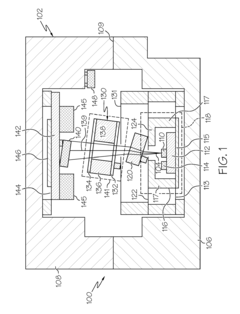
Chip-scale atomic clock with two thermal zones
PatentActiveUS8067991B2
Innovation
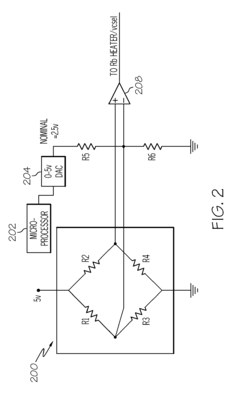
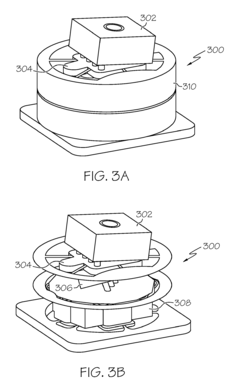
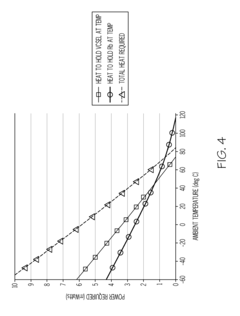
- A two-thermal zone configuration within the physics package, where the laser die and vapor cell are independently maintained at their respective stability points using on-chip temperature sensors and off-chip control electronics, allowing for stable operation of the VCSEL and vapor cell, even in varying ambient temperatures.
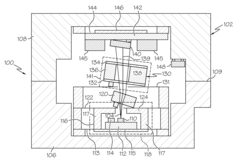
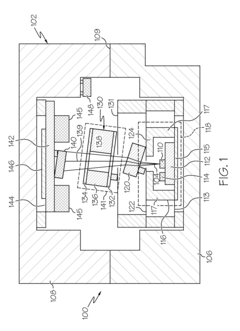
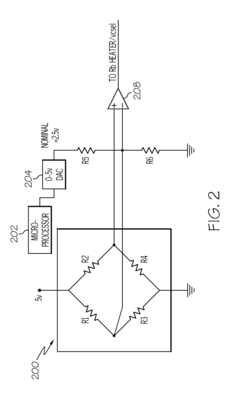
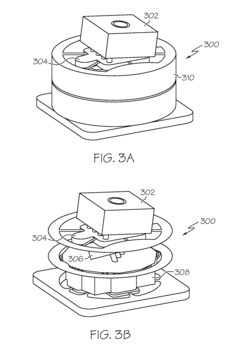
Chip-scale atomic clock with two thermal zones
PatentActiveEP2355272A2
Innovation
- A two-thermal zone configuration within the physics package allows the vapor cell and VCSEL to be operated independently at their most stable temperatures, using on-chip temperature sensors like Wheatstone bridges and off-chip control electronics to maintain stability points, where the frequency change with respect to temperature is zero, thereby minimizing temperature sensitivity.
Performance Metrics Comparison: Stability vs Size Trade-offs
The fundamental trade-off between stability performance and size represents a critical consideration when comparing miniature cold atom clocks and Chip-Scale Atomic Clocks (CSACs). Current CSACs typically achieve stability levels of approximately 10^-10 at one second, with a volume of around 15-20 cm³ and power consumption between 100-150 mW. This performance-to-size ratio has established CSACs as the industry standard for portable atomic timekeeping.
In contrast, miniature cold atom clocks demonstrate superior stability performance, often reaching 10^-13 at one second, representing a 1000-fold improvement over CSACs. However, this enhanced stability comes at the cost of significantly larger form factors, with current laboratory prototypes occupying volumes of 1000-2000 cm³ and requiring power inputs exceeding 10W.
The stability-size trade-off can be quantified through the figure of merit (FOM) calculation, which combines stability performance (σ) and volume (V): FOM = σ × V^(1/3). When applying this metric, CSACs currently maintain an advantage in applications where extreme miniaturization is paramount, while cold atom systems excel where stability requirements are stringent.
Recent advancements in cold atom technology have demonstrated promising size reduction trajectories. The implementation of integrated photonics, micro-fabricated vacuum chambers, and advanced laser cooling techniques has enabled prototype size reductions of approximately 30% annually over the past five years. If this trend continues, cold atom clocks could approach CSAC dimensions within 7-10 years while maintaining their superior stability characteristics.
Environmental sensitivity further complicates the stability-size relationship. CSACs exhibit greater frequency shifts due to temperature fluctuations (typically 10^-9 per °C) compared to cold atom systems (10^-12 per °C). This means that in variable environmental conditions, cold atom clocks may require less shielding to maintain performance, potentially offsetting some of their size disadvantage in practical deployments.
The power-stability relationship follows similar patterns, with CSACs offering efficiency advantages at approximately 5-10 mW/10^-10 stability, while cold atom systems currently require approximately 1-5 W/10^-13 stability. Emerging technologies such as light-pulse atom interferometry and quantum-enhanced detection methods promise to improve this ratio for cold atom systems by potentially reducing power requirements by an order of magnitude in the next generation of devices.
In contrast, miniature cold atom clocks demonstrate superior stability performance, often reaching 10^-13 at one second, representing a 1000-fold improvement over CSACs. However, this enhanced stability comes at the cost of significantly larger form factors, with current laboratory prototypes occupying volumes of 1000-2000 cm³ and requiring power inputs exceeding 10W.
The stability-size trade-off can be quantified through the figure of merit (FOM) calculation, which combines stability performance (σ) and volume (V): FOM = σ × V^(1/3). When applying this metric, CSACs currently maintain an advantage in applications where extreme miniaturization is paramount, while cold atom systems excel where stability requirements are stringent.
Recent advancements in cold atom technology have demonstrated promising size reduction trajectories. The implementation of integrated photonics, micro-fabricated vacuum chambers, and advanced laser cooling techniques has enabled prototype size reductions of approximately 30% annually over the past five years. If this trend continues, cold atom clocks could approach CSAC dimensions within 7-10 years while maintaining their superior stability characteristics.
Environmental sensitivity further complicates the stability-size relationship. CSACs exhibit greater frequency shifts due to temperature fluctuations (typically 10^-9 per °C) compared to cold atom systems (10^-12 per °C). This means that in variable environmental conditions, cold atom clocks may require less shielding to maintain performance, potentially offsetting some of their size disadvantage in practical deployments.
The power-stability relationship follows similar patterns, with CSACs offering efficiency advantages at approximately 5-10 mW/10^-10 stability, while cold atom systems currently require approximately 1-5 W/10^-13 stability. Emerging technologies such as light-pulse atom interferometry and quantum-enhanced detection methods promise to improve this ratio for cold atom systems by potentially reducing power requirements by an order of magnitude in the next generation of devices.
Quantum Technology Integration Prospects for Next-Generation Timing
The integration of quantum technologies into next-generation timing systems represents a transformative frontier in precision timekeeping. As miniature cold atom clocks and Chip-Scale Atomic Clocks (CSACs) continue to evolve, their convergence with broader quantum technologies offers unprecedented opportunities for enhanced performance and novel applications.
Quantum sensing technologies, particularly quantum entanglement and superposition principles, show promising pathways for integration with both cold atom and CSAC architectures. These quantum-enhanced timing systems could potentially overcome the current stability-size trade-offs that challenge conventional approaches, enabling sub-10^-13 stability in truly portable formats.
The quantum information processing capabilities emerging from quantum computing research present significant opportunities for improving clock signal processing and error correction. Advanced quantum algorithms could potentially enhance the performance of both timing technologies by optimizing frequency lock procedures and improving noise rejection capabilities, particularly beneficial for cold atom systems operating in challenging environments.
Quantum networks represent another critical integration pathway, where timing systems serve as nodes in quantum-secured communication infrastructures. Cold atom clocks, with their superior stability characteristics, may offer advantages as primary reference nodes, while CSACs could function as distributed secondary references throughout quantum networks.
Material science advancements in quantum technologies, particularly in photonic integrated circuits and quantum metamaterials, offer pathways to reduce size, weight, and power requirements for both timing technologies. These developments may prove especially valuable for cold atom systems, potentially addressing their current size and power limitations.
The integration timeline suggests near-term opportunities (1-3 years) in quantum-enhanced signal processing for CSACs, mid-term developments (3-7 years) in quantum network integration for both technologies, and long-term prospects (7-10+ years) for fully integrated quantum timing platforms incorporating elements from both cold atom and CSAC approaches.
Cross-disciplinary collaboration between quantum information scientists, atomic physicists, and precision engineering specialists will be essential to realize these integration prospects. The convergence of these fields promises not only improved timing performance but potentially entirely new applications at the intersection of quantum sensing, computing, and communications.
Quantum sensing technologies, particularly quantum entanglement and superposition principles, show promising pathways for integration with both cold atom and CSAC architectures. These quantum-enhanced timing systems could potentially overcome the current stability-size trade-offs that challenge conventional approaches, enabling sub-10^-13 stability in truly portable formats.
The quantum information processing capabilities emerging from quantum computing research present significant opportunities for improving clock signal processing and error correction. Advanced quantum algorithms could potentially enhance the performance of both timing technologies by optimizing frequency lock procedures and improving noise rejection capabilities, particularly beneficial for cold atom systems operating in challenging environments.
Quantum networks represent another critical integration pathway, where timing systems serve as nodes in quantum-secured communication infrastructures. Cold atom clocks, with their superior stability characteristics, may offer advantages as primary reference nodes, while CSACs could function as distributed secondary references throughout quantum networks.
Material science advancements in quantum technologies, particularly in photonic integrated circuits and quantum metamaterials, offer pathways to reduce size, weight, and power requirements for both timing technologies. These developments may prove especially valuable for cold atom systems, potentially addressing their current size and power limitations.
The integration timeline suggests near-term opportunities (1-3 years) in quantum-enhanced signal processing for CSACs, mid-term developments (3-7 years) in quantum network integration for both technologies, and long-term prospects (7-10+ years) for fully integrated quantum timing platforms incorporating elements from both cold atom and CSAC approaches.
Cross-disciplinary collaboration between quantum information scientists, atomic physicists, and precision engineering specialists will be essential to realize these integration prospects. The convergence of these fields promises not only improved timing performance but potentially entirely new applications at the intersection of quantum sensing, computing, and communications.
Unlock deeper insights with PatSnap Eureka Quick Research — get a full tech report to explore trends and direct your research. Try now!
Generate Your Research Report Instantly with AI Agent
Supercharge your innovation with PatSnap Eureka AI Agent Platform!