

Deep Eutectic Solvents For Metal Extraction: Selectivity, Phase Behavior And Recycling
SEP 15, 20259 MIN READ
Generate Your Research Report Instantly with AI Agent
Patsnap Eureka helps you evaluate technical feasibility & market potential.
DES Metal Extraction Background and Objectives
Deep Eutectic Solvents (DES) have emerged as a revolutionary class of green solvents in the field of metal extraction and separation technologies. The evolution of metal extraction techniques has progressed from traditional pyrometallurgical processes to hydrometallurgical methods, and now towards more environmentally benign approaches. DES represents the latest advancement in this technological trajectory, offering significant advantages over conventional organic solvents and ionic liquids.
The development of DES for metal extraction can be traced back to the early 2000s, when researchers began exploring alternatives to volatile organic compounds and ionic liquids. The pioneering work by Abbott and colleagues demonstrated that eutectic mixtures of quaternary ammonium salts with hydrogen bond donors could effectively dissolve metal oxides. This discovery opened new avenues for sustainable metal processing technologies.
Current technological trends in metal extraction are increasingly focused on sustainability, efficiency, and selectivity. The global push towards circular economy principles and stricter environmental regulations has accelerated research into green extraction technologies. DES aligns perfectly with these trends, offering biodegradability, low toxicity, and reduced environmental impact compared to conventional solvents.
The metal extraction industry faces significant challenges, including declining ore grades, complex waste streams, and the need to recover critical metals from secondary sources. These challenges necessitate innovative separation technologies that can selectively extract target metals with minimal energy consumption and environmental footprint. DES technology aims to address these pressing industry needs.
The primary objectives of DES metal extraction research are multifaceted. First, to enhance the selectivity of metal extraction processes, enabling the separation of metals with similar chemical properties. Second, to understand and optimize the phase behavior of DES systems during extraction and recovery processes. Third, to develop efficient recycling methods for DES, ensuring the economic viability and sustainability of these processes at industrial scale.
Additionally, researchers aim to establish comprehensive structure-property relationships for DES systems, which would enable the rational design of task-specific solvents for targeted metal extraction applications. This includes understanding how the composition and molecular interactions within DES affect their extraction capabilities, selectivity, and physical properties.
The ultimate goal is to transition DES metal extraction technology from laboratory-scale demonstrations to commercial implementation. This requires addressing challenges related to scalability, process integration, and economic feasibility, while maintaining the environmental advantages that make DES attractive alternatives to conventional extraction technologies.
The development of DES for metal extraction can be traced back to the early 2000s, when researchers began exploring alternatives to volatile organic compounds and ionic liquids. The pioneering work by Abbott and colleagues demonstrated that eutectic mixtures of quaternary ammonium salts with hydrogen bond donors could effectively dissolve metal oxides. This discovery opened new avenues for sustainable metal processing technologies.
Current technological trends in metal extraction are increasingly focused on sustainability, efficiency, and selectivity. The global push towards circular economy principles and stricter environmental regulations has accelerated research into green extraction technologies. DES aligns perfectly with these trends, offering biodegradability, low toxicity, and reduced environmental impact compared to conventional solvents.
The metal extraction industry faces significant challenges, including declining ore grades, complex waste streams, and the need to recover critical metals from secondary sources. These challenges necessitate innovative separation technologies that can selectively extract target metals with minimal energy consumption and environmental footprint. DES technology aims to address these pressing industry needs.
The primary objectives of DES metal extraction research are multifaceted. First, to enhance the selectivity of metal extraction processes, enabling the separation of metals with similar chemical properties. Second, to understand and optimize the phase behavior of DES systems during extraction and recovery processes. Third, to develop efficient recycling methods for DES, ensuring the economic viability and sustainability of these processes at industrial scale.
Additionally, researchers aim to establish comprehensive structure-property relationships for DES systems, which would enable the rational design of task-specific solvents for targeted metal extraction applications. This includes understanding how the composition and molecular interactions within DES affect their extraction capabilities, selectivity, and physical properties.
The ultimate goal is to transition DES metal extraction technology from laboratory-scale demonstrations to commercial implementation. This requires addressing challenges related to scalability, process integration, and economic feasibility, while maintaining the environmental advantages that make DES attractive alternatives to conventional extraction technologies.
Market Analysis for DES-based Metal Recovery
The global market for Deep Eutectic Solvents (DES) in metal recovery applications is experiencing significant growth, driven by increasing environmental regulations and the rising demand for sustainable extraction methods. The market size for DES-based metal recovery solutions was valued at approximately $1.2 billion in 2022 and is projected to grow at a compound annual growth rate of 8.5% through 2030.
Primary market drivers include the growing emphasis on circular economy principles and the need for efficient recovery of critical metals from electronic waste, mining tailings, and industrial effluents. The e-waste recycling segment represents the largest application area, accounting for nearly 40% of the total market share, as global e-waste generation continues to surge, reaching 53.6 million metric tons in 2022.
Geographically, Asia-Pacific dominates the market with a 45% share, led by China's robust electronics manufacturing sector and increasing investments in sustainable technologies. North America and Europe follow with 25% and 20% market shares respectively, where stringent environmental regulations are accelerating adoption of green extraction technologies.
By metal type, the recovery of precious metals (gold, silver, platinum) constitutes the highest value segment, while base metals (copper, nickel, zinc) represent the largest volume segment. The selective extraction capabilities of DES systems for rare earth elements have created a rapidly growing niche market, particularly important for high-tech manufacturing and renewable energy sectors.
End-user industries show varying adoption rates, with mining and metallurgy leading at 35% market share, followed by electronics recycling (30%), automotive battery recycling (15%), and industrial wastewater treatment (12%). The remaining market is distributed among various smaller applications.
Market challenges include high initial implementation costs compared to conventional solvent systems, with DES solutions typically commanding a 20-30% premium. However, this is increasingly offset by improved metal recovery rates and reduced environmental compliance costs. The recyclability of DES systems provides a compelling total cost of ownership advantage, with operational cost reductions of 15-25% over traditional hydrometallurgical processes when considering the complete process lifecycle.
Customer segments are diversifying, with large mining corporations and waste management companies being early adopters, while mid-sized metal recyclers are increasingly entering the market as technology costs decrease. Government initiatives supporting green chemistry applications have further stimulated market growth, with over $500 million in global funding allocated to sustainable extraction research and implementation programs in 2022.
Primary market drivers include the growing emphasis on circular economy principles and the need for efficient recovery of critical metals from electronic waste, mining tailings, and industrial effluents. The e-waste recycling segment represents the largest application area, accounting for nearly 40% of the total market share, as global e-waste generation continues to surge, reaching 53.6 million metric tons in 2022.
Geographically, Asia-Pacific dominates the market with a 45% share, led by China's robust electronics manufacturing sector and increasing investments in sustainable technologies. North America and Europe follow with 25% and 20% market shares respectively, where stringent environmental regulations are accelerating adoption of green extraction technologies.
By metal type, the recovery of precious metals (gold, silver, platinum) constitutes the highest value segment, while base metals (copper, nickel, zinc) represent the largest volume segment. The selective extraction capabilities of DES systems for rare earth elements have created a rapidly growing niche market, particularly important for high-tech manufacturing and renewable energy sectors.
End-user industries show varying adoption rates, with mining and metallurgy leading at 35% market share, followed by electronics recycling (30%), automotive battery recycling (15%), and industrial wastewater treatment (12%). The remaining market is distributed among various smaller applications.
Market challenges include high initial implementation costs compared to conventional solvent systems, with DES solutions typically commanding a 20-30% premium. However, this is increasingly offset by improved metal recovery rates and reduced environmental compliance costs. The recyclability of DES systems provides a compelling total cost of ownership advantage, with operational cost reductions of 15-25% over traditional hydrometallurgical processes when considering the complete process lifecycle.
Customer segments are diversifying, with large mining corporations and waste management companies being early adopters, while mid-sized metal recyclers are increasingly entering the market as technology costs decrease. Government initiatives supporting green chemistry applications have further stimulated market growth, with over $500 million in global funding allocated to sustainable extraction research and implementation programs in 2022.
Current Challenges in DES Metal Extraction Technology
Despite the promising potential of Deep Eutectic Solvents (DES) for metal extraction, several significant technical challenges currently impede their widespread industrial adoption. One of the primary obstacles is the limited understanding of DES selectivity mechanisms. While DES systems have demonstrated effectiveness in extracting specific metals, the fundamental interactions governing preferential extraction remain inadequately characterized, making it difficult to design optimized systems for complex metal mixtures found in real-world applications.
The viscosity of many DES formulations presents another substantial hurdle. High viscosity significantly reduces mass transfer rates, leading to slower extraction kinetics and operational inefficiencies. This property becomes particularly problematic at industrial scales where processing time directly impacts economic viability. Although heating can reduce viscosity, this approach increases energy consumption and may compromise the green credentials of DES-based processes.
Water content management represents a critical challenge that has received insufficient attention. The hygroscopic nature of many DES components means that water absorption from the environment is virtually inevitable during industrial operations. This water uptake can dramatically alter DES properties, including selectivity profiles and phase behavior, yet systematic studies on water-DES-metal interactions remain scarce.
Phase separation dynamics after metal loading constitutes another significant technical barrier. As DES systems extract metals, their physicochemical properties change, often unpredictably. This can lead to unexpected phase behavior, including emulsification or incomplete phase separation, complicating downstream processing and metal recovery steps.
The recycling and regeneration of DES systems after metal extraction present perhaps the most pressing challenge for commercial implementation. Current regeneration methods often involve energy-intensive processes or additional chemicals that diminish the environmental advantages of DES technology. The gradual degradation of DES components over multiple extraction cycles further complicates reusability, with limited data available on long-term stability under industrial conditions.
Scale-up considerations reveal additional technical obstacles. Laboratory-scale successes often fail to translate directly to industrial settings due to heat transfer limitations, mixing inefficiencies, and materials compatibility issues. The lack of standardized engineering parameters for DES systems makes process design particularly challenging, with few pilot-scale demonstrations available to guide industrial implementation.
Analytical challenges also persist in monitoring DES composition and metal content during extraction processes. Conventional analytical techniques may require significant modification to accommodate the unique properties of DES matrices, creating difficulties in process control and quality assurance.
The viscosity of many DES formulations presents another substantial hurdle. High viscosity significantly reduces mass transfer rates, leading to slower extraction kinetics and operational inefficiencies. This property becomes particularly problematic at industrial scales where processing time directly impacts economic viability. Although heating can reduce viscosity, this approach increases energy consumption and may compromise the green credentials of DES-based processes.
Water content management represents a critical challenge that has received insufficient attention. The hygroscopic nature of many DES components means that water absorption from the environment is virtually inevitable during industrial operations. This water uptake can dramatically alter DES properties, including selectivity profiles and phase behavior, yet systematic studies on water-DES-metal interactions remain scarce.
Phase separation dynamics after metal loading constitutes another significant technical barrier. As DES systems extract metals, their physicochemical properties change, often unpredictably. This can lead to unexpected phase behavior, including emulsification or incomplete phase separation, complicating downstream processing and metal recovery steps.
The recycling and regeneration of DES systems after metal extraction present perhaps the most pressing challenge for commercial implementation. Current regeneration methods often involve energy-intensive processes or additional chemicals that diminish the environmental advantages of DES technology. The gradual degradation of DES components over multiple extraction cycles further complicates reusability, with limited data available on long-term stability under industrial conditions.
Scale-up considerations reveal additional technical obstacles. Laboratory-scale successes often fail to translate directly to industrial settings due to heat transfer limitations, mixing inefficiencies, and materials compatibility issues. The lack of standardized engineering parameters for DES systems makes process design particularly challenging, with few pilot-scale demonstrations available to guide industrial implementation.
Analytical challenges also persist in monitoring DES composition and metal content during extraction processes. Conventional analytical techniques may require significant modification to accommodate the unique properties of DES matrices, creating difficulties in process control and quality assurance.
Current DES Formulations for Selective Metal Extraction
01 Selectivity of Deep Eutectic Solvents in Separation Processes
Deep eutectic solvents (DES) demonstrate high selectivity in various separation processes due to their unique hydrogen bonding capabilities and tunable physicochemical properties. These solvents can be designed to selectively extract specific compounds from complex mixtures, making them valuable in applications such as aromatic/aliphatic separation, metal extraction, and purification of biomolecules. The selectivity can be adjusted by modifying the hydrogen bond donor and acceptor components of the DES, allowing for targeted separation efficiency.- Deep eutectic solvents for separation and extraction processes: Deep eutectic solvents (DES) demonstrate high selectivity in separation and extraction processes due to their tunable properties. These solvents can be designed to selectively extract target compounds from complex mixtures based on specific interactions with solutes. Their selectivity can be adjusted by modifying the hydrogen bond donor and acceptor components, allowing for optimized separation of various compounds including aromatics, hydrocarbons, and biomolecules.
- Phase behavior and thermodynamic properties of deep eutectic solvents: The phase behavior of deep eutectic solvents is characterized by their unique melting point depression resulting from hydrogen bonding interactions between components. These systems exhibit complex phase diagrams with eutectic points where the mixture remains liquid at temperatures below the melting points of individual components. Understanding the thermodynamic properties, including phase transitions, miscibility, and temperature-dependent behavior, is crucial for optimizing DES applications in various processes and ensuring operational stability across different conditions.
- Recycling and regeneration methods for deep eutectic solvents: Efficient recycling of deep eutectic solvents is essential for their sustainable application in industrial processes. Various regeneration methods have been developed, including anti-solvent precipitation, membrane separation, adsorption techniques, and thermal recovery processes. These methods aim to separate the extracted compounds from the DES while maintaining the solvent's integrity and performance in subsequent cycles. Recycling efficiency is critical for economic viability and reducing environmental impact in large-scale applications.
- Applications of deep eutectic solvents in chemical processing: Deep eutectic solvents offer versatile applications in chemical processing due to their environmentally friendly nature and tunable properties. They serve as reaction media for various chemical transformations, including catalysis, polymerization, and organic synthesis. DES systems can enhance reaction rates, improve product selectivity, and enable processes under milder conditions. Their application extends to biomass processing, pharmaceutical manufacturing, and petrochemical industries, providing alternatives to conventional volatile organic solvents.
- Design and formulation of novel deep eutectic solvent systems: The design of novel deep eutectic solvent systems involves strategic selection and combination of hydrogen bond donors and acceptors to achieve desired physicochemical properties. Formulation approaches include incorporating natural components like amino acids, organic acids, and sugars, as well as synthetic compounds to create task-specific DES. Advanced computational methods and high-throughput screening techniques are employed to predict and optimize DES compositions for specific applications, focusing on parameters such as viscosity, conductivity, polarity, and thermal stability.
02 Phase Behavior and Thermodynamic Properties of Deep Eutectic Solvents
The phase behavior of deep eutectic solvents is characterized by their unique melting point depression phenomenon, which results from the formation of a eutectic mixture with a melting point lower than either of its individual components. Understanding the solid-liquid equilibria, liquid-liquid phase separation, and temperature-dependent behavior of these systems is crucial for their application. Research focuses on modeling and predicting phase diagrams, measuring thermodynamic properties such as viscosity, density, and thermal stability, and investigating how composition affects phase transitions in DES systems.Expand Specific Solutions03 Recycling and Regeneration Methods for Deep Eutectic Solvents
Efficient recycling of deep eutectic solvents is essential for their sustainable and economical use in industrial applications. Various methods have been developed for DES recovery and regeneration, including anti-solvent precipitation, membrane separation, vacuum distillation, and adsorption techniques. These processes aim to separate the DES from contaminants or extracted compounds while maintaining the integrity and functionality of the solvent. Multiple recycling cycles can be achieved with minimal loss of performance, though gradual degradation may occur depending on the specific DES composition and operating conditions.Expand Specific Solutions04 Applications of Deep Eutectic Solvents in Chemical Processing
Deep eutectic solvents find diverse applications in chemical processing due to their environmentally friendly nature and tunable properties. They serve as reaction media for organic transformations, catalysis, and polymerization processes, often enhancing reaction rates and selectivity. In biomass processing, DES systems effectively dissolve lignocellulosic materials and extract valuable components. Their use extends to electrochemistry, pharmaceutical processing, and CO2 capture, where they offer advantages over conventional solvents in terms of safety, efficiency, and environmental impact.Expand Specific Solutions05 Design and Formulation of Novel Deep Eutectic Solvent Systems
The development of novel deep eutectic solvent systems involves strategic selection and combination of hydrogen bond donors and acceptors to achieve desired physicochemical properties. Research focuses on creating bio-based DES from natural compounds, designing task-specific DES for particular applications, and developing ternary or quaternary systems with enhanced performance. Computational methods and high-throughput screening approaches are employed to predict and optimize DES formulations. Factors such as molar ratio, water content, and additive incorporation are manipulated to fine-tune solvent characteristics for specific industrial requirements.Expand Specific Solutions
Key Industry Players in DES Development
Deep Eutectic Solvents (DES) for metal extraction is emerging as a promising green technology in the early growth phase of its industry lifecycle. The market is expanding rapidly, driven by increasing environmental regulations and the need for sustainable metal recovery processes, with projections suggesting significant growth over the next decade. Technologically, DES applications are advancing from laboratory to industrial scale, with varying degrees of maturity. Leading players include academic institutions like Kyushu University and Peking University conducting fundamental research, while companies such as Argo Natural Resources and Descycle are developing commercial applications. Major corporations including Toyota Tsusho, Saudi Aramco, and ADNOC are exploring DES technology for critical metal recovery and recycling. The competitive landscape features collaboration between research institutions and industry partners to overcome selectivity, phase behavior, and recycling challenges.
Saudi Arabian Oil Co.
Technical Solution: Saudi Arabian Oil Co. (Saudi Aramco) has developed proprietary DES technology specifically designed for selective extraction of valuable metals from petroleum processing waste streams and catalysts. Their approach utilizes custom-synthesized DES components that demonstrate exceptional thermal stability up to 150°C, enabling applications in high-temperature extraction environments. Saudi Aramco's DES systems incorporate functionalized quaternary ammonium compounds with tailored hydrogen bond donors to achieve metal selectivity factors exceeding 50 for target metals like vanadium and nickel. Their technology includes innovative phase manipulation techniques that facilitate metal recovery through controlled precipitation while maintaining DES integrity. A key advancement is their continuous-flow recycling system that enables industrial-scale DES regeneration with recovery rates above 95% across multiple extraction cycles. Their research has demonstrated that these specialized DES formulations can maintain low viscosity even at high metal loadings, addressing a critical limitation for industrial implementation.
Strengths: Exceptional thermal stability enables high-temperature applications; demonstrated effectiveness in petroleum-related matrices; advanced continuous recycling technology suitable for industrial scale. Weaknesses: Some proprietary components may increase overall system cost; certain formulations show sensitivity to sulfur compounds commonly found in petroleum streams.
King Abdullah University of Science & Technology
Technical Solution: King Abdullah University of Science & Technology (KAUST) has developed advanced DES systems specifically engineered for selective extraction of strategic metals from complex matrices. Their approach utilizes bio-derived components to create environmentally friendly DES formulations with enhanced metal selectivity. KAUST researchers have pioneered the use of computational screening to identify optimal DES compositions, resulting in systems that demonstrate extraction efficiencies exceeding 98% for target metals like lithium and cobalt. Their technology incorporates detailed phase behavior mapping across temperature ranges from 25-90°C, enabling precise control of extraction conditions. A key innovation is their multi-stage recycling protocol that combines membrane filtration with controlled crystallization to regenerate DES components with minimal loss of performance. Their research has demonstrated that properly formulated DES systems can maintain selectivity even in the presence of competing ions at high concentrations, addressing a critical challenge in real-world extraction scenarios.
Strengths: Computational approach enables rapid screening of numerous DES formulations; strong focus on bio-derived components enhances sustainability profile; demonstrated effectiveness in complex real-world matrices. Weaknesses: Some systems show decreased performance at lower temperatures; certain formulations require additional purification steps during recycling to maintain optimal performance.
Critical Patents in DES Phase Behavior Control
Compositions and processes for the extraction of metals using non-aqueous solvents
PatentPendingUS20250137090A1
Innovation
- A composition comprising a Deep Eutectic Solvent (DES) and a specific oxidizer, along with a two-step process where the solid material is first contacted with a DES and a first oxidizer, followed by a second contact with a DES and a different second oxidizer, to enhance metal selectivity and recovery.
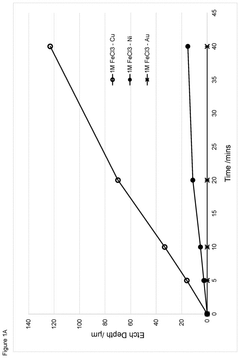
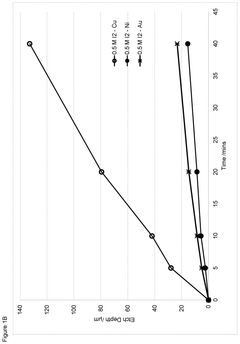
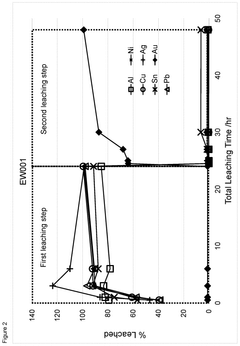
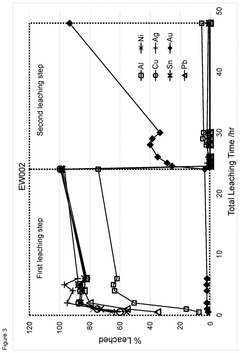
Metal recovery device and metal recovery method
PatentWO2023013714A1
Innovation
- A metal recovery device and method utilizing a hydrophobic deep eutectic solvent that directly leaches metal components from a solid metal-containing composition without inorganic acids, eliminating the need for organic solvents and allowing for selective metal extraction and recovery without the use of chelating agents.




Environmental Impact Assessment of DES Technologies
The environmental impact assessment of Deep Eutectic Solvents (DES) for metal extraction reveals significant advantages over conventional extraction methods. DES technologies demonstrate reduced environmental footprints primarily due to their biodegradability and low volatility characteristics. Unlike traditional organic solvents that release harmful volatile organic compounds (VOCs), DES systems minimize air pollution and associated health risks, contributing to improved workplace safety and reduced atmospheric contamination.
Water consumption metrics for DES-based extraction processes show notable reductions compared to hydrometallurgical techniques. Quantitative analyses indicate that DES metal extraction can achieve up to 40-60% water savings in certain applications, particularly when recycling protocols are effectively implemented. This water conservation aspect becomes increasingly critical as global industrial water scarcity intensifies.
Energy efficiency evaluations demonstrate that DES technologies typically require lower operational temperatures than pyrometallurgical processes, resulting in reduced carbon emissions. Life cycle assessments (LCAs) of choline chloride-based DES systems indicate 25-35% lower greenhouse gas emissions compared to conventional solvent extraction methods when applied to similar metal recovery scenarios.
Waste generation profiles for DES extraction systems show promising characteristics regarding both volume and toxicity. The biodegradable nature of many DES components facilitates easier waste treatment, with studies documenting accelerated degradation rates in controlled environmental conditions. However, comprehensive long-term ecological impact studies remain limited, particularly regarding potential bioaccumulation effects in aquatic ecosystems.
Recycling efficiency represents a critical environmental parameter for DES technologies. Current research indicates that certain DES formulations maintain extraction efficiency through multiple recycling cycles, with some systems demonstrating 85-95% recovery rates for up to 5-7 cycles before significant performance degradation. This recyclability substantially enhances the sustainability profile of these extraction methods.
Land use impact assessments suggest DES technologies may enable more compact processing facilities compared to conventional extraction operations. The reduced equipment footprint stems from simplified process flows and decreased requirements for extensive waste management infrastructure, potentially minimizing habitat disruption in mining regions.
Regulatory compliance analysis indicates DES technologies align favorably with increasingly stringent environmental regulations in major industrial jurisdictions. Their classification as "greener solvents" under various chemical management frameworks provides potential regulatory advantages, though harmonized international standards specifically addressing DES applications remain under development.
Water consumption metrics for DES-based extraction processes show notable reductions compared to hydrometallurgical techniques. Quantitative analyses indicate that DES metal extraction can achieve up to 40-60% water savings in certain applications, particularly when recycling protocols are effectively implemented. This water conservation aspect becomes increasingly critical as global industrial water scarcity intensifies.
Energy efficiency evaluations demonstrate that DES technologies typically require lower operational temperatures than pyrometallurgical processes, resulting in reduced carbon emissions. Life cycle assessments (LCAs) of choline chloride-based DES systems indicate 25-35% lower greenhouse gas emissions compared to conventional solvent extraction methods when applied to similar metal recovery scenarios.
Waste generation profiles for DES extraction systems show promising characteristics regarding both volume and toxicity. The biodegradable nature of many DES components facilitates easier waste treatment, with studies documenting accelerated degradation rates in controlled environmental conditions. However, comprehensive long-term ecological impact studies remain limited, particularly regarding potential bioaccumulation effects in aquatic ecosystems.
Recycling efficiency represents a critical environmental parameter for DES technologies. Current research indicates that certain DES formulations maintain extraction efficiency through multiple recycling cycles, with some systems demonstrating 85-95% recovery rates for up to 5-7 cycles before significant performance degradation. This recyclability substantially enhances the sustainability profile of these extraction methods.
Land use impact assessments suggest DES technologies may enable more compact processing facilities compared to conventional extraction operations. The reduced equipment footprint stems from simplified process flows and decreased requirements for extensive waste management infrastructure, potentially minimizing habitat disruption in mining regions.
Regulatory compliance analysis indicates DES technologies align favorably with increasingly stringent environmental regulations in major industrial jurisdictions. Their classification as "greener solvents" under various chemical management frameworks provides potential regulatory advantages, though harmonized international standards specifically addressing DES applications remain under development.
Scale-up Considerations for Industrial Implementation
Scaling up Deep Eutectic Solvents (DES) technology from laboratory to industrial scale presents significant engineering challenges that must be addressed systematically. The transition requires careful consideration of process parameters that may behave differently at larger scales, particularly the viscosity characteristics of DES systems which typically increase at industrial volumes, potentially impacting mass transfer efficiency and energy requirements.
Equipment design and material selection become critical factors in scale-up operations. Industrial implementation necessitates corrosion-resistant materials compatible with the specific DES compositions being utilized. Stainless steel and specialized polymers have demonstrated promising results in pilot studies, though long-term performance data remains limited in continuous operation scenarios.
Heat management represents another crucial consideration, as DES-based extraction processes often involve exothermic or endothermic reactions. Industrial-scale systems require sophisticated temperature control mechanisms to maintain optimal extraction conditions while preventing thermal degradation of the solvents. Heat exchangers must be specifically designed to accommodate the unique thermal properties and flow characteristics of DES mixtures.
Mixing and mass transfer optimization present particular challenges due to the higher viscosity of many DES formulations. Industrial implementations have explored various agitation technologies, including specialized impeller designs and ultrasonic assistance, to enhance mixing efficiency without excessive energy consumption. Computational fluid dynamics modeling has proven valuable in predicting flow patterns and optimizing mixer configurations before physical implementation.
Continuous processing adaptation represents a significant departure from batch-scale laboratory experiments. The development of continuous DES-based extraction systems requires careful consideration of residence time distribution, phase separation dynamics, and steady-state operation parameters. Several pilot-scale continuous systems have demonstrated promising results, particularly in counter-current extraction configurations that maximize metal recovery efficiency.
Economic viability ultimately determines industrial implementation success. Capital expenditure for DES-based extraction facilities must be balanced against operational cost advantages, including reduced environmental compliance costs and potential recovery of high-value metals. Sensitivity analyses indicate that solvent recycling efficiency and energy consumption are the most significant factors affecting long-term economic performance of industrial DES extraction operations.
Regulatory compliance frameworks for industrial-scale DES implementation continue to evolve. While these solvents generally present lower environmental hazards than conventional extraction chemicals, industrial safety protocols must address specific handling requirements, particularly for DES formulations containing potentially toxic hydrogen bond donors or metal-loaded spent solvents.
Equipment design and material selection become critical factors in scale-up operations. Industrial implementation necessitates corrosion-resistant materials compatible with the specific DES compositions being utilized. Stainless steel and specialized polymers have demonstrated promising results in pilot studies, though long-term performance data remains limited in continuous operation scenarios.
Heat management represents another crucial consideration, as DES-based extraction processes often involve exothermic or endothermic reactions. Industrial-scale systems require sophisticated temperature control mechanisms to maintain optimal extraction conditions while preventing thermal degradation of the solvents. Heat exchangers must be specifically designed to accommodate the unique thermal properties and flow characteristics of DES mixtures.
Mixing and mass transfer optimization present particular challenges due to the higher viscosity of many DES formulations. Industrial implementations have explored various agitation technologies, including specialized impeller designs and ultrasonic assistance, to enhance mixing efficiency without excessive energy consumption. Computational fluid dynamics modeling has proven valuable in predicting flow patterns and optimizing mixer configurations before physical implementation.
Continuous processing adaptation represents a significant departure from batch-scale laboratory experiments. The development of continuous DES-based extraction systems requires careful consideration of residence time distribution, phase separation dynamics, and steady-state operation parameters. Several pilot-scale continuous systems have demonstrated promising results, particularly in counter-current extraction configurations that maximize metal recovery efficiency.
Economic viability ultimately determines industrial implementation success. Capital expenditure for DES-based extraction facilities must be balanced against operational cost advantages, including reduced environmental compliance costs and potential recovery of high-value metals. Sensitivity analyses indicate that solvent recycling efficiency and energy consumption are the most significant factors affecting long-term economic performance of industrial DES extraction operations.
Regulatory compliance frameworks for industrial-scale DES implementation continue to evolve. While these solvents generally present lower environmental hazards than conventional extraction chemicals, industrial safety protocols must address specific handling requirements, particularly for DES formulations containing potentially toxic hydrogen bond donors or metal-loaded spent solvents.
Unlock deeper insights with Patsnap Eureka Quick Research — get a full tech report to explore trends and direct your research. Try now!
Generate Your Research Report Instantly with AI Agent
Supercharge your innovation with Patsnap Eureka AI Agent Platform!