Diesel Particulate Filter Heat Assimilation Efficiency
SEP 18, 20259 MIN READ
Generate Your Research Report Instantly with AI Agent
PatSnap Eureka helps you evaluate technical feasibility & market potential.
DPF Technology Background and Objectives
Diesel Particulate Filters (DPFs) emerged in the early 1980s as a response to increasingly stringent emission regulations worldwide, particularly targeting particulate matter (PM) emissions from diesel engines. The technology has evolved significantly over the past four decades, transitioning from experimental prototypes to standard equipment in modern diesel vehicles. Initially developed for heavy-duty applications, DPFs have become ubiquitous across all diesel vehicle segments, from passenger cars to commercial trucks and off-road machinery.
The fundamental principle behind DPF operation involves physical filtration of exhaust gases through porous ceramic or metallic substrates, capturing soot particles while allowing gases to pass through. As these filters accumulate particulate matter, they require periodic regeneration—a process where trapped soot is oxidized at elevated temperatures to restore filter capacity. This regeneration process represents a critical aspect of DPF technology, directly impacting system efficiency, durability, and overall vehicle performance.
Heat assimilation efficiency within DPF systems has become a focal point of technological development, as it significantly influences fuel economy, emissions control effectiveness, and component longevity. The thermal management challenges associated with DPF regeneration have driven continuous innovation in materials science, catalyst technology, and control strategies. Current technological trajectories indicate a move toward more sophisticated thermal management systems that optimize energy utilization during the regeneration process.
Global regulatory frameworks continue to push the boundaries of emissions control technology, with Euro 7, China 7, and US EPA standards demanding ever-lower particulate emissions. These regulations have accelerated research into advanced DPF technologies with improved heat assimilation characteristics, capable of more efficient and frequent regeneration cycles while minimizing fuel consumption penalties.
The primary technical objectives in DPF heat assimilation efficiency development include: reducing the energy required for complete regeneration, improving thermal distribution across the filter substrate, minimizing thermal gradients that can cause mechanical stress and failure, optimizing catalyst formulations for lower light-off temperatures, and developing advanced sensing and control algorithms for precise thermal management.
Additionally, researchers are exploring synergistic integration of DPF systems with other aftertreatment components, such as Selective Catalytic Reduction (SCR) systems, to leverage thermal energy more effectively across the entire exhaust aftertreatment architecture. This holistic approach aims to maximize overall system efficiency while meeting increasingly demanding emissions targets.
As electrification trends reshape the automotive landscape, DPF technology must also adapt to hybrid powertrains, where intermittent engine operation presents unique challenges for maintaining optimal filter temperatures. This evolving context underscores the importance of continued innovation in heat assimilation efficiency for next-generation DPF systems.
The fundamental principle behind DPF operation involves physical filtration of exhaust gases through porous ceramic or metallic substrates, capturing soot particles while allowing gases to pass through. As these filters accumulate particulate matter, they require periodic regeneration—a process where trapped soot is oxidized at elevated temperatures to restore filter capacity. This regeneration process represents a critical aspect of DPF technology, directly impacting system efficiency, durability, and overall vehicle performance.
Heat assimilation efficiency within DPF systems has become a focal point of technological development, as it significantly influences fuel economy, emissions control effectiveness, and component longevity. The thermal management challenges associated with DPF regeneration have driven continuous innovation in materials science, catalyst technology, and control strategies. Current technological trajectories indicate a move toward more sophisticated thermal management systems that optimize energy utilization during the regeneration process.
Global regulatory frameworks continue to push the boundaries of emissions control technology, with Euro 7, China 7, and US EPA standards demanding ever-lower particulate emissions. These regulations have accelerated research into advanced DPF technologies with improved heat assimilation characteristics, capable of more efficient and frequent regeneration cycles while minimizing fuel consumption penalties.
The primary technical objectives in DPF heat assimilation efficiency development include: reducing the energy required for complete regeneration, improving thermal distribution across the filter substrate, minimizing thermal gradients that can cause mechanical stress and failure, optimizing catalyst formulations for lower light-off temperatures, and developing advanced sensing and control algorithms for precise thermal management.
Additionally, researchers are exploring synergistic integration of DPF systems with other aftertreatment components, such as Selective Catalytic Reduction (SCR) systems, to leverage thermal energy more effectively across the entire exhaust aftertreatment architecture. This holistic approach aims to maximize overall system efficiency while meeting increasingly demanding emissions targets.
As electrification trends reshape the automotive landscape, DPF technology must also adapt to hybrid powertrains, where intermittent engine operation presents unique challenges for maintaining optimal filter temperatures. This evolving context underscores the importance of continued innovation in heat assimilation efficiency for next-generation DPF systems.
Market Demand Analysis for Efficient DPF Systems
The global market for Diesel Particulate Filter (DPF) systems is experiencing significant growth driven by increasingly stringent emission regulations worldwide. The automotive industry faces mounting pressure to reduce particulate matter emissions, with Euro 7, China 6b, and US EPA Tier 3 standards pushing manufacturers toward more efficient filtration solutions. Current market valuation stands at approximately 12 billion USD with projected annual growth rates of 8.3% through 2028, indicating robust demand for advanced DPF technologies.
Heat assimilation efficiency has emerged as a critical factor in this market landscape. Traditional DPF systems suffer from performance limitations during low-temperature operating conditions, creating a substantial market gap for solutions that can maintain filtration efficiency across diverse driving cycles. Fleet operators report that inefficient heat management in current DPF systems leads to increased maintenance costs, with unscheduled downtime costing commercial vehicle operators between 600-900 USD per day.
Consumer demand patterns show increasing preference for vehicles with reduced regeneration frequency and improved fuel economy. Market research indicates that 78% of commercial fleet managers prioritize DPF systems with enhanced thermal management capabilities when making purchasing decisions. This trend extends to passenger vehicle markets, where manufacturers are leveraging improved DPF performance as a competitive advantage in marketing campaigns.
Regional analysis reveals varying market dynamics. European markets show highest adoption rates for advanced DPF systems due to stringent regulatory frameworks, while emerging markets in Asia-Pacific represent the fastest-growing segment with 11.2% annual growth. North American markets demonstrate increasing demand particularly in the heavy-duty vehicle sector, where thermal efficiency improvements directly translate to operational cost savings.
Industry surveys indicate that end-users are willing to pay a premium of 15-20% for DPF systems demonstrating superior heat assimilation efficiency, provided they deliver measurable reductions in maintenance frequency and fuel consumption. This price elasticity creates significant market opportunities for innovative solutions that address current thermal management limitations.
The aftermarket segment represents another substantial opportunity, valued at 3.8 billion USD globally, with retrofit solutions for existing vehicles driving demand. As fleet operators seek to extend vehicle lifespans while meeting evolving emissions standards, aftermarket DPF systems with improved heat management capabilities are experiencing 9.7% annual growth, outpacing the overall market.
Cross-industry analysis reveals potential market expansion into non-road applications, including construction equipment, agricultural machinery, and marine engines, where thermal efficiency challenges are even more pronounced due to variable load conditions and operating environments.
Heat assimilation efficiency has emerged as a critical factor in this market landscape. Traditional DPF systems suffer from performance limitations during low-temperature operating conditions, creating a substantial market gap for solutions that can maintain filtration efficiency across diverse driving cycles. Fleet operators report that inefficient heat management in current DPF systems leads to increased maintenance costs, with unscheduled downtime costing commercial vehicle operators between 600-900 USD per day.
Consumer demand patterns show increasing preference for vehicles with reduced regeneration frequency and improved fuel economy. Market research indicates that 78% of commercial fleet managers prioritize DPF systems with enhanced thermal management capabilities when making purchasing decisions. This trend extends to passenger vehicle markets, where manufacturers are leveraging improved DPF performance as a competitive advantage in marketing campaigns.
Regional analysis reveals varying market dynamics. European markets show highest adoption rates for advanced DPF systems due to stringent regulatory frameworks, while emerging markets in Asia-Pacific represent the fastest-growing segment with 11.2% annual growth. North American markets demonstrate increasing demand particularly in the heavy-duty vehicle sector, where thermal efficiency improvements directly translate to operational cost savings.
Industry surveys indicate that end-users are willing to pay a premium of 15-20% for DPF systems demonstrating superior heat assimilation efficiency, provided they deliver measurable reductions in maintenance frequency and fuel consumption. This price elasticity creates significant market opportunities for innovative solutions that address current thermal management limitations.
The aftermarket segment represents another substantial opportunity, valued at 3.8 billion USD globally, with retrofit solutions for existing vehicles driving demand. As fleet operators seek to extend vehicle lifespans while meeting evolving emissions standards, aftermarket DPF systems with improved heat management capabilities are experiencing 9.7% annual growth, outpacing the overall market.
Cross-industry analysis reveals potential market expansion into non-road applications, including construction equipment, agricultural machinery, and marine engines, where thermal efficiency challenges are even more pronounced due to variable load conditions and operating environments.
Current DPF Heat Assimilation Challenges
Diesel Particulate Filter (DPF) systems currently face significant heat assimilation challenges that limit their efficiency and performance in modern diesel engines. The primary challenge lies in achieving optimal temperature management within the filter substrate. DPF systems require temperatures between 550°C and 650°C to effectively initiate regeneration processes, yet typical diesel exhaust temperatures during normal operation often range between 200°C and 400°C, creating a substantial thermal deficit.
This temperature gap presents a fundamental engineering dilemma, as insufficient heat assimilation leads to incomplete soot oxidation and filter clogging. Current DPF designs struggle with thermal distribution uniformity, resulting in localized hotspots that can cause filter cracking while other areas remain below regeneration temperature thresholds. These thermal gradients significantly reduce filter longevity and regeneration efficiency.
Material limitations further compound these challenges. Contemporary ceramic substrates (typically cordierite or silicon carbide) exhibit thermal conductivity constraints that impede rapid and uniform heat transfer throughout the filter structure. The trade-off between thermal durability and heat transfer efficiency remains unresolved in current material formulations, with high-performance materials often carrying prohibitive cost implications for mass-market applications.
Energy efficiency represents another critical challenge. Current active regeneration systems require substantial fuel penalties, typically consuming 2-4% additional fuel to generate the necessary heat for regeneration. This contradicts broader emissions reduction goals and fuel economy standards, creating a paradoxical situation where pollution control systems increase overall vehicle emissions through higher fuel consumption.
Sensor technology limitations also hinder precise temperature monitoring and control. Current temperature sensors provide only point measurements rather than comprehensive thermal mapping of the filter, resulting in suboptimal regeneration timing and duration. The inability to accurately measure temperature distribution across the entire filter volume leads to either excessive regeneration cycles (wasting fuel) or insufficient regeneration (reducing filter efficiency).
Cold-start conditions present particularly severe challenges for DPF heat assimilation. During cold starts, especially in low ambient temperatures, exhaust gas temperatures remain well below regeneration thresholds for extended periods. This results in accelerated soot accumulation without the possibility of passive regeneration, necessitating more frequent active regeneration cycles and increasing system stress.
Integration with other aftertreatment components further complicates heat management. Modern exhaust systems must balance thermal requirements across multiple components (DOC, DPF, SCR), each with different optimal temperature ranges. Heat prioritization between these components often results in compromised DPF performance to accommodate the thermal needs of the complete system.
This temperature gap presents a fundamental engineering dilemma, as insufficient heat assimilation leads to incomplete soot oxidation and filter clogging. Current DPF designs struggle with thermal distribution uniformity, resulting in localized hotspots that can cause filter cracking while other areas remain below regeneration temperature thresholds. These thermal gradients significantly reduce filter longevity and regeneration efficiency.
Material limitations further compound these challenges. Contemporary ceramic substrates (typically cordierite or silicon carbide) exhibit thermal conductivity constraints that impede rapid and uniform heat transfer throughout the filter structure. The trade-off between thermal durability and heat transfer efficiency remains unresolved in current material formulations, with high-performance materials often carrying prohibitive cost implications for mass-market applications.
Energy efficiency represents another critical challenge. Current active regeneration systems require substantial fuel penalties, typically consuming 2-4% additional fuel to generate the necessary heat for regeneration. This contradicts broader emissions reduction goals and fuel economy standards, creating a paradoxical situation where pollution control systems increase overall vehicle emissions through higher fuel consumption.
Sensor technology limitations also hinder precise temperature monitoring and control. Current temperature sensors provide only point measurements rather than comprehensive thermal mapping of the filter, resulting in suboptimal regeneration timing and duration. The inability to accurately measure temperature distribution across the entire filter volume leads to either excessive regeneration cycles (wasting fuel) or insufficient regeneration (reducing filter efficiency).
Cold-start conditions present particularly severe challenges for DPF heat assimilation. During cold starts, especially in low ambient temperatures, exhaust gas temperatures remain well below regeneration thresholds for extended periods. This results in accelerated soot accumulation without the possibility of passive regeneration, necessitating more frequent active regeneration cycles and increasing system stress.
Integration with other aftertreatment components further complicates heat management. Modern exhaust systems must balance thermal requirements across multiple components (DOC, DPF, SCR), each with different optimal temperature ranges. Heat prioritization between these components often results in compromised DPF performance to accommodate the thermal needs of the complete system.
Current Heat Assimilation Solutions for DPF
01 Filter design optimization for heat efficiency
Optimizing the design of diesel particulate filters to improve heat assimilation efficiency involves structural modifications that enhance heat transfer and distribution. This includes the development of specialized filter materials, geometric configurations, and internal channel designs that maximize surface area for heat exchange. These design optimizations help to ensure uniform temperature distribution across the filter, reducing thermal stress and improving regeneration efficiency.- Filter design and structure for heat efficiency: The design and structure of diesel particulate filters significantly impact heat assimilation efficiency. Innovations include optimized filter geometries, advanced substrate materials, and improved cell density configurations that enhance heat distribution and retention. These structural improvements facilitate better heat transfer throughout the filter, leading to more efficient particulate combustion during regeneration cycles while minimizing thermal stress on the filter components.
- Regeneration systems and thermal management: Advanced regeneration systems incorporate sophisticated thermal management techniques to optimize heat assimilation in diesel particulate filters. These systems utilize controlled fuel injection strategies, exhaust gas recirculation, and precise temperature monitoring to maintain ideal thermal conditions for particulate oxidation. By carefully managing heat distribution and regeneration timing, these systems maximize filtration efficiency while extending filter lifespan and reducing fuel consumption associated with the regeneration process.
- Catalyst coatings and materials for improved heat utilization: Specialized catalyst coatings and advanced materials significantly enhance heat assimilation efficiency in diesel particulate filters. These innovations include noble metal catalysts, rare earth compounds, and composite materials that lower the activation energy required for particulate oxidation. By promoting more complete combustion at lower temperatures, these materials improve filter performance, reduce regeneration frequency, and optimize the utilization of available heat energy within the exhaust system.
- Sensor integration and control systems: Sophisticated sensor networks and control systems play a crucial role in optimizing diesel particulate filter heat assimilation efficiency. These systems incorporate temperature sensors, pressure differential monitors, and exhaust gas composition analyzers to provide real-time data for adaptive control algorithms. By continuously monitoring filter conditions and adjusting operational parameters accordingly, these integrated systems ensure optimal heat distribution, timely regeneration cycles, and maximum filtration efficiency across varying engine operating conditions.
- Heat recovery and energy efficiency systems: Innovative heat recovery systems capture and repurpose thermal energy from diesel particulate filters to improve overall system efficiency. These technologies include thermoelectric generators, heat exchangers, and thermal storage solutions that harness waste heat from the filtration process. By recirculating captured heat energy back into the system or converting it to useful power, these approaches reduce fuel consumption, lower emissions, and improve the overall energy efficiency of diesel exhaust aftertreatment systems.
02 Thermal management systems for DPF regeneration
Advanced thermal management systems are employed to control and optimize the heat assimilation in diesel particulate filters during regeneration processes. These systems include intelligent heating controls, temperature sensors, and exhaust flow management mechanisms that ensure efficient heat distribution. By precisely controlling the regeneration temperature and duration, these systems maximize particulate matter oxidation while minimizing energy consumption and thermal damage to the filter substrate.Expand Specific Solutions03 Catalytic coatings to enhance heat utilization
Specialized catalytic coatings applied to diesel particulate filters can significantly improve heat assimilation efficiency by lowering the temperature required for particulate matter oxidation. These coatings, which may include precious metals or metal oxides, facilitate the conversion of exhaust heat into chemical energy for soot combustion. The catalytic action enables more complete regeneration at lower temperatures, reducing fuel consumption and thermal stress on the filter material.Expand Specific Solutions04 Exhaust gas recirculation and heat recovery systems
Integration of exhaust gas recirculation (EGR) and heat recovery systems with diesel particulate filters improves overall thermal efficiency. These systems capture and redirect waste heat from the exhaust stream back into the filter system or engine intake, reducing the energy required for filter regeneration. Advanced heat exchangers and thermal energy recovery devices help to maintain optimal filter temperatures while reducing fuel consumption and emissions.Expand Specific Solutions05 Sensor-based monitoring and control of filter temperature
Implementation of sophisticated sensor networks for real-time monitoring and control of diesel particulate filter temperatures enhances heat assimilation efficiency. These systems employ temperature sensors, pressure differential sensors, and soot load estimators to precisely determine when and how regeneration should occur. Adaptive control algorithms adjust heating parameters based on operating conditions, ensuring optimal heat utilization while preventing filter damage from excessive temperatures.Expand Specific Solutions
Key Industry Players in DPF Development
The diesel particulate filter (DPF) heat assimilation efficiency market is currently in a growth phase, driven by stringent emission regulations worldwide. The market size is expanding steadily, estimated to reach several billion dollars by 2025, with automotive applications representing the largest segment. Technologically, the field shows varying maturity levels, with established players like GM Global Technology Operations, Corning, and Toyota Motor Corp. leading innovation through advanced ceramic substrate technologies. Companies including Johnson Matthey, DENSO Corp., and NGK Insulators have developed proprietary thermal management solutions, while newer entrants like Ceracomb Co. are introducing novel materials for improved heat distribution. Chinese manufacturers such as China Petroleum & Chemical Corp. are rapidly advancing their capabilities, particularly in cost-effective solutions for emerging markets.
Toyota Motor Corp.
Technical Solution: Toyota has developed an advanced Diesel Particulate Filter (DPF) system that utilizes a proprietary heat management approach to optimize particulate matter combustion efficiency. Their system incorporates a multi-layer filter substrate with varying cell densities that creates optimized temperature distribution across the filter surface. Toyota's approach includes intelligent thermal management that precisely controls exhaust gas temperatures through a combination of post-injection strategies and active regeneration timing based on real-time soot load calculations. The company has implemented a dual-mode regeneration strategy that switches between passive and active regeneration depending on driving conditions, which helps maintain optimal filter temperatures between 550-650°C during regeneration cycles. Toyota's system also features advanced catalyst coatings that lower the combustion temperature required for soot oxidation, improving overall energy efficiency during the regeneration process. Their latest generation systems incorporate predictive algorithms that use driving pattern recognition to anticipate optimal regeneration timing, further reducing fuel consumption associated with the regeneration process.
Strengths: Superior thermal distribution technology minimizes hot spots that can damage filter substrates, extending DPF lifespan. The adaptive regeneration system reduces fuel penalty by up to 30% compared to conventional systems. Weaknesses: The complex control systems require sophisticated sensors and ECU programming, increasing system cost and potential failure points.
IFP Energies Nouvelles
Technical Solution: IFP Energies Nouvelles has pioneered innovative approaches to DPF heat assimilation efficiency through their patented "Thermal Gradient Optimization" technology. This system utilizes a combination of advanced filter materials and precise exhaust flow management to create controlled thermal gradients within the filter structure. Their solution incorporates a variable geometry inlet design that distributes exhaust flow dynamically across the filter face based on operating conditions, ensuring more uniform temperature distribution. IFP's technology includes a multi-zone catalyst coating strategy where different sections of the filter are treated with specialized catalyst formulations optimized for specific temperature ranges, maximizing oxidation efficiency across varying engine loads. The company has developed proprietary computational fluid dynamics models that accurately predict heat transfer within the filter structure, allowing for optimization of cell density and wall thickness parameters. Their latest innovation includes a "thermal energy recovery system" that captures and redirects waste heat from the DPF regeneration process to pre-heat incoming exhaust gases, creating a more self-sustaining regeneration cycle and reducing the overall energy requirements.
Strengths: The multi-zone catalyst approach enables efficient particulate oxidation across a wider temperature range (250-650°C), reducing regeneration frequency. Their thermal energy recovery system reduces fuel consumption associated with active regeneration by up to 25%. Weaknesses: The complex filter structure with variable catalyst loadings increases manufacturing complexity and cost, potentially limiting adoption in cost-sensitive market segments.
Core Patents in DPF Thermal Efficiency
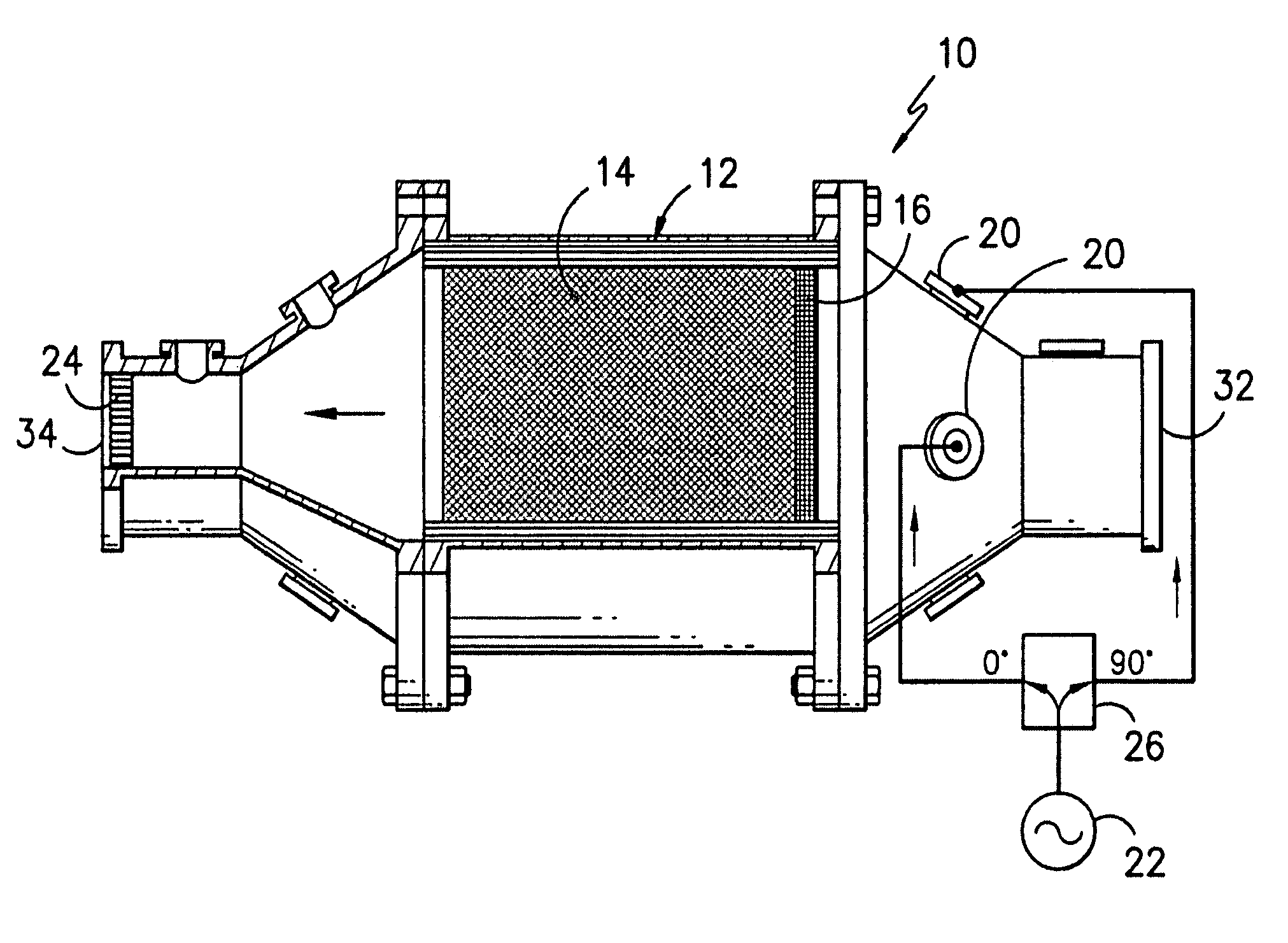
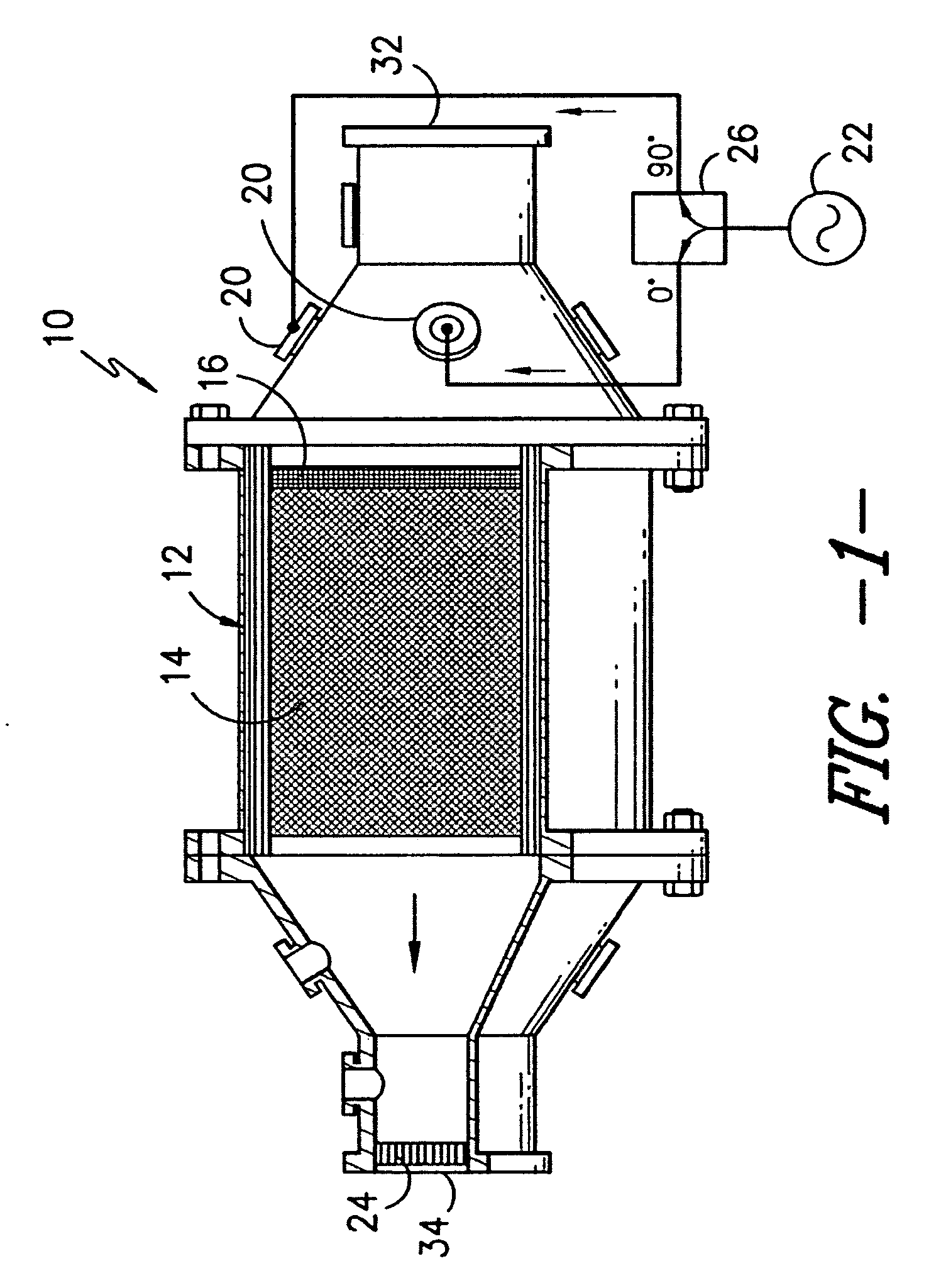
Diesel particulate filter using micro-wave regeneraiton
PatentActiveUS20060101793A1
Innovation
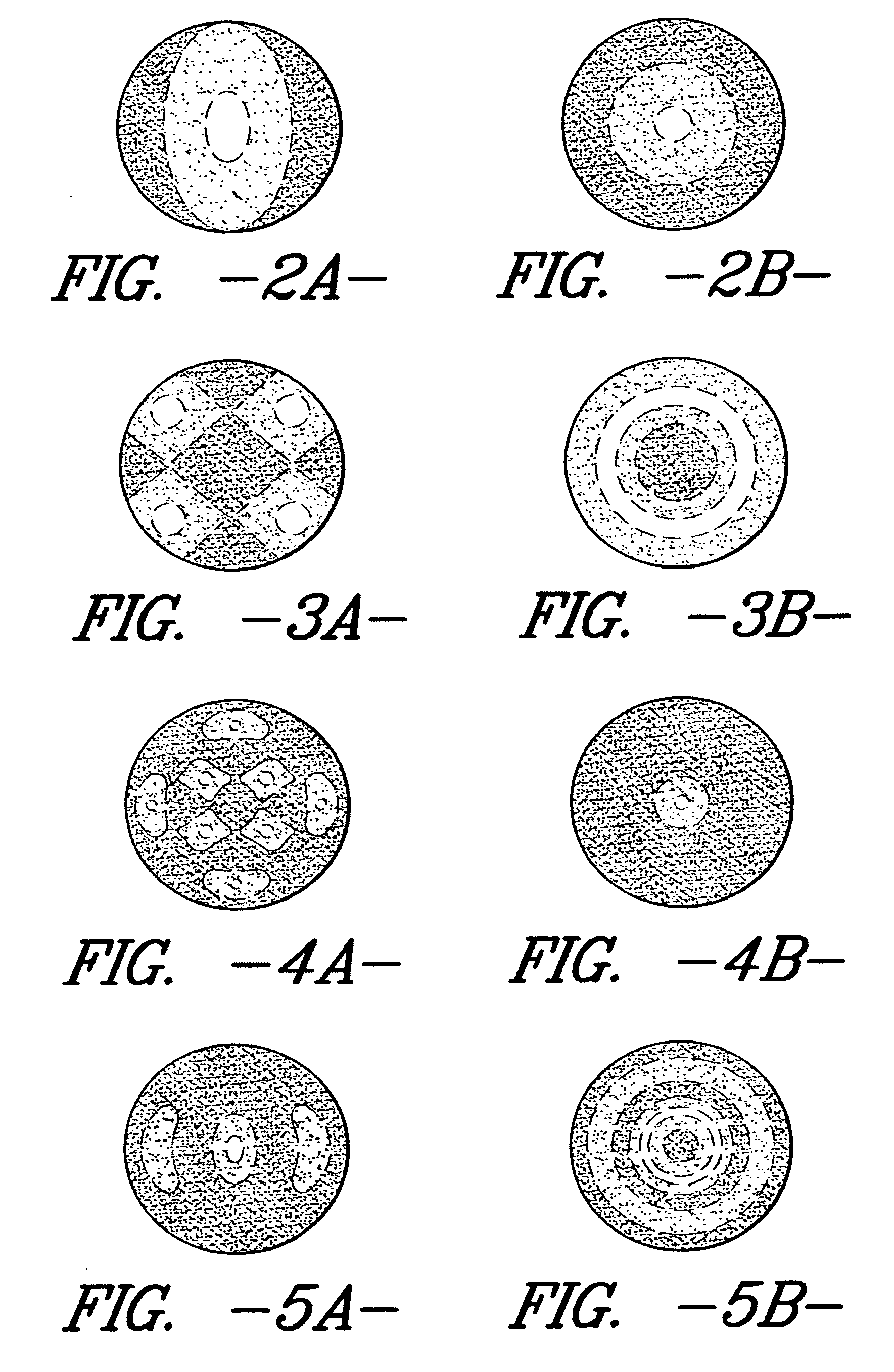
- A diesel particulate filter system with a microwave-absorbing target positioned within a waveguide cavity that accepts microwave-frequency electromagnetic radiation through input couplers 90 degrees out of phase, exciting circular polarization modes to achieve uniform heating across the filter, thereby eliminating radial non-uniformity and promoting complete particulate combustion.

Diesel particulate filter (DPF) regeneration by electrical heating of resistive coatings
PatentInactiveUS7469532B2
Innovation
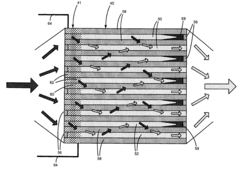
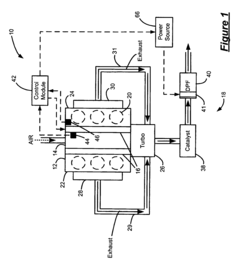
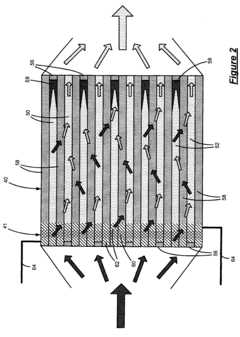
- An exhaust system with a resistive electrical heater integrally formed within the DPF, selectively heating the exhaust to initiate combustion of particulates, and a control module that determines the need for regeneration based on particulate matter thresholds, ensuring controlled and efficient heating.

Emissions Regulations Impact on DPF Technology
The evolution of emissions regulations globally has been a primary driver for advancements in Diesel Particulate Filter (DPF) technology, particularly in heat assimilation efficiency. Since the introduction of Euro 1 standards in 1992, each subsequent regulatory framework has progressively tightened particulate matter (PM) emission limits, necessitating more sophisticated DPF systems with enhanced thermal management capabilities.
The implementation of Euro 6 standards in Europe and similar Tier 4 Final regulations in the United States has established stringent PM limits of 0.01 g/kWh and 0.02 g/kWh respectively. These regulations have directly influenced DPF design parameters, particularly regarding heat distribution and retention characteristics essential for effective regeneration processes.
Regulatory bodies have increasingly focused on real-world driving emissions (RDE) testing protocols, moving beyond laboratory conditions. This shift has compelled manufacturers to develop DPF systems capable of maintaining optimal heat assimilation efficiency across diverse operating conditions, including cold starts and low-load urban driving scenarios where thermal management presents significant challenges.
China's implementation of China VI standards, comparable to Euro 6, has expanded the global market for advanced DPF technologies with superior heat management capabilities. This regulatory convergence across major markets has accelerated research into novel materials and designs that optimize thermal conductivity and heat retention within filter substrates.
The regulatory emphasis on reducing regeneration frequency while maintaining filtration efficiency has driven innovation in passive regeneration technologies. These systems rely heavily on precise thermal management to ensure consistent oxidation of trapped particulates without compromising filter integrity or vehicle performance.
Future regulatory trends indicate a continued focus on lifecycle emissions performance, including durability requirements for emissions control systems. This perspective is pushing DPF technology toward more thermally resilient designs capable of maintaining consistent heat assimilation efficiency throughout the vehicle's operational lifespan, typically exceeding 160,000 kilometers under European standards.
The regulatory landscape has also begun addressing the environmental impact of manufacturing and disposing of DPF systems, encouraging research into sustainable materials that maintain optimal thermal properties while reducing the overall carbon footprint of emissions control technologies.
The implementation of Euro 6 standards in Europe and similar Tier 4 Final regulations in the United States has established stringent PM limits of 0.01 g/kWh and 0.02 g/kWh respectively. These regulations have directly influenced DPF design parameters, particularly regarding heat distribution and retention characteristics essential for effective regeneration processes.
Regulatory bodies have increasingly focused on real-world driving emissions (RDE) testing protocols, moving beyond laboratory conditions. This shift has compelled manufacturers to develop DPF systems capable of maintaining optimal heat assimilation efficiency across diverse operating conditions, including cold starts and low-load urban driving scenarios where thermal management presents significant challenges.
China's implementation of China VI standards, comparable to Euro 6, has expanded the global market for advanced DPF technologies with superior heat management capabilities. This regulatory convergence across major markets has accelerated research into novel materials and designs that optimize thermal conductivity and heat retention within filter substrates.
The regulatory emphasis on reducing regeneration frequency while maintaining filtration efficiency has driven innovation in passive regeneration technologies. These systems rely heavily on precise thermal management to ensure consistent oxidation of trapped particulates without compromising filter integrity or vehicle performance.
Future regulatory trends indicate a continued focus on lifecycle emissions performance, including durability requirements for emissions control systems. This perspective is pushing DPF technology toward more thermally resilient designs capable of maintaining consistent heat assimilation efficiency throughout the vehicle's operational lifespan, typically exceeding 160,000 kilometers under European standards.
The regulatory landscape has also begun addressing the environmental impact of manufacturing and disposing of DPF systems, encouraging research into sustainable materials that maintain optimal thermal properties while reducing the overall carbon footprint of emissions control technologies.
Material Science Advancements for DPF Systems
Recent advancements in material science have revolutionized Diesel Particulate Filter (DPF) systems, significantly enhancing heat assimilation efficiency. Traditional ceramic materials like cordierite and silicon carbide have been the industry standard for decades, but their thermal conductivity limitations have prompted extensive research into next-generation materials.
Nano-engineered ceramics represent a breakthrough in DPF technology, incorporating precisely controlled porosity structures that optimize both filtration efficiency and heat distribution. These materials feature tailored pore size distributions that maintain high particulate capture rates while reducing backpressure, a critical factor in maintaining engine performance during regeneration cycles.
Metal-ceramic composites have emerged as promising alternatives, combining the thermal durability of ceramics with the superior heat conductivity of metals. These hybrid materials demonstrate up to 40% improvement in thermal response times compared to conventional DPF substrates, allowing for more rapid and uniform heating during active regeneration processes.
Advanced coating technologies have further enhanced DPF performance through the application of catalytic materials with optimized surface area characteristics. Washcoat formulations incorporating rare earth metals and novel oxygen storage compounds have demonstrated exceptional ability to lower regeneration temperatures by up to 50°C, significantly reducing thermal stress on the filter substrate.
Thermal barrier coatings (TBCs) derived from aerospace applications are being adapted for DPF systems, creating protective layers that prevent thermal degradation while maintaining efficient heat transfer to catalytic sites. These multi-layer coating systems can withstand temperature gradients exceeding 200°C/mm without compromising structural integrity.
Graphene-enhanced ceramic composites represent the cutting edge of DPF material science, with preliminary studies showing remarkable improvements in thermal conductivity. The incorporation of graphene nanoplatelets into ceramic matrices has yielded materials with up to 300% higher thermal conductivity than traditional cordierite, potentially revolutionizing heat management in DPF systems.
Self-healing ceramic materials are under development, utilizing embedded phase-change materials that can repair microcracks formed during thermal cycling. This technology could significantly extend DPF service life by mitigating the cumulative damage caused by repeated regeneration cycles, addressing one of the primary failure modes in current systems.
Nano-engineered ceramics represent a breakthrough in DPF technology, incorporating precisely controlled porosity structures that optimize both filtration efficiency and heat distribution. These materials feature tailored pore size distributions that maintain high particulate capture rates while reducing backpressure, a critical factor in maintaining engine performance during regeneration cycles.
Metal-ceramic composites have emerged as promising alternatives, combining the thermal durability of ceramics with the superior heat conductivity of metals. These hybrid materials demonstrate up to 40% improvement in thermal response times compared to conventional DPF substrates, allowing for more rapid and uniform heating during active regeneration processes.
Advanced coating technologies have further enhanced DPF performance through the application of catalytic materials with optimized surface area characteristics. Washcoat formulations incorporating rare earth metals and novel oxygen storage compounds have demonstrated exceptional ability to lower regeneration temperatures by up to 50°C, significantly reducing thermal stress on the filter substrate.
Thermal barrier coatings (TBCs) derived from aerospace applications are being adapted for DPF systems, creating protective layers that prevent thermal degradation while maintaining efficient heat transfer to catalytic sites. These multi-layer coating systems can withstand temperature gradients exceeding 200°C/mm without compromising structural integrity.
Graphene-enhanced ceramic composites represent the cutting edge of DPF material science, with preliminary studies showing remarkable improvements in thermal conductivity. The incorporation of graphene nanoplatelets into ceramic matrices has yielded materials with up to 300% higher thermal conductivity than traditional cordierite, potentially revolutionizing heat management in DPF systems.
Self-healing ceramic materials are under development, utilizing embedded phase-change materials that can repair microcracks formed during thermal cycling. This technology could significantly extend DPF service life by mitigating the cumulative damage caused by repeated regeneration cycles, addressing one of the primary failure modes in current systems.
Unlock deeper insights with PatSnap Eureka Quick Research — get a full tech report to explore trends and direct your research. Try now!
Generate Your Research Report Instantly with AI Agent
Supercharge your innovation with PatSnap Eureka AI Agent Platform!