

How to Deploy Advanced Modeling for Diesel Particulate Filter
SEP 18, 20259 MIN READ
Generate Your Research Report Instantly with AI Agent
PatSnap Eureka helps you evaluate technical feasibility & market potential.
DPF Modeling Background and Objectives
Diesel Particulate Filters (DPFs) have evolved significantly since their introduction in the early 1980s as a response to increasingly stringent emission regulations worldwide. Initially developed for heavy-duty diesel applications, DPFs have become standard components in modern diesel engines across various sectors including automotive, marine, and industrial equipment. The technology has progressed from simple mechanical filtration systems to sophisticated components integrated with complex exhaust aftertreatment systems.
The primary objective of advanced DPF modeling is to optimize filter performance while minimizing negative impacts on engine efficiency and operational costs. This involves developing computational models that can accurately predict soot accumulation patterns, regeneration behavior, thermal gradients, and pressure drop characteristics across diverse operating conditions. Such models must account for the complex physical and chemical processes occurring within the filter, including filtration mechanisms, catalytic reactions, and thermal phenomena.
Current modeling approaches face significant challenges in balancing computational efficiency with accuracy. Traditional one-dimensional models, while computationally efficient, often fail to capture the spatial heterogeneity of soot distribution and thermal gradients. Conversely, detailed three-dimensional computational fluid dynamics (CFD) models provide high fidelity but at prohibitive computational costs for real-time applications or design optimization studies involving numerous iterations.
The evolution of DPF modeling has been driven by advancements in computational capabilities, improved understanding of fundamental physical processes, and the availability of more sophisticated experimental validation techniques. Early models focused primarily on pressure drop predictions, while contemporary approaches incorporate multi-physics simulations addressing filtration efficiency, thermal management, and chemical kinetics of regeneration processes.
Recent technological trends indicate a shift toward multi-scale modeling approaches that combine micro-scale representations of porous media with macro-scale system models. This integration aims to capture both the detailed pore-level phenomena and system-level interactions with other aftertreatment components. Additionally, there is growing interest in leveraging machine learning techniques to develop surrogate models that can approximate complex physical behaviors while maintaining computational efficiency.
The ultimate goal of advanced DPF modeling is to enable predictive design and control strategies that maximize filter lifetime, minimize fuel consumption penalties, ensure robust regeneration under all operating conditions, and maintain compliance with increasingly stringent emission standards throughout the vehicle lifecycle. This requires models capable of addressing the inherent trade-offs between filtration efficiency, pressure drop, thermal durability, and regeneration stability.
The primary objective of advanced DPF modeling is to optimize filter performance while minimizing negative impacts on engine efficiency and operational costs. This involves developing computational models that can accurately predict soot accumulation patterns, regeneration behavior, thermal gradients, and pressure drop characteristics across diverse operating conditions. Such models must account for the complex physical and chemical processes occurring within the filter, including filtration mechanisms, catalytic reactions, and thermal phenomena.
Current modeling approaches face significant challenges in balancing computational efficiency with accuracy. Traditional one-dimensional models, while computationally efficient, often fail to capture the spatial heterogeneity of soot distribution and thermal gradients. Conversely, detailed three-dimensional computational fluid dynamics (CFD) models provide high fidelity but at prohibitive computational costs for real-time applications or design optimization studies involving numerous iterations.
The evolution of DPF modeling has been driven by advancements in computational capabilities, improved understanding of fundamental physical processes, and the availability of more sophisticated experimental validation techniques. Early models focused primarily on pressure drop predictions, while contemporary approaches incorporate multi-physics simulations addressing filtration efficiency, thermal management, and chemical kinetics of regeneration processes.
Recent technological trends indicate a shift toward multi-scale modeling approaches that combine micro-scale representations of porous media with macro-scale system models. This integration aims to capture both the detailed pore-level phenomena and system-level interactions with other aftertreatment components. Additionally, there is growing interest in leveraging machine learning techniques to develop surrogate models that can approximate complex physical behaviors while maintaining computational efficiency.
The ultimate goal of advanced DPF modeling is to enable predictive design and control strategies that maximize filter lifetime, minimize fuel consumption penalties, ensure robust regeneration under all operating conditions, and maintain compliance with increasingly stringent emission standards throughout the vehicle lifecycle. This requires models capable of addressing the inherent trade-offs between filtration efficiency, pressure drop, thermal durability, and regeneration stability.
Market Demand Analysis for Advanced DPF Solutions
The global market for Diesel Particulate Filter (DPF) solutions is experiencing significant growth driven by increasingly stringent emission regulations worldwide. The current market size for advanced DPF technologies is estimated at $12.3 billion and projected to reach $17.5 billion by 2027, representing a compound annual growth rate of 7.3%. This growth trajectory is primarily fueled by the implementation of Euro 7 standards in Europe, China 6 regulations in Asia, and EPA Tier 3 requirements in North America.
Commercial vehicle manufacturers constitute the largest demand segment, accounting for approximately 65% of the total market. These manufacturers face mounting pressure to comply with emission standards while maintaining vehicle performance and fuel efficiency. Fleet operators represent another significant market segment, increasingly seeking retrofit solutions to extend the operational life of existing vehicles while meeting updated emission requirements.
Market research indicates a growing preference for advanced modeling solutions that can optimize DPF design and operation. A recent industry survey revealed that 78% of automotive engineers consider computational fluid dynamics (CFD) modeling essential for next-generation DPF development. The ability to predict soot accumulation patterns, regeneration behavior, and backpressure effects has become a critical competitive advantage for filter manufacturers.
Regional analysis shows Europe leading the demand for advanced DPF modeling solutions with 42% market share, followed by North America (27%) and Asia-Pacific (23%). However, the fastest growth is occurring in emerging markets, particularly India and China, where rapid industrialization and tightening emission standards are creating new opportunities for advanced filtration technologies.
The market is also witnessing a shift toward integrated solutions that combine DPF modeling with broader powertrain optimization tools. This trend reflects the industry's move toward holistic approaches to emissions management, where DPF performance is considered within the context of the entire exhaust aftertreatment system.
Cost considerations remain a significant factor influencing market demand. While large OEMs can afford sophisticated modeling solutions, smaller manufacturers and suppliers often seek more accessible options. This has created a market segment for scalable modeling platforms that can be tailored to different budget constraints and technical requirements.
Looking forward, the market for advanced DPF modeling solutions is expected to be shaped by the transition toward electrification. As hybrid powertrains gain market share, there will be increasing demand for models that can account for the unique operating conditions of diesel engines in hybrid configurations, including frequent starts and stops, variable load profiles, and lower exhaust temperatures.
Commercial vehicle manufacturers constitute the largest demand segment, accounting for approximately 65% of the total market. These manufacturers face mounting pressure to comply with emission standards while maintaining vehicle performance and fuel efficiency. Fleet operators represent another significant market segment, increasingly seeking retrofit solutions to extend the operational life of existing vehicles while meeting updated emission requirements.
Market research indicates a growing preference for advanced modeling solutions that can optimize DPF design and operation. A recent industry survey revealed that 78% of automotive engineers consider computational fluid dynamics (CFD) modeling essential for next-generation DPF development. The ability to predict soot accumulation patterns, regeneration behavior, and backpressure effects has become a critical competitive advantage for filter manufacturers.
Regional analysis shows Europe leading the demand for advanced DPF modeling solutions with 42% market share, followed by North America (27%) and Asia-Pacific (23%). However, the fastest growth is occurring in emerging markets, particularly India and China, where rapid industrialization and tightening emission standards are creating new opportunities for advanced filtration technologies.
The market is also witnessing a shift toward integrated solutions that combine DPF modeling with broader powertrain optimization tools. This trend reflects the industry's move toward holistic approaches to emissions management, where DPF performance is considered within the context of the entire exhaust aftertreatment system.
Cost considerations remain a significant factor influencing market demand. While large OEMs can afford sophisticated modeling solutions, smaller manufacturers and suppliers often seek more accessible options. This has created a market segment for scalable modeling platforms that can be tailored to different budget constraints and technical requirements.
Looking forward, the market for advanced DPF modeling solutions is expected to be shaped by the transition toward electrification. As hybrid powertrains gain market share, there will be increasing demand for models that can account for the unique operating conditions of diesel engines in hybrid configurations, including frequent starts and stops, variable load profiles, and lower exhaust temperatures.
Current State and Challenges in DPF Modeling
Diesel Particulate Filter (DPF) modeling has evolved significantly over the past two decades, transitioning from simplified zero-dimensional models to sophisticated three-dimensional computational fluid dynamics (CFD) approaches. Currently, the state-of-the-art in DPF modeling encompasses multi-scale approaches that integrate micro-scale phenomena with macro-scale system behavior, allowing for more accurate predictions of filtration efficiency, pressure drop, and regeneration processes.
The industry has established several mature modeling frameworks, including 1D system-level models that provide real-time simulation capabilities for engine control unit (ECU) implementation, and detailed 3D models that capture complex flow distributions and thermal gradients within the filter substrate. Commercial software packages such as GT-Power, AVL BOOST, and ANSYS Fluent have incorporated specialized DPF modules, making advanced modeling more accessible to engineers.
Despite these advancements, significant challenges persist in DPF modeling. One primary challenge is accurately representing the complex porous media structure of the filter substrate, which exhibits multi-scale characteristics ranging from nanometer-sized pores to millimeter-scale channels. Current models often rely on simplified geometrical representations that fail to capture the true complexity of modern filter designs, particularly those with asymmetric channel geometries or variable porosity distributions.
Another critical challenge lies in modeling the dynamic nature of soot accumulation and distribution. Existing models struggle to accurately predict the spatial and temporal evolution of soot deposits, which significantly impacts pressure drop predictions and regeneration behavior. The heterogeneous nature of diesel soot, with varying composition and morphology depending on engine operating conditions, further complicates modeling efforts.
Regeneration modeling presents additional challenges, particularly in capturing the complex chemical kinetics involved in soot oxidation processes. Current models often employ simplified reaction schemes that fail to account for the influence of ash components, catalyst aging effects, and the interaction between multiple regeneration mechanisms (thermal, NO2-assisted, and catalyst-assisted).
Computational efficiency remains a significant constraint, particularly for models intended for real-time applications or design optimization studies. High-fidelity models that capture all relevant physical phenomena typically require substantial computational resources, limiting their practical utility in product development cycles.
The geographical distribution of DPF modeling expertise shows concentration in automotive research centers in Europe, North America, and Japan, with emerging capabilities in China and India. Academic institutions and research laboratories continue to drive fundamental advances, while industry focuses on practical implementation and validation against real-world data.
The industry has established several mature modeling frameworks, including 1D system-level models that provide real-time simulation capabilities for engine control unit (ECU) implementation, and detailed 3D models that capture complex flow distributions and thermal gradients within the filter substrate. Commercial software packages such as GT-Power, AVL BOOST, and ANSYS Fluent have incorporated specialized DPF modules, making advanced modeling more accessible to engineers.
Despite these advancements, significant challenges persist in DPF modeling. One primary challenge is accurately representing the complex porous media structure of the filter substrate, which exhibits multi-scale characteristics ranging from nanometer-sized pores to millimeter-scale channels. Current models often rely on simplified geometrical representations that fail to capture the true complexity of modern filter designs, particularly those with asymmetric channel geometries or variable porosity distributions.
Another critical challenge lies in modeling the dynamic nature of soot accumulation and distribution. Existing models struggle to accurately predict the spatial and temporal evolution of soot deposits, which significantly impacts pressure drop predictions and regeneration behavior. The heterogeneous nature of diesel soot, with varying composition and morphology depending on engine operating conditions, further complicates modeling efforts.
Regeneration modeling presents additional challenges, particularly in capturing the complex chemical kinetics involved in soot oxidation processes. Current models often employ simplified reaction schemes that fail to account for the influence of ash components, catalyst aging effects, and the interaction between multiple regeneration mechanisms (thermal, NO2-assisted, and catalyst-assisted).
Computational efficiency remains a significant constraint, particularly for models intended for real-time applications or design optimization studies. High-fidelity models that capture all relevant physical phenomena typically require substantial computational resources, limiting their practical utility in product development cycles.
The geographical distribution of DPF modeling expertise shows concentration in automotive research centers in Europe, North America, and Japan, with emerging capabilities in China and India. Academic institutions and research laboratories continue to drive fundamental advances, while industry focuses on practical implementation and validation against real-world data.
Current Advanced Modeling Approaches for DPF
01 Computational fluid dynamics (CFD) modeling for DPF
Advanced computational fluid dynamics (CFD) models are used to simulate and analyze the flow behavior, pressure distribution, and thermal characteristics within diesel particulate filters. These models help in understanding the complex interactions between exhaust gases and filter substrates, enabling optimization of filter design and performance prediction under various operating conditions. CFD modeling can account for factors such as porous media flow, heat transfer, and chemical reactions occurring within the filter.- Computational fluid dynamics (CFD) modeling for DPF: Advanced computational fluid dynamics (CFD) models are used to simulate the flow behavior, temperature distribution, and pressure drop across diesel particulate filters. These models incorporate complex mathematical algorithms to predict filter performance under various operating conditions, helping to optimize filter design and regeneration strategies. The models can account for particle deposition patterns, filter loading, and the effects of different inlet flow conditions on filtration efficiency.
- Soot accumulation and regeneration modeling: Models that predict soot accumulation patterns and regeneration processes in diesel particulate filters are essential for optimizing filter performance and longevity. These models simulate how particulate matter is captured within the filter walls and how it affects backpressure over time. They also model the thermal and chemical processes during active and passive regeneration, including heat transfer, oxidation kinetics, and ash formation, allowing for better control strategies and improved filter durability.
- Real-time monitoring and predictive modeling: Advanced sensor-based models enable real-time monitoring of diesel particulate filter conditions and predictive analysis of filter performance. These models integrate data from pressure sensors, temperature sensors, and exhaust gas composition sensors to continuously assess filter loading status and predict when regeneration is needed. Machine learning algorithms can be incorporated to improve prediction accuracy over time, optimizing engine performance and reducing emissions while extending filter life.
- Filter material and structure optimization models: Models focused on optimizing the material properties and structural design of diesel particulate filters help improve filtration efficiency and durability. These models simulate how different pore sizes, wall thicknesses, cell densities, and material compositions affect filter performance. They can predict how various filter geometries impact soot distribution, pressure drop, thermal resistance, and mechanical strength, enabling the development of more efficient and durable filter designs.
- Multi-scale modeling approaches: Multi-scale modeling techniques combine micro-scale, meso-scale, and macro-scale models to provide comprehensive understanding of diesel particulate filter behavior. These integrated approaches model phenomena ranging from individual pore-level filtration mechanisms to full-system performance under various engine operating conditions. By linking models at different scales, engineers can better understand the relationships between microscopic filter properties and macroscopic performance metrics, leading to more effective filter designs and control strategies.
02 Soot loading and regeneration modeling techniques
Advanced models have been developed to predict soot accumulation patterns and regeneration processes in diesel particulate filters. These models simulate the deposition of particulate matter within filter channels, the resulting backpressure increase, and the thermal behavior during active and passive regeneration events. By accurately modeling these phenomena, engineers can optimize regeneration strategies, predict filter lifespan, and develop control algorithms that balance filtration efficiency with fuel economy.Expand Specific Solutions03 Multi-dimensional and multi-scale modeling approaches
Multi-dimensional and multi-scale modeling approaches are employed to capture the complex physical and chemical processes occurring at different scales within diesel particulate filters. These models integrate micro-scale phenomena (such as soot particle capture mechanisms and pore-level filtration) with macro-scale behavior (such as overall pressure drop and thermal gradients). This comprehensive modeling approach enables more accurate predictions of filter performance and durability under real-world operating conditions.Expand Specific Solutions04 Real-time monitoring and predictive modeling systems
Advanced real-time monitoring and predictive modeling systems have been developed for diesel particulate filters to enable on-board diagnostics and adaptive control strategies. These systems use sensor data combined with model-based algorithms to estimate the current state of the filter, predict future performance, and optimize engine operation accordingly. Real-time models can account for variations in driving conditions, fuel quality, and aging effects, allowing for more efficient filter management and reduced maintenance costs.Expand Specific Solutions05 Material and structural optimization modeling
Advanced modeling techniques are used to optimize the material properties and structural design of diesel particulate filters. These models simulate how different substrate materials, cell geometries, porosity distributions, and catalyst coatings affect filtration efficiency, pressure drop, thermal durability, and regeneration behavior. By using these models, engineers can develop filters with improved performance characteristics, longer service life, and reduced manufacturing costs.Expand Specific Solutions
Key Industry Players in DPF Modeling and Development
The diesel particulate filter (DPF) advanced modeling market is currently in a growth phase, characterized by increasing regulatory pressures for emissions reduction in automotive and industrial sectors. The market size is expanding significantly as manufacturers seek more efficient filtration solutions to meet stringent environmental standards. Leading automotive OEMs including Renault, Ford, GM, Hyundai, and Stellantis are investing heavily in this technology, while specialized suppliers like Bosch, Cummins Emission Solutions, and MANN+HUMMEL demonstrate advanced technical capabilities. Research institutions such as IFP Energies Nouvelles and Tongji University are contributing to technological advancement. The technology is approaching maturity with sophisticated computational models being developed, though challenges remain in real-time simulation accuracy and durability prediction under varying operating conditions.
Ford Global Technologies LLC
Technical Solution: Ford has developed an integrated DPF modeling framework that combines physics-based models with data-driven approaches for robust performance prediction. Their system employs reduced-order modeling techniques to enable real-time simulation capabilities for onboard diagnostics and control optimization. Ford's approach incorporates stochastic elements to account for manufacturing variations and aging effects on filter performance. They utilize high-performance computing resources to perform detailed CFD simulations of complex flow patterns within filter channels under various operating conditions. Ford has implemented digital twin technology for DPF systems that continuously updates model parameters based on vehicle telemetry data. Their models feature specialized components for cold-start emissions prediction and optimization of regeneration strategies to minimize fuel consumption penalties.
Strengths: Excellent integration with production vehicle calibration processes; robust validation across diverse driving conditions; strong focus on practical implementation for production vehicles. Weaknesses: Models may be optimized primarily for light-duty applications; proprietary nature limits external validation and improvement.
GM Global Technology Operations LLC
Technical Solution: GM has developed a comprehensive DPF modeling suite that integrates multi-dimensional simulation capabilities with control-oriented models for production implementation. Their approach features adaptive parameter estimation techniques that continuously refine model accuracy based on sensor feedback. GM employs machine learning algorithms to predict soot distribution patterns within the filter based on driving history and operating conditions. Their models incorporate detailed thermal management strategies to optimize regeneration timing and duration while minimizing fuel economy impact. GM has pioneered the use of neural networks to predict DPF pressure drop evolution under varying conditions, enabling more precise maintenance scheduling. Their modeling framework includes specialized components for cold operation and transient driving conditions that present unique challenges for emission control systems.
Strengths: Excellent balance between model complexity and computational efficiency; strong focus on production implementation and calibration; extensive validation across diverse vehicle platforms. Weaknesses: Models may require significant calibration effort for new applications; some advanced features may be limited to internal use rather than published methodologies.
Critical Technologies in DPF Simulation and Prediction
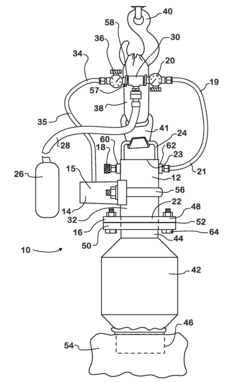
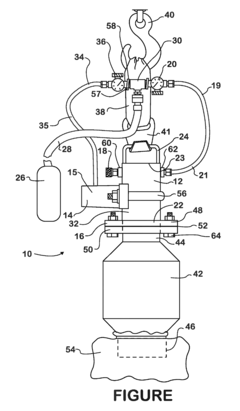
Diesel particulate filter cleaning apparatus and method
PatentInactiveUS7819978B2
Innovation
- An air chamber connected to the diesel particulate filter with a pressure relief valve and a vibrator is used to dislodge and remove particulate material using pressurized air and vibrations, allowing for quick and economical cleaning with readily available shop equipment.
Environmental Regulations Impact on DPF Development
Environmental regulations have become a primary driver for the development and advancement of Diesel Particulate Filter (DPF) technologies globally. Since the early 2000s, increasingly stringent emission standards such as Euro VI in Europe, Tier 4 Final in the United States, and China VI have progressively reduced allowable particulate matter (PM) emissions from diesel engines. These regulations have necessitated sophisticated DPF systems capable of capturing over 95% of diesel soot particles.
The regulatory landscape continues to evolve with notable regional variations. European regulations have traditionally focused on both PM mass and particle number limits, driving the development of highly efficient wall-flow filters. Meanwhile, North American standards have emphasized durability and in-use compliance, leading to robust DPF designs with enhanced regeneration capabilities. Emerging markets like China and India are rapidly adopting similar stringent standards, creating global demand for advanced DPF solutions.
Recent regulatory trends indicate a shift toward real-world emission testing protocols, such as Real Driving Emissions (RDE) in Europe and In-Use Verification Program (IUVP) in the US. These testing methodologies have exposed discrepancies between laboratory certification and actual on-road performance, particularly in varying driving conditions and ambient temperatures. Consequently, DPF modeling approaches must now account for a wider range of operating scenarios to ensure compliance across all conditions.
The regulatory focus has also expanded beyond tailpipe emissions to include lifecycle environmental impact. This has prompted research into more sustainable DPF materials, manufacturing processes, and end-of-life recycling options. Regulations concerning the handling and disposal of collected particulate matter have similarly influenced filter design and regeneration strategies.
Looking forward, upcoming regulations are expected to address ultrafine particles and secondary emissions formed in the atmosphere. The Euro 7 standard, anticipated to be implemented by 2025, may introduce stricter limits on particle number emissions and potentially regulate particles below the current 23 nm threshold. This regulatory direction will likely necessitate more advanced filtration technologies and sophisticated modeling approaches to predict filter performance across an expanded particle size spectrum.
The economic implications of these regulations are substantial, with non-compliance penalties reaching millions of dollars for manufacturers. This financial pressure has accelerated investment in advanced modeling techniques that can optimize DPF designs while ensuring regulatory compliance across diverse operating conditions, ultimately driving innovation in the field of diesel emission control technologies.
The regulatory landscape continues to evolve with notable regional variations. European regulations have traditionally focused on both PM mass and particle number limits, driving the development of highly efficient wall-flow filters. Meanwhile, North American standards have emphasized durability and in-use compliance, leading to robust DPF designs with enhanced regeneration capabilities. Emerging markets like China and India are rapidly adopting similar stringent standards, creating global demand for advanced DPF solutions.
Recent regulatory trends indicate a shift toward real-world emission testing protocols, such as Real Driving Emissions (RDE) in Europe and In-Use Verification Program (IUVP) in the US. These testing methodologies have exposed discrepancies between laboratory certification and actual on-road performance, particularly in varying driving conditions and ambient temperatures. Consequently, DPF modeling approaches must now account for a wider range of operating scenarios to ensure compliance across all conditions.
The regulatory focus has also expanded beyond tailpipe emissions to include lifecycle environmental impact. This has prompted research into more sustainable DPF materials, manufacturing processes, and end-of-life recycling options. Regulations concerning the handling and disposal of collected particulate matter have similarly influenced filter design and regeneration strategies.
Looking forward, upcoming regulations are expected to address ultrafine particles and secondary emissions formed in the atmosphere. The Euro 7 standard, anticipated to be implemented by 2025, may introduce stricter limits on particle number emissions and potentially regulate particles below the current 23 nm threshold. This regulatory direction will likely necessitate more advanced filtration technologies and sophisticated modeling approaches to predict filter performance across an expanded particle size spectrum.
The economic implications of these regulations are substantial, with non-compliance penalties reaching millions of dollars for manufacturers. This financial pressure has accelerated investment in advanced modeling techniques that can optimize DPF designs while ensuring regulatory compliance across diverse operating conditions, ultimately driving innovation in the field of diesel emission control technologies.
Implementation Strategies for DPF Models in Production
Implementing advanced Diesel Particulate Filter (DPF) models in production environments requires a structured approach that balances theoretical accuracy with practical constraints. The deployment process begins with model selection, where companies must evaluate computational efficiency against prediction accuracy. High-fidelity models offering detailed soot distribution predictions may be necessary for research purposes, while simplified models focusing on pressure drop and regeneration timing often suffice for production vehicle control systems.
Integration with existing Engine Control Units (ECUs) represents a critical implementation challenge. Modern ECUs have limited computational resources, necessitating model optimization through techniques such as look-up tables, reduced-order modeling, and strategic simplification of complex physical phenomena. Companies typically employ a multi-tiered approach, using complex models during development and calibration phases while deploying streamlined versions in production vehicles.
Validation protocols must be established to ensure model reliability across diverse operating conditions. This includes laboratory testing under controlled conditions, dynamometer validation across various drive cycles, and extensive field testing in different environmental scenarios. Successful implementation strategies incorporate automated regression testing to verify model performance after software updates or calibration changes.
Data management frameworks support continuous model improvement through telemetry collection from production vehicles. Leading manufacturers implement secure over-the-air update capabilities that allow model refinement based on real-world performance data. These systems typically include fallback mechanisms to ensure vehicle operability even if model predictions deviate from expected patterns.
Cross-functional collaboration proves essential for successful implementation. Engineering teams must work closely with software developers to optimize code efficiency, with calibration specialists to ensure accurate parameter settings, and with validation teams to verify performance across the vehicle's operating envelope. Companies that establish clear communication channels between these groups report significantly higher success rates in DPF model deployment.
Cost-benefit analysis should guide implementation decisions, balancing development expenses against potential improvements in emission control, fuel economy, and maintenance intervals. Phased implementation approaches allow organizations to manage risk while gradually increasing model sophistication as experience and validation data accumulate.
Integration with existing Engine Control Units (ECUs) represents a critical implementation challenge. Modern ECUs have limited computational resources, necessitating model optimization through techniques such as look-up tables, reduced-order modeling, and strategic simplification of complex physical phenomena. Companies typically employ a multi-tiered approach, using complex models during development and calibration phases while deploying streamlined versions in production vehicles.
Validation protocols must be established to ensure model reliability across diverse operating conditions. This includes laboratory testing under controlled conditions, dynamometer validation across various drive cycles, and extensive field testing in different environmental scenarios. Successful implementation strategies incorporate automated regression testing to verify model performance after software updates or calibration changes.
Data management frameworks support continuous model improvement through telemetry collection from production vehicles. Leading manufacturers implement secure over-the-air update capabilities that allow model refinement based on real-world performance data. These systems typically include fallback mechanisms to ensure vehicle operability even if model predictions deviate from expected patterns.
Cross-functional collaboration proves essential for successful implementation. Engineering teams must work closely with software developers to optimize code efficiency, with calibration specialists to ensure accurate parameter settings, and with validation teams to verify performance across the vehicle's operating envelope. Companies that establish clear communication channels between these groups report significantly higher success rates in DPF model deployment.
Cost-benefit analysis should guide implementation decisions, balancing development expenses against potential improvements in emission control, fuel economy, and maintenance intervals. Phased implementation approaches allow organizations to manage risk while gradually increasing model sophistication as experience and validation data accumulate.
Unlock deeper insights with PatSnap Eureka Quick Research — get a full tech report to explore trends and direct your research. Try now!
Generate Your Research Report Instantly with AI Agent
Supercharge your innovation with PatSnap Eureka AI Agent Platform!