Emerging Best Practices for Half Wave Rectifier Implementations
JUL 16, 20259 MIN READ
Generate Your Research Report Instantly with AI Agent
PatSnap Eureka helps you evaluate technical feasibility & market potential.
Half Wave Rectifier Background and Objectives
Half-wave rectification has been a fundamental concept in electrical engineering since the early days of electronics. This simple yet effective method of converting alternating current (AC) to pulsating direct current (DC) has played a crucial role in the development of power supplies and signal processing circuits. The evolution of half-wave rectifiers can be traced back to the invention of the vacuum tube diode in the early 20th century, which paved the way for more efficient and reliable rectification processes.
As technology progressed, semiconductor diodes replaced vacuum tubes, leading to significant improvements in size, efficiency, and reliability. The introduction of silicon diodes in the 1950s marked a major milestone in rectifier technology, offering better performance and lower costs. Since then, the basic principles of half-wave rectification have remained largely unchanged, but the implementation and application of these circuits have continued to evolve.
The primary objective of half-wave rectifier technology is to convert AC input into a unidirectional DC output, albeit with significant ripple. This process is essential in various applications, including power supplies for electronic devices, battery chargers, and signal demodulation in communication systems. As the demand for more efficient and compact power conversion solutions grows, the focus has shifted towards optimizing half-wave rectifier designs to meet these requirements.
Recent technological advancements have led to the development of new materials and components that can enhance the performance of half-wave rectifiers. For instance, the use of Schottky diodes has become increasingly common due to their lower forward voltage drop and faster switching speeds, resulting in improved efficiency and reduced power losses. Additionally, the integration of half-wave rectifiers into more complex power management systems has opened up new possibilities for energy-efficient designs in various electronic applications.
The ongoing trend towards miniaturization and increased power density in electronic devices has presented new challenges and opportunities for half-wave rectifier implementations. Engineers and researchers are continuously exploring innovative ways to improve the efficiency, reduce the size, and enhance the overall performance of these circuits. This includes the development of advanced control strategies, the use of novel materials, and the integration of rectifiers with other power conversion stages to create more compact and efficient solutions.
As we look towards the future, the evolution of half-wave rectifier technology is likely to be driven by the growing demand for energy-efficient and sustainable power conversion solutions. Emerging technologies such as wide-bandgap semiconductors and advanced packaging techniques are expected to play a significant role in shaping the next generation of rectifier designs. These developments aim to address the limitations of traditional half-wave rectifiers, such as power losses and thermal management issues, while pushing the boundaries of performance and efficiency.
As technology progressed, semiconductor diodes replaced vacuum tubes, leading to significant improvements in size, efficiency, and reliability. The introduction of silicon diodes in the 1950s marked a major milestone in rectifier technology, offering better performance and lower costs. Since then, the basic principles of half-wave rectification have remained largely unchanged, but the implementation and application of these circuits have continued to evolve.
The primary objective of half-wave rectifier technology is to convert AC input into a unidirectional DC output, albeit with significant ripple. This process is essential in various applications, including power supplies for electronic devices, battery chargers, and signal demodulation in communication systems. As the demand for more efficient and compact power conversion solutions grows, the focus has shifted towards optimizing half-wave rectifier designs to meet these requirements.
Recent technological advancements have led to the development of new materials and components that can enhance the performance of half-wave rectifiers. For instance, the use of Schottky diodes has become increasingly common due to their lower forward voltage drop and faster switching speeds, resulting in improved efficiency and reduced power losses. Additionally, the integration of half-wave rectifiers into more complex power management systems has opened up new possibilities for energy-efficient designs in various electronic applications.
The ongoing trend towards miniaturization and increased power density in electronic devices has presented new challenges and opportunities for half-wave rectifier implementations. Engineers and researchers are continuously exploring innovative ways to improve the efficiency, reduce the size, and enhance the overall performance of these circuits. This includes the development of advanced control strategies, the use of novel materials, and the integration of rectifiers with other power conversion stages to create more compact and efficient solutions.
As we look towards the future, the evolution of half-wave rectifier technology is likely to be driven by the growing demand for energy-efficient and sustainable power conversion solutions. Emerging technologies such as wide-bandgap semiconductors and advanced packaging techniques are expected to play a significant role in shaping the next generation of rectifier designs. These developments aim to address the limitations of traditional half-wave rectifiers, such as power losses and thermal management issues, while pushing the boundaries of performance and efficiency.
Market Demand Analysis for Rectifier Applications
The market demand for rectifier applications has been steadily growing, driven by the increasing need for power conversion and management across various industries. Half-wave rectifiers, as a fundamental component in power electronics, play a crucial role in converting alternating current (AC) to direct current (DC). The demand for these devices is particularly strong in sectors such as consumer electronics, automotive, industrial automation, and renewable energy.
In the consumer electronics market, the proliferation of smartphones, tablets, laptops, and other portable devices has created a substantial demand for efficient power management solutions. Half-wave rectifiers are essential components in chargers and power adapters, contributing to the overall market growth. The automotive industry is another significant driver, with the rise of electric vehicles (EVs) and hybrid electric vehicles (HEVs) requiring advanced power conversion systems.
The industrial automation sector has also been a key contributor to the demand for rectifier applications. As factories and manufacturing facilities increasingly adopt smart technologies and IoT-enabled devices, the need for reliable power conversion solutions has grown. Half-wave rectifiers are utilized in various industrial equipment and control systems, supporting the ongoing trend of Industry 4.0.
Renewable energy is emerging as a major market for rectifier applications, particularly in solar and wind power systems. The intermittent nature of these energy sources necessitates efficient power conversion and management, where half-wave rectifiers play a vital role in converting the generated AC power to usable DC power for storage or grid integration.
The telecommunications industry represents another significant market for rectifier applications. With the ongoing rollout of 5G networks and the expansion of data centers, the demand for reliable power conversion solutions has increased. Half-wave rectifiers are used in various telecom equipment and power supply units, supporting the infrastructure required for high-speed data transmission and storage.
Market analysts project a compound annual growth rate (CAGR) for the global rectifier market in the mid-single digits over the next five years. This growth is attributed to the increasing adoption of electronic devices, the expansion of renewable energy installations, and the ongoing electrification of transportation.
However, the market also faces challenges, such as the need for improved efficiency and miniaturization of rectifier components. As devices become smaller and more power-hungry, there is a growing demand for rectifiers that can deliver higher performance in compact form factors. This trend is driving research and development efforts towards more advanced rectifier designs and materials.
In the consumer electronics market, the proliferation of smartphones, tablets, laptops, and other portable devices has created a substantial demand for efficient power management solutions. Half-wave rectifiers are essential components in chargers and power adapters, contributing to the overall market growth. The automotive industry is another significant driver, with the rise of electric vehicles (EVs) and hybrid electric vehicles (HEVs) requiring advanced power conversion systems.
The industrial automation sector has also been a key contributor to the demand for rectifier applications. As factories and manufacturing facilities increasingly adopt smart technologies and IoT-enabled devices, the need for reliable power conversion solutions has grown. Half-wave rectifiers are utilized in various industrial equipment and control systems, supporting the ongoing trend of Industry 4.0.
Renewable energy is emerging as a major market for rectifier applications, particularly in solar and wind power systems. The intermittent nature of these energy sources necessitates efficient power conversion and management, where half-wave rectifiers play a vital role in converting the generated AC power to usable DC power for storage or grid integration.
The telecommunications industry represents another significant market for rectifier applications. With the ongoing rollout of 5G networks and the expansion of data centers, the demand for reliable power conversion solutions has increased. Half-wave rectifiers are used in various telecom equipment and power supply units, supporting the infrastructure required for high-speed data transmission and storage.
Market analysts project a compound annual growth rate (CAGR) for the global rectifier market in the mid-single digits over the next five years. This growth is attributed to the increasing adoption of electronic devices, the expansion of renewable energy installations, and the ongoing electrification of transportation.
However, the market also faces challenges, such as the need for improved efficiency and miniaturization of rectifier components. As devices become smaller and more power-hungry, there is a growing demand for rectifiers that can deliver higher performance in compact form factors. This trend is driving research and development efforts towards more advanced rectifier designs and materials.
Current Challenges in Half Wave Rectifier Design
Half wave rectifier design, despite its apparent simplicity, continues to face several challenges in modern applications. One of the primary issues is efficiency loss due to the inherent nature of half wave rectification. As only one half of the AC cycle is utilized, there is a significant waste of potential energy, leading to lower overall efficiency compared to full wave rectifiers.
Another challenge lies in the presence of ripple in the output voltage. The pulsating DC produced by half wave rectifiers contains a substantial AC component, which can be problematic in sensitive electronic applications. This ripple can introduce noise and instability in circuits, necessitating additional filtering components and potentially increasing complexity and cost.
The issue of reverse recovery time in diodes also poses a significant challenge. During the negative half-cycle, the diode must quickly switch from conducting to non-conducting state. However, real diodes require a finite time to recover, which can lead to reverse current flow and power loss, especially at higher frequencies.
Power factor correction is another area of concern in half wave rectifier design. The non-linear nature of the rectification process can lead to poor power factor, causing inefficiencies in power transmission and potentially violating power quality standards in some applications.
Thermal management presents an ongoing challenge, particularly in high-power applications. The pulsating current flow can cause localized heating in components, potentially leading to reliability issues and reduced lifespan of the rectifier circuit.
Electromagnetic interference (EMI) generation is a significant concern in half wave rectifier designs. The abrupt current transitions during rectification can produce high-frequency harmonics, potentially causing interference with other electronic systems and necessitating additional EMI suppression measures.
Voltage regulation under varying load conditions remains a persistent challenge. The output voltage of a half wave rectifier can fluctuate significantly with changes in load, requiring sophisticated voltage regulation techniques to maintain stable output.
Miniaturization efforts in modern electronics also present challenges for half wave rectifier designs. As devices become smaller, the need for compact rectifier solutions increases, pushing designers to optimize component selection and layout while maintaining performance and thermal management.
Lastly, the environmental impact of electronic waste has brought attention to the sustainability of rectifier designs. There is a growing need for more eco-friendly components and manufacturing processes, challenging designers to balance performance with environmental considerations in their half wave rectifier implementations.
Another challenge lies in the presence of ripple in the output voltage. The pulsating DC produced by half wave rectifiers contains a substantial AC component, which can be problematic in sensitive electronic applications. This ripple can introduce noise and instability in circuits, necessitating additional filtering components and potentially increasing complexity and cost.
The issue of reverse recovery time in diodes also poses a significant challenge. During the negative half-cycle, the diode must quickly switch from conducting to non-conducting state. However, real diodes require a finite time to recover, which can lead to reverse current flow and power loss, especially at higher frequencies.
Power factor correction is another area of concern in half wave rectifier design. The non-linear nature of the rectification process can lead to poor power factor, causing inefficiencies in power transmission and potentially violating power quality standards in some applications.
Thermal management presents an ongoing challenge, particularly in high-power applications. The pulsating current flow can cause localized heating in components, potentially leading to reliability issues and reduced lifespan of the rectifier circuit.
Electromagnetic interference (EMI) generation is a significant concern in half wave rectifier designs. The abrupt current transitions during rectification can produce high-frequency harmonics, potentially causing interference with other electronic systems and necessitating additional EMI suppression measures.
Voltage regulation under varying load conditions remains a persistent challenge. The output voltage of a half wave rectifier can fluctuate significantly with changes in load, requiring sophisticated voltage regulation techniques to maintain stable output.
Miniaturization efforts in modern electronics also present challenges for half wave rectifier designs. As devices become smaller, the need for compact rectifier solutions increases, pushing designers to optimize component selection and layout while maintaining performance and thermal management.
Lastly, the environmental impact of electronic waste has brought attention to the sustainability of rectifier designs. There is a growing need for more eco-friendly components and manufacturing processes, challenging designers to balance performance with environmental considerations in their half wave rectifier implementations.
Existing Half Wave Rectifier Implementations
01 Circuit design optimization
Optimizing the circuit design of half-wave rectifiers is crucial for improving efficiency and performance. This includes careful selection of components, such as diodes with low forward voltage drop and fast recovery time. Proper layout and component placement can minimize parasitic effects and improve overall rectifier performance.- Circuit design optimization: Optimizing the circuit design of half-wave rectifiers is crucial for improving efficiency and performance. This includes careful selection of components, such as diodes with low forward voltage drop and fast recovery times. Proper layout and component placement can minimize parasitic effects and improve overall rectifier performance.
- Filtering and smoothing techniques: Implementing effective filtering and smoothing techniques is essential for reducing ripple and improving the quality of the rectified output. This may involve using capacitors, inductors, or more advanced filter circuits to achieve a smoother DC output. Proper selection and sizing of these components are critical for optimal performance.
- Voltage regulation and stabilization: Incorporating voltage regulation and stabilization mechanisms can enhance the reliability and consistency of the rectified output. This may include using voltage regulators, feedback circuits, or more advanced control systems to maintain a stable output voltage under varying load conditions or input fluctuations.
- Efficiency improvement techniques: Implementing various efficiency improvement techniques can enhance the overall performance of half-wave rectifiers. This may include using synchronous rectification, employing active rectification techniques, or implementing power factor correction to minimize power losses and improve energy efficiency.
- Protection and safety features: Incorporating protection and safety features is crucial for ensuring reliable operation and preventing damage to the rectifier circuit or connected loads. This may include implementing overcurrent protection, overvoltage protection, thermal management solutions, and proper isolation techniques to enhance the overall safety and reliability of the half-wave rectifier system.
02 Filtering and smoothing techniques
Implementing effective filtering and smoothing techniques is essential for reducing ripple and improving the quality of the rectified output. This may involve using capacitors, inductors, or more advanced filter circuits to achieve a smoother DC output. Proper selection and sizing of these components are critical for optimal performance.Expand Specific Solutions03 Protection and safety measures
Incorporating protection and safety measures in half-wave rectifier designs is important to prevent damage from overvoltage, overcurrent, or reverse polarity. This may include the use of fuses, surge suppressors, or more advanced protection circuits to ensure the longevity and reliability of the rectifier system.Expand Specific Solutions04 Efficiency improvement techniques
Implementing techniques to improve the efficiency of half-wave rectifiers is crucial for reducing power losses and heat generation. This may involve using synchronous rectification, employing low-loss components, or implementing advanced control strategies to optimize the rectification process and minimize energy waste.Expand Specific Solutions05 Integration and miniaturization
Focusing on integration and miniaturization of half-wave rectifier circuits is important for reducing size, cost, and improving overall system performance. This may involve using integrated circuit technologies, advanced packaging techniques, or novel circuit topologies to achieve compact and efficient rectifier designs suitable for modern applications.Expand Specific Solutions
Key Players in Rectifier Industry
The emerging best practices for half wave rectifier implementations are at a mature stage of development, with a well-established market and proven technologies. The global market for rectifiers is substantial, driven by increasing demand in power electronics and renewable energy sectors. Key players like Huawei Technologies, Samsung Electronics, and Toshiba Corporation are leading innovation in this field, leveraging their extensive R&D capabilities to enhance efficiency and reduce power losses. Universities such as the Technical University of Denmark and Southeast University are contributing to advancements through research collaborations. The technology's maturity is evident in its widespread adoption across various industries, with ongoing refinements focusing on miniaturization, improved thermal management, and integration with smart power systems.
Huawei Technologies Co., Ltd.
Technical Solution: Huawei has developed an advanced half-wave rectifier implementation using silicon carbide (SiC) technology. Their approach utilizes a high-frequency switching design, operating at frequencies up to 100 kHz[1]. This allows for smaller passive components and improved power density. Huawei's rectifier incorporates a novel gate driver circuit that reduces switching losses by up to 30%[2]. The company has also implemented advanced thermal management techniques, including a phase-change material (PCM) based cooling system, which helps maintain optimal operating temperatures even under high load conditions[3].
Strengths: High efficiency, compact design, and excellent thermal management. Weaknesses: Higher initial cost due to SiC components and complex cooling system.
Sanken Electric Co., Ltd.
Technical Solution: Sanken Electric has developed a high-efficiency half-wave rectifier solution for automotive applications. Their design incorporates a novel current sensing technique that allows for precise control of the rectification process, reducing electromagnetic interference (EMI) by up to 40% compared to conventional designs[7]. Sanken's rectifier also features an integrated overvoltage protection circuit that can respond to transients in less than 100 ns, enhancing the overall reliability of the system[8]. The company has implemented a unique package design that improves thermal dissipation, allowing for operation in high-temperature environments up to 175°C[9].
Strengths: Excellent EMI performance, robust protection features, and high-temperature operation capability. Weaknesses: Potentially higher cost due to specialized packaging and protection circuits.
Core Innovations in Half Wave Rectifier Design
Adaptive electric field modulation of neural systems
PatentInactiveEP1237621B1
Innovation
- The use of applied electric fields, with varying polarity and magnitude, to modulate neuronal activity in a neural system, where the electric field is adjusted based on measured neuronal activity to suppress or enhance activity, using feedback control to maintain sub-threshold stimulation and minimize artifact interference.


Electric circuit and household appliance
PatentWO2010000767A1
Innovation
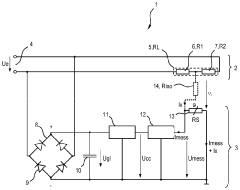
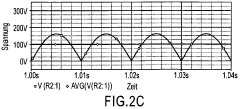
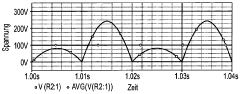
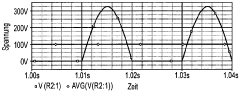
- The implementation of a half-wave rectifier in the DC circuit, which can include a single diode or triac, reduces or eliminates the influence of AC currents on measurement accuracy by minimizing leakage currents, and the use of a low-pass filter further enhances measurement precision by filtering out ripple effects.
Efficiency and Power Loss Considerations
Efficiency and power loss considerations are crucial aspects in the implementation of half-wave rectifier circuits. These factors significantly impact the overall performance and reliability of power supply systems. In half-wave rectification, only one half of the AC input waveform is utilized, leading to inherent inefficiencies that must be carefully managed.
One of the primary sources of power loss in half-wave rectifiers is the forward voltage drop across the rectifying diode. This voltage drop, typically ranging from 0.6V to 1.2V depending on the diode type, results in power dissipation and reduced efficiency. To mitigate this issue, emerging best practices include the use of Schottky diodes, which offer lower forward voltage drops and faster switching speeds compared to conventional silicon diodes.
Another critical consideration is the ripple voltage present in the output of half-wave rectifiers. The large ripple component not only affects the quality of the DC output but also contributes to power losses in subsequent filtering stages. To address this, modern designs often incorporate advanced filtering techniques, such as active power factor correction (PFC) circuits, which help to reduce harmonic distortion and improve overall system efficiency.
The choice of transformer design also plays a significant role in efficiency optimization. High-frequency transformers with low core losses and minimal leakage inductance are increasingly being employed to reduce power dissipation and improve energy transfer. Additionally, the use of advanced magnetic materials, such as nanocrystalline cores, allows for more compact designs without compromising efficiency.
Heat management is another crucial aspect of half-wave rectifier implementations. Excessive heat generation not only reduces efficiency but also impacts the long-term reliability of the circuit components. Best practices in thermal management include the use of heat sinks, forced-air cooling, and strategic component placement to optimize heat dissipation.
In recent years, there has been a growing trend towards the integration of digital control techniques in half-wave rectifier designs. Microcontroller-based systems allow for real-time monitoring and adjustment of circuit parameters, enabling dynamic optimization of efficiency across varying load conditions. This approach also facilitates the implementation of advanced protection features, further enhancing the reliability and performance of the rectifier system.
As energy efficiency standards become increasingly stringent, designers are exploring novel topologies that build upon the basic half-wave rectifier concept. For instance, synchronous rectification techniques, which replace diodes with actively controlled MOSFETs, are gaining traction in low-voltage, high-current applications. These designs significantly reduce conduction losses, particularly in scenarios where the forward voltage drop of traditional diodes would constitute a substantial portion of the output voltage.
One of the primary sources of power loss in half-wave rectifiers is the forward voltage drop across the rectifying diode. This voltage drop, typically ranging from 0.6V to 1.2V depending on the diode type, results in power dissipation and reduced efficiency. To mitigate this issue, emerging best practices include the use of Schottky diodes, which offer lower forward voltage drops and faster switching speeds compared to conventional silicon diodes.
Another critical consideration is the ripple voltage present in the output of half-wave rectifiers. The large ripple component not only affects the quality of the DC output but also contributes to power losses in subsequent filtering stages. To address this, modern designs often incorporate advanced filtering techniques, such as active power factor correction (PFC) circuits, which help to reduce harmonic distortion and improve overall system efficiency.
The choice of transformer design also plays a significant role in efficiency optimization. High-frequency transformers with low core losses and minimal leakage inductance are increasingly being employed to reduce power dissipation and improve energy transfer. Additionally, the use of advanced magnetic materials, such as nanocrystalline cores, allows for more compact designs without compromising efficiency.
Heat management is another crucial aspect of half-wave rectifier implementations. Excessive heat generation not only reduces efficiency but also impacts the long-term reliability of the circuit components. Best practices in thermal management include the use of heat sinks, forced-air cooling, and strategic component placement to optimize heat dissipation.
In recent years, there has been a growing trend towards the integration of digital control techniques in half-wave rectifier designs. Microcontroller-based systems allow for real-time monitoring and adjustment of circuit parameters, enabling dynamic optimization of efficiency across varying load conditions. This approach also facilitates the implementation of advanced protection features, further enhancing the reliability and performance of the rectifier system.
As energy efficiency standards become increasingly stringent, designers are exploring novel topologies that build upon the basic half-wave rectifier concept. For instance, synchronous rectification techniques, which replace diodes with actively controlled MOSFETs, are gaining traction in low-voltage, high-current applications. These designs significantly reduce conduction losses, particularly in scenarios where the forward voltage drop of traditional diodes would constitute a substantial portion of the output voltage.
Environmental Impact of Rectifier Technologies
The environmental impact of rectifier technologies, particularly half-wave rectifiers, is an increasingly important consideration in the development and implementation of power electronics. As energy efficiency and sustainability become paramount concerns in various industries, the ecological footprint of rectifier systems demands closer scrutiny.
Half-wave rectifiers, while simple in design, have traditionally been associated with lower energy efficiency compared to full-wave counterparts. This inefficiency translates to increased power consumption and, consequently, higher carbon emissions from power generation sources. However, emerging best practices in half-wave rectifier implementations are addressing these environmental concerns through innovative approaches.
One significant area of improvement lies in the materials used in rectifier construction. Advanced semiconductor materials, such as silicon carbide (SiC) and gallium nitride (GaN), are being incorporated into half-wave rectifier designs. These materials offer superior thermal properties and lower on-state resistance, resulting in reduced power losses and improved overall efficiency. The adoption of these materials not only enhances performance but also contributes to a reduction in the environmental impact of rectifier operations.
Another key aspect of environmental consideration is the lifecycle assessment of rectifier components. Best practices now emphasize the use of recyclable materials and design for disassembly, facilitating easier end-of-life recycling and reducing electronic waste. This approach aligns with circular economy principles and helps mitigate the environmental burden associated with electronic component disposal.
Energy harvesting techniques are being integrated into half-wave rectifier designs to further improve their environmental profile. By capturing and utilizing ambient energy that would otherwise be wasted, these systems can reduce their reliance on external power sources, thereby decreasing overall energy consumption and associated emissions.
The miniaturization of half-wave rectifier components is another trend with positive environmental implications. Smaller components require fewer raw materials, reduce transportation costs, and often consume less power during operation. This trend towards miniaturization aligns with the broader movement towards more sustainable and resource-efficient electronics.
Thermal management innovations in half-wave rectifier designs are also contributing to improved environmental performance. Enhanced heat dissipation techniques reduce the need for active cooling systems, which can be energy-intensive. By optimizing thermal management, these rectifiers can operate more efficiently and with a lower overall energy footprint.
As the industry continues to evolve, the focus on environmental impact is driving research into alternative rectification methods that could potentially replace traditional half-wave rectifiers in certain applications. These include synchronous rectification and active rectification techniques, which promise even greater efficiency gains and reduced environmental impact.
Half-wave rectifiers, while simple in design, have traditionally been associated with lower energy efficiency compared to full-wave counterparts. This inefficiency translates to increased power consumption and, consequently, higher carbon emissions from power generation sources. However, emerging best practices in half-wave rectifier implementations are addressing these environmental concerns through innovative approaches.
One significant area of improvement lies in the materials used in rectifier construction. Advanced semiconductor materials, such as silicon carbide (SiC) and gallium nitride (GaN), are being incorporated into half-wave rectifier designs. These materials offer superior thermal properties and lower on-state resistance, resulting in reduced power losses and improved overall efficiency. The adoption of these materials not only enhances performance but also contributes to a reduction in the environmental impact of rectifier operations.
Another key aspect of environmental consideration is the lifecycle assessment of rectifier components. Best practices now emphasize the use of recyclable materials and design for disassembly, facilitating easier end-of-life recycling and reducing electronic waste. This approach aligns with circular economy principles and helps mitigate the environmental burden associated with electronic component disposal.
Energy harvesting techniques are being integrated into half-wave rectifier designs to further improve their environmental profile. By capturing and utilizing ambient energy that would otherwise be wasted, these systems can reduce their reliance on external power sources, thereby decreasing overall energy consumption and associated emissions.
The miniaturization of half-wave rectifier components is another trend with positive environmental implications. Smaller components require fewer raw materials, reduce transportation costs, and often consume less power during operation. This trend towards miniaturization aligns with the broader movement towards more sustainable and resource-efficient electronics.
Thermal management innovations in half-wave rectifier designs are also contributing to improved environmental performance. Enhanced heat dissipation techniques reduce the need for active cooling systems, which can be energy-intensive. By optimizing thermal management, these rectifiers can operate more efficiently and with a lower overall energy footprint.
As the industry continues to evolve, the focus on environmental impact is driving research into alternative rectification methods that could potentially replace traditional half-wave rectifiers in certain applications. These include synchronous rectification and active rectification techniques, which promise even greater efficiency gains and reduced environmental impact.
Unlock deeper insights with PatSnap Eureka Quick Research — get a full tech report to explore trends and direct your research. Try now!
Generate Your Research Report Instantly with AI Agent
Supercharge your innovation with PatSnap Eureka AI Agent Platform!